
Data centers are the digital steel of the AI century. America can't stop building them.
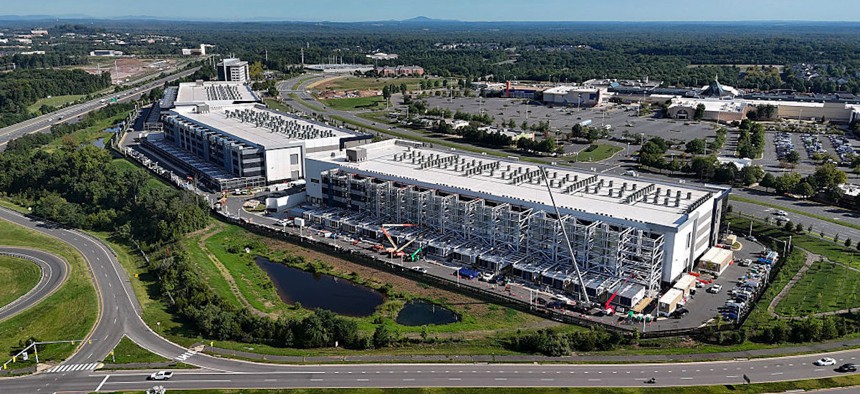
An aerial view of the construction of a new Amazon Web Services data center on August 26, 2026 in Sterling, Virginia. Anna Moneymaker/Getty Images



 By
Tom Suder
COMMENTARY | In defense of the industry that will power America's next century.
I grew up in Aliquippa, Pennsylvania, a steel town that knows what losing an industry costs. When the mill closed, the jobs and the tax base went with it. Families watched storefronts empty and kids move away. Data centers sound far from the kitchen table. They are not. They are where artificial intelligence lives, and every advance below runs on one.
Start with science. The Department of Energy's Genesis Mission, launched in November 2025, connects DOE's 17 national laboratories and their supercomputers into one AI discovery platform, aiming to double the productivity of American science within a decade. The order behind it says America is "in a race for global technology dominance."
Then the taxpayer. Through ATARC, I hear firsthand how government officials are using AI to serve the American people. Our fraud working group brings oversight officials and industry together to stop improper payments in Medicare, Medicaid, SNAP and Social Security before the money goes out the door. At our October forum in Reston, inspectors general also focused on how AI and shared data can spot risks faster.
Then cancer, which touches nearly every family. In Sweden's MASAI trial of more than 105,000 women, AI-supported mammography found 29% more cancers than standard screening. Sybil, built at MIT and Massachusetts General Hospital, predicts lung cancer risk up to six years out from a single CT scan.
This is the space race of our time, and America is canceling launches. The Information Technology and Innovation Foundation, citing Heatmap data, reports that at least $260 billion in planned U.S. data center investment has been canceled after local opposition this year, costing more than 2 million construction jobs, while China keeps building.
Loudoun County, Virginia, shows what is at stake. It is the world's largest data center market and has the nation's highest median household income. Its roughly 233 data center buildings generated $1.2 billion in property taxes in fiscal 2026 — 39% of the county budget — which has helped cut homeowners' rates. Replacing that revenue would take roughly 63 more cents on today's 80.5-cent rate. Just as Silicon Valley grew up around the chip, a data center ecosystem has grown up in Loudoun: electricians, construction crews, network and cybersecurity professionals, suppliers and a community college degree in data center operations.
Not every voice against this industry is a neighbor. In August, X reported roughly 200 accounts tied to a suspected Chinese bot farm pushing Americans to oppose data centers. Most opposition is homegrown, but Beijing knows what is at stake, and so should we.
So let me be blunt: local zoning is paramount. If a community does not want a data center next to its homes, it does not go there. Period. The race will be won by building where communities welcome the investment, not by steamrolling neighborhoods.
The administration's job is to make those projects possible, and the biggest barrier is power. Speed permitting for generation and transmission, clear the way for advanced nuclear and make the biggest users pay the full cost of their power so households never subsidize hyperscalers.
Which brings me home. The Wall Street Journal has reported on a $2 billion plan to turn Aliquippa's long-closed mill site into a power plant and AI data centers. For towns like mine, the bigger risk is another generation of empty mill sites.
Aliquippa's mills made the steel that built America's century. Data centers are the digital steel that will build the next one. Respect the neighbors. Power the grid. Keep making digital steel.
Tom Suder is the founder and president of the Advanced Technology Academic Research Center (ATARC), a GovExec company.