
sponsor content What's this?
Connecting communities through SLED network transformation
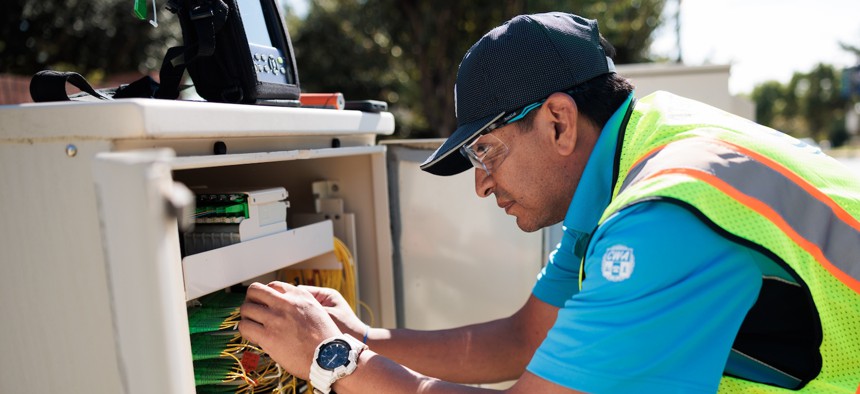






As state, local and education organizations juggle responsibilities like managing daily civic services and campus infrastructure and coordinating emergency response, demands on public sector networks have never been higher. Too often, however, modernization is stymied by too much focus on individual solutions and not enough on how to stitch them together in a robust technology ecosystem.
“A lot of CIOs talk about network modernization, but what they're really saying is, ‘I need a resilient communications platform,’” said Tim Lake, vice president of SLED at AT&T.
For public sector leaders constrained by limited resources, modernization is critical to moving beyond fragmented, siloed tech deployments to a more cost- and workforce-efficient approach. Industry partnerships play a key role in creating an integrated foundation for better service delivery.
Unifying first responders during a crisis
Natural disasters and other emergencies are the most high-stakes tests of public sector networks. During a crisis, networks can become overwhelmed by a sudden influx of traffic, and any drop in connectivity for first responders could mean the difference between life and death. To avoid such disruptions, AT&T provides FirstNet.
“It’s not just network slicing, or giving a little bit of a priority, this is a dedicated core for public safety when the worst of the worst happens,” Lake said. “It’s not like in the movies when there is one sole person who is saving the day. … You have teams of people from different agencies all coming together.”
Sometimes, enabling communications between disparate teams is as simple as making sure they have reliable cell connections. But to ensure reliability in the most complex scenarios, FirstNet has developed FirstNet Fusion, which can connect mission-critical push-to-talk (MCPTT) and land mobile radio (LMR) across any device or carrier network.
“It doesn’t matter what the platform is, in an emergency, we can pull them all together,” Lake said.
FirstNet Fusion is expected to be released later this year, delivering next-gen interoperability to unify fragmented communications in even the most chaotic emergency events.
Scalable infrastructure for modern communities
While effective emergency response is always a top priority, network transformation also serves to reshape daily life. As cities plan for a reliable, connected future, the underlying network infrastructure must be able to scale to meet temporary surges during major events and the needs of long-term development.
Modern infrastructure planning increasingly relies on converged connectivity to provide the advantages of both the deep capacity of fiber and the agility of 5G. In preparation for the 2026 FIFA World Cup, for example, some host cities needed better traffic monitoring systems, which could be accomplished through 5G, or public safety enhancements, such as FirstNet.
“But that base connectivity is really important,” Lake said. “Fiber and hard connectivity is always better. … What is that infrastructure allowing you to do to improve the day-to-day lives of residents? Whether that’s traffic management, whether that's connectivity to homes and the economic development that comes with it, whatever you want to do today, you've got to be connected.”
Moreover, in the highly decentralized United States, where state and local municipalities operate independently, interoperability and open standards are even more essential. Successfully executing major events often requires collaboration across multiple public jurisdictions and private organizations, and interoperability supports a shared technology framework to help them work together seamlessly.
Connecting the modern campus, from dorms to research labs
On a smaller scale, higher education institutions face similar challenges as each operates much like its own city, from athletic facilities and student housing to classrooms and heavy-compute research labs. On top of this complexity, campuses see unique movement and technology trends.
“When you look at the internal traffic or the internal motion of a university, you've got thousands of people all moving at the same time at certain times of day,” Lake said. “We can’t have them moving between disparate systems where their experience is different.”
Students living on campus move in with multiple devices, such as smartphones, smart speakers, gaming systems, PCs and laptops. They travel about campus with many of those devices — quiet libraries to busy dining halls to packed athletic events. They expect to be able to seamlessly transition across all locations.
“We can make sure that a student's devices talk to each other and don't talk to the rest of the campus, and make it feel like they've got their own little home inside their dorm room,” Lake said. “That same technology, if deployed correctly, means that in a giant stadium, when thousands of people are all trying to post the same amazing moment … whether it’s via Wi-Fi, whether it’s 5G, we need to make sure that connectivity is there.”
Finally, the research done on university campuses is crucial to the success of the nation and comes with its own requirements. Research universities need high-capacity, isolated environments to support advanced exploration. Often those environments are contained within a laboratory, but they can also expand past the campus borders.
“Sometimes we’re helping a large university with a grant around transportation or drones set up a research 5g network so they can simulate things in a lab environment — I say ‘lab environment,’ but it's many square miles of work,” Lake said. “When you look at AT&T’s history, we have a long history of research and innovation … and it is a real joy for our team to work with researchers, and bring resources and experience to bear from a large company.”
Delivering AI-first healthcare grounded in privacy and security
In healthcare, network transformation is tied to both improving patient outcomes and administrative efficiency. For many forward-thinking health systems, this now means planning for AI-first hospitals, using automation to reduce clinical burnout and keep caregivers focused at the bedside.
AI solutions in the healthcare space, for example, can allow patients and doctors “to just have a conversation” while AI notetakers transcribe, so the doctor can focus on the patient and not typing out notes on their computer, Lake said.
For these tools to function well, the hospital’s network must be advanced and reliable. Hospitals cannot tolerate disruptions, which makes backup plans and redundant architecture critical to keeping devices online during emergencies or cyberattacks. For some hospital CIOs, this means exploring fully isolated, 5G-enabled devices to bypass compromised networks.
Because health data is also highly sensitive and regulated, privacy must be embedded into the network architecture from day one. An AI-first approach only works if clinicians can trust the environment, which means security must be top priority across network design, including access control segmentation, encryption monitoring and compliance awareness.
“We're not just helping connect devices, we're helping customers think through how those devices, applications, users and data flows should be protected in a public sector environment,” Lake said. “Whether it’s hospitals or something more mundane, that human right of privacy should be honored. We start there, and we make that foundational.”
An invisible, resilient foundation for public missions
Ultimately for AT&T, public sector network modernization is about being there for people on their best and worst days, Lake said. Solutions like FirstNet, FirstNet Fusion and Next Generation 911 support reliability and interoperability among first responders, enabling seamless collaboration when it’s needed most. Meanwhile, delivering scalable performance during major events keeps people connected as they watch their favorite teams make history.
As state, local and educational institutions plan their digital futures, the true goal of a network provider is to remove the burden of infrastructure management from agencies’ plates.
“My vision for the public sector is connectivity so reliable, secure and well-integrated that agencies can focus less on the network and more on the people they serve,” Lake said. “I want to be invisible to these customers.”
This content is made possible by our sponsor AT&T; it is not written by and does not necessarily reflect the views of Route Fifty's editorial staff.
NEXT STORY: From cloud migration to mission enablement: The next phase of SLED Modernization