
On this nearly deserted Alaska island, you pay to keep hundreds of empty buildings wired for internet
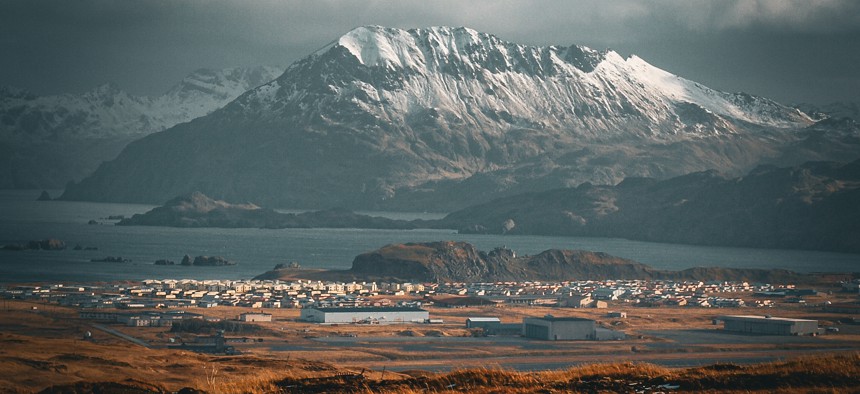
James B Williams Photography via Getty Images





U.S. phone customers pay more than $340,000 a year for an Anchorage company to keep homes and buildings on Alaska’s Adak Island wired for obsolete internet service. All but a few of them sit empty.
This article was originally published by ProPublica.
On an island in the Bering Sea 1,200 miles from Anchorage, Alaska, sits an abandoned house on an abandoned Navy base. There is no furniture, and the wind blows through broken windows. The last people to live here moved away long ago. Yet a bright orange pipe with a black fiber-optic cable inside runs from the outer wall down into the surrounding soil.
The cable was installed to connect the home to the internet after the base closed. It costs more than $340,000 per year to provide this building and hundreds of others — all but a few of them empty — with internet access no one says they use.
The money being wasted is yours.
It comes from a fee added to nearly every American’s phone bill as part of a Federal Communications Commission subsidy program intended to bring fast, affordable internet to remote towns.
Reporting this year by the Anchorage Daily News and ProPublica has found that the multibillion-dollar Universal Service Fund pays for what often amounts to slow internet access for customers who actually no longer use it.
The FCC keeps the money flowing to telecom companies regardless of their owners’ track records. It kept paying a Fairbanks company to provide internet service while its owner served federal prison time for tax evasion. The government kept paying Alaska’s largest telecom, GCI, even after it signed a settlement for alleged fraud related to the subsidy. (The settlement said it was neither an admission of guilt by GCI nor a concession by the Justice Department that the claims were not well founded.)
Yet few places make the federal government’s failure to safeguard this money more obvious than Adak.
Once home to thousands of sailors and their families, the island emptied after the base closed in 1997. While the state estimated the population to be 77 last year, residents themselves put it at closer to two dozen — meaning the federal internet subsidy to the local telecom amounts to about $14,000 a year per person. And, it turns out, there’s zero indication any of these people are benefiting from it.
We know this because we flew to the island in June and visited every building the company itself told regulators it serves. We knocked on every door. Talked to every person we could find.
Not a single one told us they subscribe to the island’s subsidized internet service.
Residents get online through Starlink, the Elon Musk satellite service that arrived in 2023 without any subsidy from the FCC. People here say it’s up to 40 times faster and costs $90 to $140 per month, compared with the hundreds of dollars a month that Adak Eagle, the local telecom, once collected from customers on top of its subsidy checks. (Adak Eagle’s website currently advertises internet plans for $99 to $550 per month.)
But the subsidies remain.
Like many Alaska telecoms, Adak Eagle was built on public money. It began in the early 2000s with FCC subsidies and federal loans to upgrade old telephone wires for fiber-optic lines that could support both voice and internet service. By 2011, the company was collecting $2.68 million a year from the Universal Service Fund.
A 2013 federal order determined company president Larry Mayes spent telecom subsidy money on a fleet of vehicles and a fishing boat that weren’t necessary for his business, and that the $237,455 salary Mayes paid himself one year was “unreasonable” and “disproportionate” given the size of the company and what’s typical for Anchorage, where he lives.
(The company filed letters with the FCC at the time stating its salaries “should be evaluated in the context of a small company where each employee wears multiple hats” and citing the island’s “remoteness and harsh climate conditions.”)
On top of the $3.6 million his company has received from the federal broadband subsidy since 2016, he also received $3.54 million from the FCC through a program that replaces revenue phone companies once earned connecting long-distance calls. The state kicked in an additional $3.75 million through its own subsidy program, the Alaska Universal Service Fund. (Some Adak residents said they continue to pay the company for landlines that they use as cellphone backup.)
When we first asked Mayes about the federal internet money, he hung up on us. He did not respond to questions emailed in May, a written interview request delivered to his Adak office in June or detailed questions emailed and hand-delivered to his Anchorage office in July. Reached again by phone on July 13, he declined to comment and ended the call.
The one thing Mayes did say before hanging up on the first call: that he is playing by the rules of the FCC’s subsidy program, and if we had questions about it, we should ask the agency.
We did. Repeatedly. About the publicly funded connections to demolished homes on Adak and other uses of internet subsidies in Alaska.
The FCC never responded.
Internet for Vacant Homes
Step outside Adak’s tiny airport terminal, and the scene is straight out of “The Walking Dead.” You can spend hours walking the city streets without seeing another human, the only sounds the dry scrape of tall grass and warbling seabirds. Stiffened copies of People magazine declare George Clooney the 2006 Sexiest Man Alive. A shuttered McDonald’s drive-thru still advertises 99-cent hamburgers.
Subdivisions outside the city core sprawl like any in America, with neatly arranged ranch-style homes, powder-blue roofs, wide driveways and generous garages. After the Navy shipped out, hurricane-force Aleutian winds pried homes apart. The worst of it is in a beachfront neighborhood called “Officer’s Country” on old city maps. Bathroom mirrors and toilets and kitchen tables stand exposed to the rain in homes cleaved in half like dollhouses.
Even in newer neighborhoods, we found rotted exterior walls with holes so wide you could drive a truck inside. Grass grew on living room floors. Bedrooms were filled with bird nests.
In the few homes the FCC paid Adak Eagle to connect that are habitable, the occupants have abandoned Adak Eagle.
Henry Collins, 61, lives in one of those homes. He was partially blinded in a chemical accident years ago while cleaning a boat at the island docks. Now he and his wife spend their days caring for their newborn. Sometimes they FaceTime with his wife’s family in the Philippines and hold the baby up to the screen.
He accidentally cut Adak Eagle’s internet cable with a string trimmer. No matter. He never could afford the subsidized service anyway, and his rooftop Starlink receiver was untouched in the landscaping incident.
One street over, 26-year-old Steven Ivanoff pays close attention to internet speeds because he plays Overwatch and Fortnite competitively online.
Before Starlink, residents said, Ivanoff’s former roommate and fellow gamer was notorious for using up the scant bandwidth Adak Eagle provided every time he went online to play. Neighbors hollered at him to get off the damn computer. Adak Eagle’s subsidized fiber offers download speeds of 1 to 10 megabits per second, according to the FCC National Broadband Map — far short of the FCC’s 100-megabit standard for broadband and, at the low end, barely fast enough to load a modern webpage.
All that has changed. At our request, Ivanoff tested the speed of his Starlink connection using an online service called speedtest.net. He clocked it at a screaming (by Alaska standards) 447 megabits per second.
At another house, four dachshunds stood guard in a fenced yard while inside, an agent with the Transportation Security Administration who moved from Arkansas was playing a reality TV show on her widescreen — Starlink-powered, like everyone else’s internet.
Elizabeth Pryor has leaned into the isolation by starting a mini farm. In her solarium, a cardboard box trembled with teenage chicks, peeping under a heat lamp. No bears on the island, she said. So that’s nice. No foxes either. “But the rats ate my jalapeno peppers down to the stalk! Chomp chomp chomp.”
Her house rises across the street from a pile of rubble, the remains of a house fire.
Both properties — the rubble pile and Pryor’s home, alive with puppies and chickens — are on the list of houses for which Adak Eagle received subsidies to connect to the internet. She doesn’t use it.
Wiring an Empty Island
Adak was already a ghost town when Mayes’ company started wiring the island.
According to the U.S. Navy’s own Record of Decision on the base closure, published in 2000, “there was no established community on Adak” after the military’s departure. The Navy’s ongoing assessments documented houses being condemned and boarded up.
Andilea Weaver, the company’s former vice president, said Adak Eagle began replacing rat-gnawed copper landline wires to Adak buildings in 2006 — nine years after the base closure.
In 2016, Adak Eagle proposed a 10-year plan to receive new subsidies in exchange for connecting or maintaining lines to 346 locations, nearly every building left standing. The FCC agreed. The agency formally declared the new spending plan to be in the public interest.
The FCC in 2022 reduced the number of locations Adak Eagle was obligated to serve to 306 after the company reported some buildings were unlivable, but the agency left the subsidy amount unchanged.
According to federal data published by the Universal Service Administrative Co., the most locations that Adak Eagle reported having broadband available was 283.
The buildings the FCC says Adak Eagle keeps wired for internet include duplexes, fourplexes and ranches where we found no sign of life. The agency shows connections at places where we found doors yawning open in the wind, hinges screaming with rust — no furniture inside, no appliances, yet in many cases, a single telephone still plugged into a wall.
Whether the abandoned structures Adak Eagle has prepped for low-speed internet can beckon new occupants is an open question.
Adak is so far west of the Alaska mainland that it’s in a different time zone. So far west that it’s almost in the Eastern Hemisphere.
The last vestige of industry departed with the closure of the island’s fish processing plant in 2020. Now the economy consists of a bit of hunting and bird-watching that lures a few hardy tourists aboard the two flights a week that serve the island. (Warning: Pack canned goods. The grocery store and restaurant were closed our entire visit.)
Alaska’s Republican U.S. Sen. Dan Sullivan has argued the U.S. should open a new military base on Adak because of its strategic proximity to waters cruised by the Chinese and Russian navies. With $115 million set aside by Congress last year for “exploration and development of existing Arctic infrastructure,” a Pentagon-led task force is developing recommendations on how to proceed, a Sullivan spokesperson said.
After knocking on hundreds of doors and canvassing every subdivision, we spent our last hours in Adak checking to see if anyone was using the subsidized internet in the old commercial buildings and offices scattered around the center of the city.
At one of the last addresses on the list crouched a cinder block building surrounded by pickup trucks and wide spools of orange piping — the same piping we’d seen leading up to demolished houses the day before. A rotary phone hung on the wall.
This was the local office of the company we’d been examining. Even the people who work there have stopped relying on the internet service that you pay for. Above the front door, above the sign for Adak Eagle Enterprises, stood two Starlink dishes.