
Wyoming County approves construction of what could become the largest data center in US

Erik Isakson via Getty Images





The project could eventually use the same amount of electricity as produced by 10 nuclear power plants, boosting Wyoming’s energy industry while challenging efforts to limit emissions and stressing water supplies.
This article originally appeared on Inside Climate News, a nonprofit, non-partisan news organization that covers climate, energy and the environment. Sign up for their newsletter here.
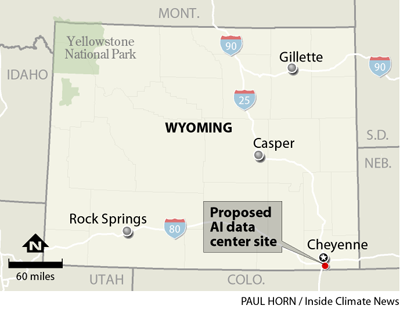
Wyoming is poised to become an artificial-intelligence powerhouse after Laramie County commissioners last week unanimously voted to move forward with the construction of a 1.8 gigawatt data center designed to eventually scale up to 10 gigawatts, which would be the largest single AI campus in the U.S.
The facility will include the Project Jade data center campus built by AI infrastructure company Crusoe and the BFC Power and Cheyenne Power Hub built next door by Tallgrass Energy Partners to provide it with electricity. BFC Power and Cheyenne Power Hub will provide on-site power from natural gas turbines. Matt Field, chief real estate officer for Crusoe, told the Laramie County commissioners during last week’s hearing that the first phase of the project will leverage natural gas with a potential pathway for CO2 sequestration in the future.
Crusoe and Tallgrass announced in July that the center’s close proximity to Tallgrass’ existing CO2 sequestration hub will “provide long-term carbon capture solutions” for the gas turbines powering the data center. “Future renewable energy developments” touted by the companies in their joint statement could include solar power to augment the gas turbines in later stages of the project, according to Wyoming Energy Authority.
The companies have yet to announce the specific tech firms to benefit from the Jade data center, but the project is expected to meet the extreme power and infrastructure demands of hyperscale cloud providers and AI industry leaders, said Crusoe spokesperson Andrew Schmitt.
Both of the interconnected projects are now proceeding to the construction phase in the Switch Grass Industrial Park area, located 8 miles south of Cheyenne. With the site plans approved by the county, Crusoe and Tallgrass energy expect construction to be completed on the first buildings in 2027.
Prior to the final vote, the Hyndman Homesites Homeowners Association, which represents a community adjacent to the project, wrote a letter to the county commissioners requesting that the site plan adhere to certain considerations. The letter details residents’ concerns with deep wells drilled into the aquifer, increased traffic and noise, light pollution, gas turbine emissions, noxious odors and the location of wastewater ponds. Additionally, the letter urged the Wyoming Game and Fish Department to ensure compliance with requirements to minimize the impacts to wildlife migration routes and sensitive habitat inside the project area.
“We accept the inevitability of the project and want to identify and mitigate concerns before they become problems,” the homeowners’ association wrote.
The AI campus is expected to open with a capacity of 1.8 gigawatts of electricity, over five times more than the roughly 238,000 homes in Wyoming currently use, with the potential to scale up to 10 gigawatts, pending state and county approvals. One gigawatt can power approximately 750,000 to one million average U.S. homes, according to the U.S. Department of Energy.
The Associated Press reported that electricity needed to power the first phase of the center is predicted to double the entire state of Wyoming’s current energy generation. Compared to a report listing the 15 largest data centers in the world by the information technology provider Brightlio, the Jade Project could set a global record in energy use by a single center if the planned expansion reaches 10 gigawatts. Jones Lang LaSalle’s 2026 Global Data Center Outlook projects total global data center energy capacity to rise from 103 gigawatts to about 200 gigawatts by 2030.
“Building an American AI factory that can scale to 10 gigawatts of capacity illustrates Crusoe’s commitment to delivering infrastructure at the scale needed for the U.S. to win the global AI race,” Crusoe co-founder and CEO Chase Lochmiller stated in a July press release announcing the project.
Jumping Into the AI Race
Wyoming developers and state officials have touted the projected benefits of becoming a hub for AI and high-performance computing, which they say will include job creation, economic diversification, increased tax revenue and demand for natural gas and renewable energy. The project’s construction phase is expected to employ approximately 5,000 workers at its peak, per the site plan. Field said the data center will have approximately 400 permanent jobs, ranging from janitorial positions to engineers.
“Wyoming is pro-business and pro-growth,” U.S. Sen. John Barrasso (R-Wyo.) said in a press release. “Our commitment to innovation and investment is what makes our state great. New, state-of-the-art data centers like this will bring high-paying jobs and a skilled workforce to southeast Wyoming.”
The state is also looking to nuclear energy to meet the increasing demands of the AI industry. TerraPower, the advanced nuclear reactor company founded by Bill Gates, and Meta, the parent company of Facebook, announced Friday that Cheyenne is one of the sites being considered for a dual-unit Natrium power plant that could be completed as soon as 2032 to fuel the Meta AI data center already under construction there. TerraPower is building the world’s first Natrium reactor in Kemmerer, Wyoming.
The proposals for AI are exciting for the state’s fossil fuel industry as well.
In a statement last year when the Jade data center was announced, Wyoming Gov. Mark Gordon wrote that the news was exciting for “Wyoming and for Wyoming natural gas producers.” Gordon had previously called Wyoming an optimal location for AI expansion, partly due to its energy infrastructure and cooler climate.
Wyoming Energy Authority Executive Director Rob Creager told Inside Climate News that the state needs to keep up with the world’s growing demand for AI. Creager said that the AI platform ChatGPT will eventually become as mainstream as a Google search.
“I’ve heard it as an arms race before,” Creager said. “We can’t lose track of the fact that we’re in a competition with folk in China. It is really crucial to national security that we lead on AI and that we have those technologies.”
But Johanna Fornberg, a senior researcher at Greenpeace USA, has urged local and state governments to rein in huge AI investments. Legislators should instead focus on what directly benefits people’s lives, such as transitioning to renewable energy, Fornberg said.
“The industry has been using a lot of these big hypothetical promises about the benefits of AI,” Fornberg said. “They’re selling it for healthcare and curing cancer, accelerating climate action, improving well-being, even in your day-to-day life and in your job. And that’s all sort of a tactic to create demand and support for the data center buildout that’s happening.”
Fornberg noted that the Crusoe and Tallgrass project, which will use “an unprecedented amount of power in a relatively short amount of time,” is an example of charging ahead without fully investigating the potential risks involved.
“This data center, at 10 gigawatts, is huge,” Fornberg said. “I mean, a large nuclear power plant provides about 1 gigawatt of energy. So, at the top end, we’re talking about the same energy output as 10 big nuclear power plants, which is a lot.”
AI’s Opportunities and Challenges for Wyoming Energy
Wyoming’s energy resources position the state to capitalize on AI, Creager said.
“Everybody knows that there is plenty sitting in the ground that can help fuel this,” Creager said, noting that Crusoe’s plan to augment its electricity supply with solar should bring down the demand for gas. “I think it’s doable. I think as we do this … we’ll figure out how to do it more efficiently.”
Some AI data centers, including Microsoft’s facility in Cheyenne, power their servers with a mix of fossil fuels and renewable energy, and learning how to power and manage data centers efficiently is a work in progress, Creager said.
Neither Crusoe nor Tallgrass made representatives available for comment, but Crusoe’s website stated that the center would source energy from natural gas rigs outfitted with carbon capture and sequestration (CCS) technology to limit their emissions of climate-warming gases.
But Fornberg believes using CCS for data center energy generation is counterproductive.
“Carbon capture is sort of one of these techno solutions that is very energy intensive, expensive and often just increases net emissions and pollution overall,” she said. “Especially when compared to just replacing those energy sources with clean energy sources. It’s a way that we are really providing a longer lifespan for existing fossil fuel infrastructure. And in some cases, even justifying new fossil fuels.”
An August analysis from Goldman Sachs Research forecasts that about 60 percent of the increasing electricity demands from U.S. data centers will be met by burning fossil fuels, increasing carbon emissions through 2030 by approximately 220 million tons. Those increased emissions could also impact human health, Fornberg added.
“Part of the nature of working with gas as an energy source is that you have these leaks and in some cases, intentional flares or releases of gas,” Fornberg said. “That is a major climate impact but can also cause well-documented health impacts for the communities that live locally to those gas generation facilities.”
Crusoe and Tallgrass have yet to state the amount of solar power that will be paired with natural gas or at what stage in the project solar power would be included in the energy mix.
Thirsty Technology in a Water-Stressed State
A single data center’s cooling towers can consume millions of gallons of water annually to prevent the computing infrastructure from overheating, according to Veolia Water Technologies & Solutions, which is particularly problematic for a facility as large as Project Jade in an arid state like Wyoming.
To reduce that demand, Crusoe announced plans in its 2024 Impact Report to combat significant water loss at its data centers by implementing closed-loop cooling systems that recycle treated water and treatment fluids.
Still, there are always system losses, said Jonathan Brant, a University of Wyoming environmental engineering professor.
“Even if it’s a quote-unquote closed loop, you’re going to have losses because of the nature of heat exchange,” Brant said. “Those computers generate an incredible amount of heat.”
To remove the most heat from computers, water must transform from a liquid into a vapor, Brant explained, and a portion of that evaporates, much like the billowing clouds that rise from the cooling towers at power plants. How much new freshwater will be needed to replace what evaporates from the cooling system is a critical question, he said.
“It’s scary when you think about the power and the water that’s going to be consumed by these facilities,” Brant said. “That’s why they keep it secret.”
Many AI centers in Wyoming tap into brackish or alkaline groundwater, as opposed to using freshwater, Brant said, but even if the cooling water is sourced from an aquifer with water too low quality for other uses, it could potentially impact a connected aquifer with a potable supply, so industry engineers must study how aquifers are connected before tapping into them. And safely disposing of increasingly salty water after it has undergone many cycles of heat exchange also poses a challenge, Brant said.
“Some say they’re going to reinject it, like they do in the oil and gas field,” Brant said. “That may work. But if that’s not something that can be done, are they just going to use surface impoundments? Evaporation ponds can be an environmental hazard just like they are in the gas sector.”
If waste water is expelled during the cooling process, it could be contaminated with per- and polyfluoroalkyl chemicals. PFAS are used to prevent the corrosion of AI electronics, which would pose other health concerns, Fornberg cautioned. Studies have linked long-term exposure to even low levels of some PFAS, also known as “forever chemicals” for their persistence in the environment, with serious health problems, including cancer and damage to reproductive and immune systems.
A Lack of Regulation
During the hearing to review the Jade project’s site plan, several Laramie County residents voiced concerns with lack of water regulations.
The plan states that engineers plan to drill deep wells underneath the shale and sandstone Lance Formation to access industrial water beneath the Ogallala Aquifer’s potable water. But Randy Fox, president of Hyndman Homesites Homeowners Association, questioned whether the geologic survey of the region that will guide the drilling of the wells adequately maps the varying size and depth of the aquifer to protect the drinking-water supply.
“You don’t know until you punch a hole in it what you’re dealing with,” Fox said. “Does the state have the data to support drilling deep wells into the Lance Formation without compromising the Ogallala Formation’s [drinking water] above it?”
Resident Thomas White, who lives near the site of the Jade data center, is also concerned about water contamination.
“They say that they’re going to drill deeper,” White said. “What happens when they punch a hole and there’s leaks that contaminate the aquifer? How much water will they be taking out of the ground? We have to take that into consideration.”
In November, the Wyoming Outdoor Council released a white paper about data center policy in Wyoming that recommends regulations for permitting, site selection and community assistance.
Among them: mandating public energy and water use reporting “to allow regulators and communities to assess impacts of data centers and track progress toward efficiency or sustainability goals.” The report pointed to Illinois’ Data Center Energy and Water Reporting Act as a regulatory guide.
Wyoming has yet to establish laws to track the environmental and economic impacts of AI centers, and state legislators are not expected to discuss the growth of the industry during the upcoming budget session in February.
In December, Greenpeace USA, along with over 230 environmental groups, signed an open letter to Congress demanding a national moratorium on new data-center construction until regulations address environmental and economic concerns. State and local governments, which negotiate deals with data developers, need comprehensive rules, Fornberg said—protecting consumers from utility rate hikes, requiring renewable energy and more.
“There has to be strong regulations in place in order for these companies to do the right thing,” Fornberg said. “I think the issue is not whether or not we should value innovation, it’s how we are valuing innovation.”