Virginia lawmakers move closer to regulating self-driving vehicles
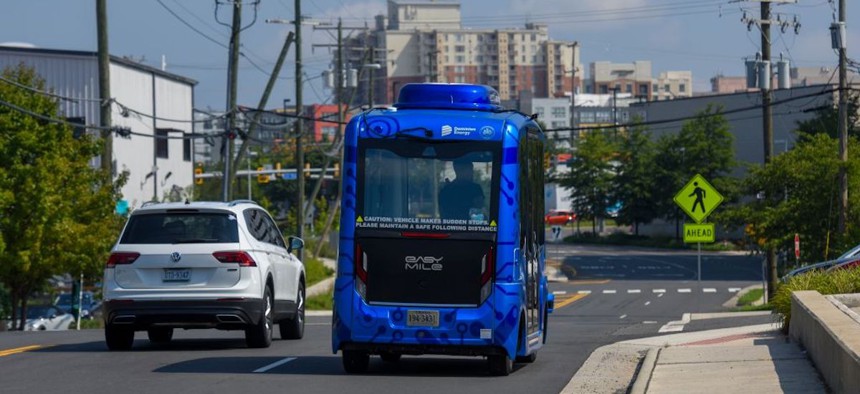
Testing of the Relay shuttle, an electric and autonomous vehicle, is underway in Fairfax, VA, on Tuesday, Aug. 11, 2020. The shuttle service will carry passengers between Dunn Loring Metro and t he Mosaic District as part of a pilot program bringing the driverless technology to Northern Virginia.

Testing of the Relay shuttle, an electric and autonomous vehicle, is underway in Fairfax, VA, on Tuesday, Aug. 11, 2020. The shuttle service will carry passengers between Dunn Loring Metro and t he Mosaic District as part of a pilot program bringing the driverless technology to Northern Virginia. Jahi Chikwendiu/The Washington Post via Getty Images


A proposed framework focuses on commercial uses as debates continue over safety, data collection and worker protections.

This story was originally published by the Virginia Mercury.

Virginia is moving closer to regulating self-driving vehicles, with lawmakers and experts recently agreeing on a plan ahead of the next legislative session as the technology expands and safety concerns grow.

Last year, the General Assembly directed a workgroup to consider rules for autonomous vehicles, or AVs, which have been tested in states including Arizona and Texas and restricted in California. Meanwhile, the federal government announced a national strategy plan to accelerate the development and deployment of self-driving vehicles across the country.

Leaders in the commonwealth are drafting proposals to establish a framework for implementing AV policy and create an ongoing advisory committee after the group concludes its work. The panel held its most recent meeting on Aug. 28. 

Virginia’s proposed framework would focus on commercial use rather than personal vehicles, including ride-sharing and delivery services, buses and Class 7 and 8 heavy-duty vehicles.

However, the meeting was not without disagreements over regulatory authority, various protections and workforce impacts.

“I believe what we’re doing … leading up to session, is illustrating where there’s strong consensus,” said Senate Transportation Committee Chair Lamont Bagby, D-Henrico, at the August meeting. “Folks can lobby to make amendments to legislation leading up to session or during session, but we’re just trying to… I think what I would love to see is the sort of bones of what this legislation looks like.”

On regulation, the group disagreed over whether the initial framework should cover light-, medium- and heavy-duty vehicles, with the latter ultimately excluded from the broader motion. Members also debated how much discretion the Department of Motor Vehicles should have to suspend or revoke permits, rather than establishing specific standards and limits in state law.

However, there was general agreement that the state should regulate AVs, with local regulation primarily applying to AVs operating as taxis.

Debate also focused on data collection, consumer and safety protections, and how to determine whether an AV pilot is safe and successful enough to continue or expand.

Specifically, members disagreed over whether to set specific safety requirements and benchmarks upfront or allow the DMV to determine whether a pilot is safe enough based on the vehicle’s operating conditions and the distance it has traveled. 

The meeting also included debate over whether to collect comprehensive, real-time operational and location data from AVs or limit reporting to non-real-time information comparable to existing federal and California requirements. 

Members also disagreed over whether legislation should protect AV customers from being forced to use arbitration to resolve disputes or leave those issues to existing consumer protection laws.

The group reached a consensus that agencies should recover administrative costs but disagreed over whether AV-specific fees should also fund worker retraining and support for displaced drivers.

Additionally, there was broad agreement that law enforcement and first responders need AV-specific training, but disagreement over whether that training should be mandatory, statewide and funded through fees or addressed separately.

Questions remain about whether AV services should receive special retail sales and use tax treatment. Lawmakers also debated whether legislation should immediately include worker retraining and support or address those issues later through separate laws and funding.

Several people, including Renee Gibson, vice president of government affairs at the Autonomous Vehicle Industry Association, spoke during the August meeting about developing a regulatory framework for AVs in Virginia. 

Gibson said to the work group, “Without a legislative framework that offers a clear path to commercial deployment, companies will simply not be able to enter the market.”

She was joined by business representatives from Uber, Tesla, Stack AV, Torc Robotics and Volkswagen, as well as labor union and organizational representatives who emphasized the need for commercial deployment pathways and labor protections.

Kevin O’Neill, a steering committee member of the DMV Drivers Alliance, was among those representing organizations, associations and unions concerned about job and income losses from AV deployment.

”Before Virginia gives companies a predictable path into this market, drivers do deserve to know what happens when autonomous fleets begin taking trips and income out of the existing workforce,” O’Neill said.

The workgroup is preparing a final report for the General Assembly to consider by Nov. 1.

Virginia Mercury is part of States Newsroom, a nonprofit news network supported by grants and a coalition of donors as a 501c(3) public charity. Virginia Mercury maintains editorial independence. Contact Editor Samantha Willis for questions: info@virginiamercury.com.

X
This website uses cookies to enhance user experience and to analyze performance and traffic on our website. We also share information about your use of our site with our social media, advertising and analytics partners. Learn More / Do Not Sell My Personal Information
Accept Cookies
X
Cookie Preferences Cookie List

Do Not Sell My Personal Information

When you visit our website, we store cookies on your browser to collect information. The information collected might relate to you, your preferences or your device, and is mostly used to make the site work as you expect it to and to provide a more personalized web experience. However, you can choose not to allow certain types of cookies, which may impact your experience of the site and the services we are able to offer. Click on the different category headings to find out more and change our default settings according to your preference. You cannot opt-out of our First Party Strictly Necessary Cookies as they are deployed in order to ensure the proper functioning of our website (such as prompting the cookie banner and remembering your settings, to log into your account, to redirect you when you log out, etc.). For more information about the First and Third Party Cookies used please follow this link.

Allow All Cookies

Manage Consent Preferences

Strictly Necessary Cookies - Always Active

We do not allow you to opt-out of our certain cookies, as they are necessary to ensure the proper functioning of our website (such as prompting our cookie banner and remembering your privacy choices) and/or to monitor site performance. These cookies are not used in a way that constitutes a “sale” of your data under the CCPA. You can set your browser to block or alert you about these cookies, but some parts of the site will not work as intended if you do so. You can usually find these settings in the Options or Preferences menu of your browser. Visit www.allaboutcookies.org to learn more.

Sale of Personal Data, Targeting & Social Media Cookies

Under the California Consumer Privacy Act, you have the right to opt-out of the sale of your personal information to third parties. These cookies collect information for analytics and to personalize your experience with targeted ads. You may exercise your right to opt out of the sale of personal information by using this toggle switch. If you opt out we will not be able to offer you personalised ads and will not hand over your personal information to any third parties. Additionally, you may contact our legal department for further clarification about your rights as a California consumer by using this Exercise My Rights link

If you have enabled privacy controls on your browser (such as a plugin), we have to take that as a valid request to opt-out. Therefore we would not be able to track your activity through the web. This may affect our ability to personalize ads according to your preferences.

Targeting cookies may be set through our site by our advertising partners. They may be used by those companies to build a profile of your interests and show you relevant adverts on other sites. They do not store directly personal information, but are based on uniquely identifying your browser and internet device. If you do not allow these cookies, you will experience less targeted advertising.

Social media cookies are set by a range of social media services that we have added to the site to enable you to share our content with your friends and networks. They are capable of tracking your browser across other sites and building up a profile of your interests. This may impact the content and messages you see on other websites you visit. If you do not allow these cookies you may not be able to use or see these sharing tools.

If you want to opt out of all of our lead reports and lists, please submit a privacy request at our Do Not Sell page.

Save Settings
Cookie Preferences Cookie List

Cookie List

A cookie is a small piece of data (text file) that a website – when visited by a user – asks your browser to store on your device in order to remember information about you, such as your language preference or login information. Those cookies are set by us and called first-party cookies. We also use third-party cookies – which are cookies from a domain different than the domain of the website you are visiting – for our advertising and marketing efforts. More specifically, we use cookies and other tracking technologies for the following purposes:

Strictly Necessary Cookies

We do not allow you to opt-out of our certain cookies, as they are necessary to ensure the proper functioning of our website (such as prompting our cookie banner and remembering your privacy choices) and/or to monitor site performance. These cookies are not used in a way that constitutes a “sale” of your data under the CCPA. You can set your browser to block or alert you about these cookies, but some parts of the site will not work as intended if you do so. You can usually find these settings in the Options or Preferences menu of your browser. Visit www.allaboutcookies.org to learn more.

Functional Cookies

We do not allow you to opt-out of our certain cookies, as they are necessary to ensure the proper functioning of our website (such as prompting our cookie banner and remembering your privacy choices) and/or to monitor site performance. These cookies are not used in a way that constitutes a “sale” of your data under the CCPA. You can set your browser to block or alert you about these cookies, but some parts of the site will not work as intended if you do so. You can usually find these settings in the Options or Preferences menu of your browser. Visit www.allaboutcookies.org to learn more.

Performance Cookies

We do not allow you to opt-out of our certain cookies, as they are necessary to ensure the proper functioning of our website (such as prompting our cookie banner and remembering your privacy choices) and/or to monitor site performance. These cookies are not used in a way that constitutes a “sale” of your data under the CCPA. You can set your browser to block or alert you about these cookies, but some parts of the site will not work as intended if you do so. You can usually find these settings in the Options or Preferences menu of your browser. Visit www.allaboutcookies.org to learn more.

Sale of Personal Data

We also use cookies to personalize your experience on our websites, including by determining the most relevant content and advertisements to show you, and to monitor site traffic and performance, so that we may improve our websites and your experience. You may opt out of our use of such cookies (and the associated “sale” of your Personal Information) by using this toggle switch. You will still see some advertising, regardless of your selection. Because we do not track you across different devices, browsers and GEMG properties, your selection will take effect only on this browser, this device and this website.

Social Media Cookies

We also use cookies to personalize your experience on our websites, including by determining the most relevant content and advertisements to show you, and to monitor site traffic and performance, so that we may improve our websites and your experience. You may opt out of our use of such cookies (and the associated “sale” of your Personal Information) by using this toggle switch. You will still see some advertising, regardless of your selection. Because we do not track you across different devices, browsers and GEMG properties, your selection will take effect only on this browser, this device and this website.

Targeting Cookies

We also use cookies to personalize your experience on our websites, including by determining the most relevant content and advertisements to show you, and to monitor site traffic and performance, so that we may improve our websites and your experience. You may opt out of our use of such cookies (and the associated “sale” of your Personal Information) by using this toggle switch. You will still see some advertising, regardless of your selection. Because we do not track you across different devices, browsers and GEMG properties, your selection will take effect only on this browser, this device and this website.