Lawmakers mull cybersecurity concerns as they prepare for overhaul of Georgia’s voting system
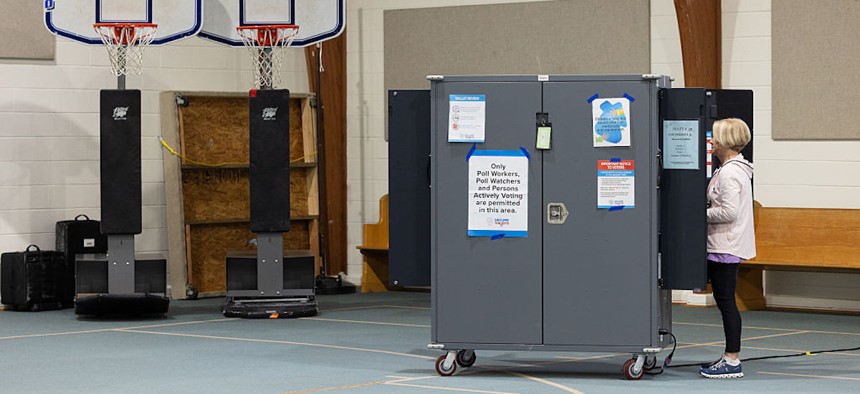
Barbara Mordecai casts her vote at the Mt. Zion United Methodist Church polling station for the primary runoff election on June 16, 2026, in Marietta, Georgia.

Barbara Mordecai casts her vote at the Mt. Zion United Methodist Church polling station for the primary runoff election on June 16, 2026, in Marietta, Georgia. Jessica McGowan via Getty Images


Georgia seems poised to switch to hand-marked ballots, but cybersecurity experts say there is a lot to consider to ensure that voting stays secure.

This story was originally published by the Georgia Recorder.

Georgia seems poised to switch to a hand-marked paper ballot system for the 2028 election, but researchers and cybersecurity experts say there is a lot more to consider to ensure that voting stays secure and free from undue influence.

Election security concerns have long been at the forefront of the conversation around election equipment. Georgia’s current voting machines, which use a QR code to tally votes, have repeatedly faced criticism from advocates of hand-marked paper ballots, who say that ballots should be counted based on text that can be deciphered by humans. 

State lawmakers have passed legislation to phase out the use of QR codes on ballots, but are still developing the guidelines that state lawmakers will use when selecting their next statewide voting system.

Sen. Max Burns, a Sylvania Republican who is co-chairing a special committee tasked with helping select Georgia’s next statewide election system, said he is hoping to land on a system that is as secure as possible, while maintaining the convenience that he said Georgia voters have come to expect.

“100% [security] is a goal,” he said. “We have to get as close to that as we can, and then we have to build other processes and mitigation opportunities around it to ensure that we address any potential challenges that we find.”

At a Thursday meeting at the state Capitol in Atlanta, cybersecurity experts and researchers gathered to share their insights with members of the legislative panel. Here are some of the election security issues state lawmakers will have to consider.

Equipment maintenance

Georgia’s current ballot-marking devices were purchased under a 10-year contract, and used statewide in Georgia for the first time in 2020. More than half a decade later the machines are still in use, but experts say the lack of software upgrades has left vulnerabilities in the system. 

Whichever system the state turns to next, state leaders say, will likely be in use for at least the next decade. However, Geoff Hale, a fellow at the nonpartisan Washington-based Center for Democracy and Technology, said technology and cybersecurity risks often evolve much more quickly, meaning that Georgia’s voting equipment will likely need to be updated several times over the course of its lifespan.

“Georgia is not purchasing something that will remain permanently secure,” Hale said. “Election security is a process and not a purchase.”

In addition to picking equipment that meets Georgia’s current specifications, Michael Barnes, the deputy director of information technology for voting systems for the secretary of state’s office, said lawmakers should ensure that the vendor they select has a plan to continue providing support, technology updates and spare parts for however long the state plans to keep using the system.

“What is the vendor providing, and what is their plan for providing that, not only for the initial deployment, but for five, 10, 15 years down the road?” he said.

Voter secrecy

The question of how to ensure that a voter’s selections remain private is another issue lawmakers will have to juggle. 

Georgia’s constitution mandates that voters’ ballots be kept secret. However, rapid developments in artificial intelligence and other technology can make that harder to guarantee, especially in smaller counties. Last month, a Princeton University researcher claimed that he was able to use AI to tie thousands of voters in Heard and Cherokee counties to specific ballots with relative certainty by putting publicly available data through an AI tool.

The intersection of privacy and accessibility is another challenge. Precincts are required to keep at least one voting machine on hand for voters with disabilities according to federal law. But in jurisdictions where most voters mark ballots by hand, it may be fairly easy to determine how voters who used accessibility software voted.

Mark Lindeman, Philadelphia-based Verified Voting’s policy and strategy director, said that while he supported minimizing the role of ballot-marking devices in Georgia’s elections, there shouldn’t be restrictions on who gets to use the machines.

He noted that many voters who don’t consider themselves disabled may benefit from using a machine-marked system. A larger pool of people casting ballots marked by voting machines will also give voters with disabilities an increased level of anonymity when casting their ballot.

“It doesn’t have to be hundreds in a polling place, but to protect voter privacy and dignity, it shouldn’t be just a handful,” he said.

Foreign interference

Federal cuts to election security systems and a recent spike in cyberattacks may also fuel the risk of foreign interference in the midterm elections. Already this year, several Georgia counties have been hit by cyber attacks targeting their water systems. States like Minnesota, Michigan and Wisconsin have also faced similar attacks, according to the FBI. The Cybersecurity and Infrastructure Security Agency put out an advisory in April warning that such attacks may be linked to Iran.

But experts say it’s impossible to implement a system that completely eliminates the risk of bad actors interfering with elections. According to Michael Specter, an assistant professor and cybersecurity researcher at Georgia Tech, the most secure systems assume that a breach will happen at some point and develop transparent protocols to disclose and adapt to such instances.

“A system is only secure if the adversary knows how the system works and it is still secure,” he said.

Switching to hand-marked ballots may lessen the risk of certain security breaches, but experts emphasized that no technology is impervious to manipulation.

“Ballot on demand [printing] does not remove software from the election entirely,” said Hale, the Center for Democracy and Technology fellow. “Instead, it changes where software sits in the process.”

Paulding County Elections Director Deirdre Holden said that she worries about bad actors trying to access voter data, but added that in her experience, state officials had been quick to respond in instances where counties had faced cyberattacks.

“We have a very, very robust state system that takes care of us that knows when things like that are going on and they alert us very quickly,” she said.

Georgia Recorder is part of States Newsroom, a nonprofit news network supported by grants and a coalition of donors as a 501c(3) public charity. Georgia Recorder maintains editorial independence. Contact Editor Jill Nolin for questions: info@georgiarecorder.com.

X
This website uses cookies to enhance user experience and to analyze performance and traffic on our website. We also share information about your use of our site with our social media, advertising and analytics partners. Learn More / Do Not Sell My Personal Information
Accept Cookies
X
Cookie Preferences Cookie List

Do Not Sell My Personal Information

When you visit our website, we store cookies on your browser to collect information. The information collected might relate to you, your preferences or your device, and is mostly used to make the site work as you expect it to and to provide a more personalized web experience. However, you can choose not to allow certain types of cookies, which may impact your experience of the site and the services we are able to offer. Click on the different category headings to find out more and change our default settings according to your preference. You cannot opt-out of our First Party Strictly Necessary Cookies as they are deployed in order to ensure the proper functioning of our website (such as prompting the cookie banner and remembering your settings, to log into your account, to redirect you when you log out, etc.). For more information about the First and Third Party Cookies used please follow this link.

Allow All Cookies

Manage Consent Preferences

Strictly Necessary Cookies - Always Active

We do not allow you to opt-out of our certain cookies, as they are necessary to ensure the proper functioning of our website (such as prompting our cookie banner and remembering your privacy choices) and/or to monitor site performance. These cookies are not used in a way that constitutes a “sale” of your data under the CCPA. You can set your browser to block or alert you about these cookies, but some parts of the site will not work as intended if you do so. You can usually find these settings in the Options or Preferences menu of your browser. Visit www.allaboutcookies.org to learn more.

Sale of Personal Data, Targeting & Social Media Cookies

Under the California Consumer Privacy Act, you have the right to opt-out of the sale of your personal information to third parties. These cookies collect information for analytics and to personalize your experience with targeted ads. You may exercise your right to opt out of the sale of personal information by using this toggle switch. If you opt out we will not be able to offer you personalised ads and will not hand over your personal information to any third parties. Additionally, you may contact our legal department for further clarification about your rights as a California consumer by using this Exercise My Rights link

If you have enabled privacy controls on your browser (such as a plugin), we have to take that as a valid request to opt-out. Therefore we would not be able to track your activity through the web. This may affect our ability to personalize ads according to your preferences.

Targeting cookies may be set through our site by our advertising partners. They may be used by those companies to build a profile of your interests and show you relevant adverts on other sites. They do not store directly personal information, but are based on uniquely identifying your browser and internet device. If you do not allow these cookies, you will experience less targeted advertising.

Social media cookies are set by a range of social media services that we have added to the site to enable you to share our content with your friends and networks. They are capable of tracking your browser across other sites and building up a profile of your interests. This may impact the content and messages you see on other websites you visit. If you do not allow these cookies you may not be able to use or see these sharing tools.

If you want to opt out of all of our lead reports and lists, please submit a privacy request at our Do Not Sell page.

Save Settings
Cookie Preferences Cookie List

Cookie List

A cookie is a small piece of data (text file) that a website – when visited by a user – asks your browser to store on your device in order to remember information about you, such as your language preference or login information. Those cookies are set by us and called first-party cookies. We also use third-party cookies – which are cookies from a domain different than the domain of the website you are visiting – for our advertising and marketing efforts. More specifically, we use cookies and other tracking technologies for the following purposes:

Strictly Necessary Cookies

We do not allow you to opt-out of our certain cookies, as they are necessary to ensure the proper functioning of our website (such as prompting our cookie banner and remembering your privacy choices) and/or to monitor site performance. These cookies are not used in a way that constitutes a “sale” of your data under the CCPA. You can set your browser to block or alert you about these cookies, but some parts of the site will not work as intended if you do so. You can usually find these settings in the Options or Preferences menu of your browser. Visit www.allaboutcookies.org to learn more.

Functional Cookies

We do not allow you to opt-out of our certain cookies, as they are necessary to ensure the proper functioning of our website (such as prompting our cookie banner and remembering your privacy choices) and/or to monitor site performance. These cookies are not used in a way that constitutes a “sale” of your data under the CCPA. You can set your browser to block or alert you about these cookies, but some parts of the site will not work as intended if you do so. You can usually find these settings in the Options or Preferences menu of your browser. Visit www.allaboutcookies.org to learn more.

Performance Cookies

We do not allow you to opt-out of our certain cookies, as they are necessary to ensure the proper functioning of our website (such as prompting our cookie banner and remembering your privacy choices) and/or to monitor site performance. These cookies are not used in a way that constitutes a “sale” of your data under the CCPA. You can set your browser to block or alert you about these cookies, but some parts of the site will not work as intended if you do so. You can usually find these settings in the Options or Preferences menu of your browser. Visit www.allaboutcookies.org to learn more.

Sale of Personal Data

We also use cookies to personalize your experience on our websites, including by determining the most relevant content and advertisements to show you, and to monitor site traffic and performance, so that we may improve our websites and your experience. You may opt out of our use of such cookies (and the associated “sale” of your Personal Information) by using this toggle switch. You will still see some advertising, regardless of your selection. Because we do not track you across different devices, browsers and GEMG properties, your selection will take effect only on this browser, this device and this website.

Social Media Cookies

We also use cookies to personalize your experience on our websites, including by determining the most relevant content and advertisements to show you, and to monitor site traffic and performance, so that we may improve our websites and your experience. You may opt out of our use of such cookies (and the associated “sale” of your Personal Information) by using this toggle switch. You will still see some advertising, regardless of your selection. Because we do not track you across different devices, browsers and GEMG properties, your selection will take effect only on this browser, this device and this website.

Targeting Cookies

We also use cookies to personalize your experience on our websites, including by determining the most relevant content and advertisements to show you, and to monitor site traffic and performance, so that we may improve our websites and your experience. You may opt out of our use of such cookies (and the associated “sale” of your Personal Information) by using this toggle switch. You will still see some advertising, regardless of your selection. Because we do not track you across different devices, browsers and GEMG properties, your selection will take effect only on this browser, this device and this website.