
National outages, emergency alerts become fodder for doomsday conspiracy theories
NurPhoto via Getty Images



Real infrastructure vulnerabilities, cyberthreats complicate an already tense climate of online misinformation.
This article was originally published by Stateline.
Stock up on food and medicine. Fill containers with water. Prepare to live off the grid for at least 90 days.
Those were among the warnings circulating on social media in recent weeks, as online posts predicted a looming national catastrophe and urged Americans to prepare for the worst.
The supposed warning signs? A nationwide flight shutdown, disruptions to banking and technology services and a routine federal emergency alert test — seemingly unrelated events that some online users portrayed as evidence of a coordinated cyberattack or impending emergency.
The doomsday predictions lack credible evidence. But the speculation comes as the nation’s aging infrastructure faces mounting vulnerabilities from extreme weather, rising energy demands and cyberthreats — raising legitimate questions about the country’s preparedness for major disruptions.
Federal officials have said they found no evidence that the latest disruptions were connected or that a nationwide emergency was imminent. And some emergency management experts warn that false alarms can undermine public trust in official warnings and complicate disaster response when real emergencies strike.
Still, the attention surrounding these unfounded predictions does not necessarily mean they have gained widespread acceptance.
Joseph Uscinski, a political science professor at the University of Miami who studies conspiracy theories, cautioned against interpreting viral posts as evidence of a broader shift in public beliefs.
“Your average conspiracy theory dies on the vine,” he said, noting that many fade as the news cycle moves on.
Uscinski described the reaction as a recurring pattern: A major event sparks conspiracy theories, those claims attract attention and then eventually fade, only for the cycle to repeat when another event captures the public’s attention.
Some of the latest rumors appeared to gain traction ahead of Tuesday’s nationwide Emergency Alert System test, which interrupted television and radio broadcasts across the country. The Federal Emergency Management Agency, or FEMA, and the Federal Communications Commission, or FCC, had announced the Nov. 17 test in September as part of routine efforts to evaluate the nation’s emergency warning infrastructure. Federal rules require nationwide testing at least once every three years.
The timing of the test, combined with recent outages and national security concerns, fueled speculation that the government was preparing Americans for a major catastrophe.
FEMA addressed the claims on Facebook, saying the test was scheduled in advance and unrelated to any impending disaster.
“We love a good fan theory as much as anyone, but there is no secret emergency happening here,” the agency’s post read.
From Technical Glitches to Doomsday Warnings
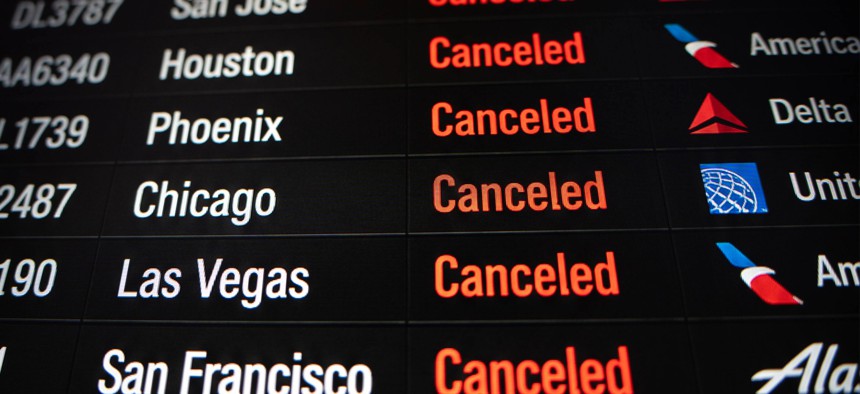
The online speculation followed several high-profile disruptions this month, including a major Microsoft service outage Nov. 12-14, and a nationwide ground stop issued by the Federal Aviation Administration on Nov. 13.
Microsoft attributed its disruptions to technical problems. And the FAA blamed work by a contractor upgrading a router in Arkansas.
But this week brought more disruptions: to several major banks Monday, to Apple services and the National Security Agency’s internal network Tuesday. Those also were separate technical issues, officials said.
Adding to the national security concerns, CNN reported Monday that U.S. intelligence suggested Iran was developing plans to potentially target senior Trump administration officials with a radioactive “dirty bomb” or chemical weapon in Washington, D.C.
U.S. Secretary of State Marco Rubio said Tuesday that he did not believe there was an imminent threat to Washington. Iran also denied the allegations.
During a congressional hearing Wednesday, Director of National Intelligence Jay Clayton told lawmakers that threats from Iran against Americans at home and abroad had increased substantially. Asked specifically about the reported dirty-bomb plot, Clayton declined to discuss the intelligence but acknowledged that threats involving weapons capable of causing mass casualties were not new.
Despite those explanations, social media posts increasingly portrayed the events as connected.
Some TikTok videos warned of a 90-day nationwide blackout that was to begin Nov. 17, while other videos encouraged viewers to stockpile emergency supplies, including water, food and medicine.
One widely circulated video manipulated footage of President Donald Trump speaking at a Nov. 9 news conference to make it appear that he had announced an impending blackout, according to a PolitiFact investigation.
Trump made no such announcement. The account sharing the manipulated footage also promoted cryptocurrency purchases ahead of the supposed national emergency.
Other online posts pointed to a federal Department of Defense initiative announced in September to help military installations operate independently of civilian power grids for at least 90 days. The initiative, known as FORTRESS America, is intended to strengthen military readiness during potential disruptions.
Homeland Security Secretary Markwayne Mullin also dismissed the online warnings, telling Fox News that Americans did not need to stockpile supplies in anticipation of widespread disruptions to electricity or to food and water sources.
Vice President JD Vance similarly sought to ease concerns Monday, saying Americans did not need to build bunkers or rush to stockpile food and water in response to the recent outages. “We do not see some crisis coming down, but you have to be prepared for everything,” Vance said during an interview with Fox News.
Other countries, including the United Kingdom, France and Germany, have urged residents to prepare for severe weather, cyberattacks and other emergencies –– adding to confusion among some Americans about whether they should take similar precautions. The UK launched its “Be Ready” campaign in October suggesting a three-day supply in case of emergency.
Real Vulnerabilities
The conspiracy theories have emerged against a backdrop of genuine concerns about the nation’s aging infrastructure and growing cybersecurity threats, which have exposed vulnerabilities in systems Americans rely on for electricity, transportation, healthcare and emergency services.
The American Society of Civil Engineers gave U.S. infrastructure an overall C grade in its 2025 report card, a slight improvement from the C- awarded in 2021. The national report card is released every four years.
But the organization warned that significant vulnerabilities remain. The nation’s energy and aviation infrastructure each received a D+, and the report estimated a $3.7 trillion gap between planned infrastructure investments and what is needed to bring the country’s systems into good working order.
The recent disruptions also drew scrutiny on Capitol Hill on Thursday, where lawmakers questioned Trump’s nominee to lead the Cybersecurity and Infrastructure Security Agency, or CISA, about the nation’s ability to withstand cyberthreats.
“American citizens are jittery,” Michigan Democratic U.S. Sen. Elissa Slotkin said during the Senate Homeland Security Committee hearing, raising concerns about the Trump administration’s elimination of more than 1,000 positions at the agency.
The nominee, Michael LoSapio, declined to assess the agency’s current resources but said he would evaluate potential gaps and request additional funding if necessary.
Cyberattacks are a growing concern for critical infrastructure operators, as hackers target hospitals, utilities, government agencies and other essential services.
“Modern society is effectively built on interdependence and high levels of complexity of technologies supporting human systems, and so when you get kind of a localized failure, it can very quickly cascade to more strategic problems,” said Charles Harry, an associate research professor at the University of Maryland who specializes in cybersecurity risk and previously worked for the National Security Agency.
Harry pointed to healthcare and transportation as examples of sectors where interconnected systems can allow disruptions to spread far beyond their original source.
Hundreds of thousands of cyberattacks occur every day, but most attract little public attention because they cause minimal disruption, Harry said.
The landscape is evolving as artificial intelligence gives cybercriminals, state-sponsored hackers and even less sophisticated attackers new tools, putting additional pressure on organizations to address security weaknesses before they can be exploited.
“Over the last 12 months, we’ve seen just an explosion in this type of activity, and it means that we’re going to have more frequent attacks, more consequential attacks,” Harry said.
When Misinformation Becomes a Public Safety Threat
Beyond the latest doomsday predictions, the spread of false information presents a broader challenge for state and local emergency management agencies, which rely on public trust to communicate accurate information during disasters.
During an actual emergency, false or misleading information can divert critical resources, delay response efforts and create confusion about evacuation routes, available shelters and government assistance.
“Sometimes (misinformation) can even mask itself as being something that comes from us, so you really have to dig deep, look at where the messages are coming from,” said Marc Pappas, the president of the National Emergency Management Association and director of the Rhode Island Emergency Management Agency.
The consequences have already played out during real emergencies.
Following Hurricanes Helene and Milton in 2024, conspiracy theories shared online alleged that the federal government had deliberately created or steered the storms toward certain communities. Other false claims accused federal officials of withholding disaster assistance, confiscating property and preventing private organizations from delivering supplies.
The National Oceanic and Atmospheric Administration, or NOAA, publicly debunked the weather manipulation claims, emphasizing that no technology exists to create or steer hurricanes. FEMA also launched an online “rumor response” page to counter misinformation and reassure survivors that assistance remained available.
The challenges facing emergency officials come as the Trump administration considers shifting more disaster response responsibilities to state and local governments. During a U.S. House hearing Thursday, FEMA Administrator Cameron Hamilton called for significant changes to the agency, arguing that stronger states would make the nation more prepared and resilient. Some lawmakers questioned whether states have the resources to take on additional responsibilities.
“Emergency management is ready. We continue to be ready and prepared for emergencies, threats that happen to occur across the nation,” Pappas told Stateline, arguing that state agencies are well equipped to take on additional disaster response responsibilities.