Texas city charges $2 million for Flock records as agencies make it harder to see how cameras are used
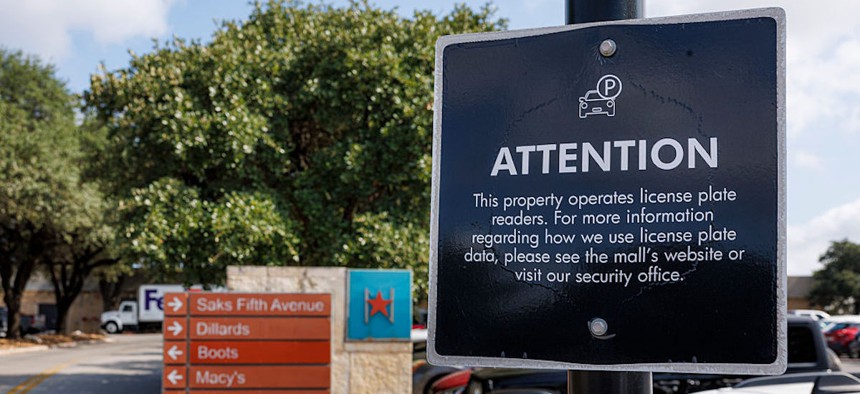
A sign notifies drivers that Flock Safety cameras monitor traffic entering and leaving North Star Mall along West Rector Drive in San Antonio on Friday, Aug. 7, 2026.

A sign notifies drivers that Flock Safety cameras monitor traffic entering and leaving North Star Mall along West Rector Drive in San Antonio on Friday, Aug. 7, 2026. Sam Owens/San Antonio Express-News via Getty Images


High invoices and challenges to accessing data on how departments use the surveillance cameras have hindered requests by privacy advocates and journalists.

This article first appeared on The Texas Tribune.

In the Fort Worth-area suburb of North Richland Hills, getting answers about how police use their Flock Safety cameras could cost $2.3 million.

Or at least, that’s how much the city is charging a Flock watchdog — requiring it all be paid up-front — after he filed a public records request for information about the city’s AI-powered cameras. The invoice said it was accounting for labor costs of $15 an hour — equivalent to more than 14 years of work — to search about a terabyte worth of communications about errors, misuse and effectiveness of the Flock system.

The North Richland Hills price tag is just the latest example of how local and state governments have increasingly made it more difficult to access information about Flock cameras as scrutiny over the surveillance system has intensified in recent months.

Phil Mynona filed the records request in late August on behalf of his anti-surveillance group called the Texas Privacy Coalition. He’s filed nearly identical public record requests to almost 200 law enforcement agencies seeking to understand how they use the devices.

Mynona is a pseudonym he has often used to speak publicly about Flock, because he said his job in the technology industry would be put at risk because of his advocacy. He has received troves of information from agencies, some at no cost and others with varying price tags for labor costs. Recently he said the city of Sealy, west of Houston, handed over more than 400,000 pages of documents for free.

The multimillion dollar invoice from North Richland Hills struck him as “ludicrous” and a way of stifling his search for records.

“This is a crazy outlier, I think the highest that we received in some amount was [$5,000] from Victoria, Texas, and at the time, I thought that was ridiculous,” he said.

A North Richland Hills city spokesperson confirmed the public records invoice to The Texas Tribune but declined to answer questions. The Tribune has a similar pending request for records to the city.

Flock cameras collect license plate numbers as well as other identifying information, including make, model, bumper stickers and dents, and officers can search thousands of cameras owned by hundreds of police agencies in a single query.

Flock Safety, the Atlanta-based company, releases few details about its cameras, leaving disclosure and transparency decisions to be decided by the patchwork of both state and local governments.

Camera locations, the amount of data retained and how often police are searching for vehicles are unknown in most cities across Texas unless departments explicitly share them, placing even more importance on receiving public records.

Anti-surveillance groups have underscored the need for transparency surrounding the use of the devices, as information unearthed in public records requests has spurred investigations, arrests and prompted departments to change policies or conduct their first audits.

That includes the case involving Lufkin Police, where an officer on Wednesday was sentenced to 5 years in prison after pleading guilty to 100 felony counts of abusing official information after he used Flock cameras to stalk several people.

It was a public records request from USA Today that prompted both the investigation and an audit of the entire Lufkin Police Department — which flagged a second officer for potential misuse, according to records from the Department of Public Safety.

Gov. Greg Abbott has pointed to that case as part of the reason for a “crackdown” on Flock cameras, which he joined in by blocking state funding and pausing certain installations for the surveillance cameras in August and September.

Meanwhile, information provided for free by some law enforcement agencies has been held behind invoices costing thousands by others, while some agencies have denied requests to review data on camera locations and searches on the camera network.

Houston news station KPRC was quoted $121,000 for Flock records, despite the news agency receiving thousands of pages’ worth of similar records from smaller police departments at no cost, it reported. Conservative online Texas news site Current Revolt reported the city of Irving is charging $70,000 for records that the city of Carrollton provided for free.

In some cases, records provided publicly earlier this year by agencies have become more elusive.

In response to a public records request for Flock audit data, DPS in July gave the Tribune a complete list of the department’s searches and thousands of other agencies using the agency’s Flock network, with officer and license plate numbers redacted.

But when the Tribune made an identical request for the next few weeks of data in early August, DPS only provided records of its own searches and not that of outside agencies.

When asked for a third set of search data shortly after, DPS withheld the records completely and challenged the request, asking the Attorney General’s Office to allow it to withhold the entirety of the search data it previously provided.

DPS did not respond to a request for comment about the change in their response.

The agency operates more than 900 of the estimated 13,000 Flock cameras statewide across state roads and along the state’s border.

DPS recently reined in how many agencies are allowed to access its extensive network after a Tribune review of its audit data revealed that 2,800 agencies, most of them outside of Texas, were accessing its cameras every four seconds without required agreements with DPS.

The Texas Department of Transportation, which is required to approve permits for license plate readers placed along state roads and highways, declined a request to share the number of permits it approved and the locations of approved cameras. In a challenge sent to the Attorney General’s Office, TxDOT cited public safety concerns.

DPS and Texas’ Department of Criminal Justice have also challenged record requests that would identify camera locations across Texas.

Some city departments, however, are more forthcoming about where their cameras are placed. Police in the city of Live Oak, northeast of San Antonio, provide an interactive map of their Flock camera locations, and Corinth in North Texas lists the street locations of all of their cameras online.

Flock provides agencies with their own avenues to be more transparent with how they use the devices, but whether departments use the features and how is up to them.

Agencies’ audit data of searches is exportable through the click of a few buttons on Flock’s platform. The company also provides agencies with the option to host transparency portals that show how many cameras departments have, how many searches they conduct, how many vehicles are scanned and even allow search data to be directly downloaded from the site.

“The portals give agencies a public-facing way to publish information about their [license plate reader] programs, including policies, usage and access rules to help communities better understand how the technology is being used,” Flock spokesperson Andrew Smith said in a statement.

Out of the hundreds of agencies that use Flock cameras in Texas, only 59 make use of the transparency portals, the Tribune found, representing more than 2,600 of the estimated 13,000 cameras operating in the state. Of those, only 16 share their search records.

X
This website uses cookies to enhance user experience and to analyze performance and traffic on our website. We also share information about your use of our site with our social media, advertising and analytics partners. Learn More / Do Not Sell My Personal Information
Accept Cookies
X
Cookie Preferences Cookie List

Do Not Sell My Personal Information

When you visit our website, we store cookies on your browser to collect information. The information collected might relate to you, your preferences or your device, and is mostly used to make the site work as you expect it to and to provide a more personalized web experience. However, you can choose not to allow certain types of cookies, which may impact your experience of the site and the services we are able to offer. Click on the different category headings to find out more and change our default settings according to your preference. You cannot opt-out of our First Party Strictly Necessary Cookies as they are deployed in order to ensure the proper functioning of our website (such as prompting the cookie banner and remembering your settings, to log into your account, to redirect you when you log out, etc.). For more information about the First and Third Party Cookies used please follow this link.

Allow All Cookies

Manage Consent Preferences

Strictly Necessary Cookies - Always Active

We do not allow you to opt-out of our certain cookies, as they are necessary to ensure the proper functioning of our website (such as prompting our cookie banner and remembering your privacy choices) and/or to monitor site performance. These cookies are not used in a way that constitutes a “sale” of your data under the CCPA. You can set your browser to block or alert you about these cookies, but some parts of the site will not work as intended if you do so. You can usually find these settings in the Options or Preferences menu of your browser. Visit www.allaboutcookies.org to learn more.

Sale of Personal Data, Targeting & Social Media Cookies

Under the California Consumer Privacy Act, you have the right to opt-out of the sale of your personal information to third parties. These cookies collect information for analytics and to personalize your experience with targeted ads. You may exercise your right to opt out of the sale of personal information by using this toggle switch. If you opt out we will not be able to offer you personalised ads and will not hand over your personal information to any third parties. Additionally, you may contact our legal department for further clarification about your rights as a California consumer by using this Exercise My Rights link

If you have enabled privacy controls on your browser (such as a plugin), we have to take that as a valid request to opt-out. Therefore we would not be able to track your activity through the web. This may affect our ability to personalize ads according to your preferences.

Targeting cookies may be set through our site by our advertising partners. They may be used by those companies to build a profile of your interests and show you relevant adverts on other sites. They do not store directly personal information, but are based on uniquely identifying your browser and internet device. If you do not allow these cookies, you will experience less targeted advertising.

Social media cookies are set by a range of social media services that we have added to the site to enable you to share our content with your friends and networks. They are capable of tracking your browser across other sites and building up a profile of your interests. This may impact the content and messages you see on other websites you visit. If you do not allow these cookies you may not be able to use or see these sharing tools.

If you want to opt out of all of our lead reports and lists, please submit a privacy request at our Do Not Sell page.

Save Settings
Cookie Preferences Cookie List

Cookie List

A cookie is a small piece of data (text file) that a website – when visited by a user – asks your browser to store on your device in order to remember information about you, such as your language preference or login information. Those cookies are set by us and called first-party cookies. We also use third-party cookies – which are cookies from a domain different than the domain of the website you are visiting – for our advertising and marketing efforts. More specifically, we use cookies and other tracking technologies for the following purposes:

Strictly Necessary Cookies

We do not allow you to opt-out of our certain cookies, as they are necessary to ensure the proper functioning of our website (such as prompting our cookie banner and remembering your privacy choices) and/or to monitor site performance. These cookies are not used in a way that constitutes a “sale” of your data under the CCPA. You can set your browser to block or alert you about these cookies, but some parts of the site will not work as intended if you do so. You can usually find these settings in the Options or Preferences menu of your browser. Visit www.allaboutcookies.org to learn more.

Functional Cookies

We do not allow you to opt-out of our certain cookies, as they are necessary to ensure the proper functioning of our website (such as prompting our cookie banner and remembering your privacy choices) and/or to monitor site performance. These cookies are not used in a way that constitutes a “sale” of your data under the CCPA. You can set your browser to block or alert you about these cookies, but some parts of the site will not work as intended if you do so. You can usually find these settings in the Options or Preferences menu of your browser. Visit www.allaboutcookies.org to learn more.

Performance Cookies

We do not allow you to opt-out of our certain cookies, as they are necessary to ensure the proper functioning of our website (such as prompting our cookie banner and remembering your privacy choices) and/or to monitor site performance. These cookies are not used in a way that constitutes a “sale” of your data under the CCPA. You can set your browser to block or alert you about these cookies, but some parts of the site will not work as intended if you do so. You can usually find these settings in the Options or Preferences menu of your browser. Visit www.allaboutcookies.org to learn more.

Sale of Personal Data

We also use cookies to personalize your experience on our websites, including by determining the most relevant content and advertisements to show you, and to monitor site traffic and performance, so that we may improve our websites and your experience. You may opt out of our use of such cookies (and the associated “sale” of your Personal Information) by using this toggle switch. You will still see some advertising, regardless of your selection. Because we do not track you across different devices, browsers and GEMG properties, your selection will take effect only on this browser, this device and this website.

Social Media Cookies

We also use cookies to personalize your experience on our websites, including by determining the most relevant content and advertisements to show you, and to monitor site traffic and performance, so that we may improve our websites and your experience. You may opt out of our use of such cookies (and the associated “sale” of your Personal Information) by using this toggle switch. You will still see some advertising, regardless of your selection. Because we do not track you across different devices, browsers and GEMG properties, your selection will take effect only on this browser, this device and this website.

Targeting Cookies

We also use cookies to personalize your experience on our websites, including by determining the most relevant content and advertisements to show you, and to monitor site traffic and performance, so that we may improve our websites and your experience. You may opt out of our use of such cookies (and the associated “sale” of your Personal Information) by using this toggle switch. You will still see some advertising, regardless of your selection. Because we do not track you across different devices, browsers and GEMG properties, your selection will take effect only on this browser, this device and this website.