
North Dakota lawmaker seeks limits on Flock-style cameras
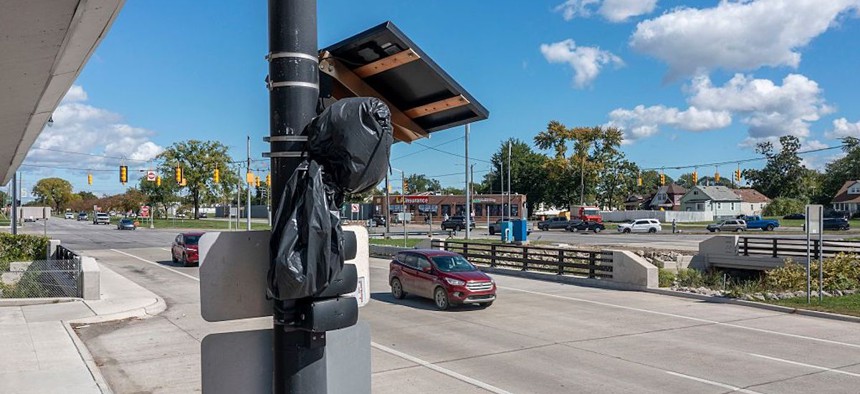
Flock surveillance cameras are covered with black plastic bags in a Detroit suburb. Citing privacy concerns, the Detroit City Council decided to cover the cameras while they consider the issue. Jim West/UCG/Universal Images Group via Getty Images





A state lawmaker is planning to propose a bill to regulate the use of controversial automated license plate readers, such as Flock cameras.
This story was originally published by the North Dakota Monitor.
A North Dakota lawmaker is planning to propose a bill to regulate the use of controversial automated license plate readers, such as Flock cameras, across the state.
“I have a lot of constituents who reach out on a nearly daily basis who are very concerned about this, and they want them banned,” said Sen. Jamie Selzler, D-Fargo. “People do not want these at all.”
Rather than banning the cameras, Selzler’s bill would implement “reasonable regulations” on their use, he said. The lawmaker said he’s working on the proposal with a bipartisan group of legislators.
Under the bill, law enforcement agencies would have to publicly disclose the locations of these cameras and provide a 30-day public notice before installing a new one. They also wouldn’t be allowed to install cameras near schools, places of worship or hospitals, and agencies would only be able to keep data for 14 days.
The bill would also criminalize intentional misuse of the technology and require there to be an open investigation before an officer is able to run a search through the cameras’ database.
“It’s putting guardrails in place to protect the public from abuse or overreach by law enforcement,” Selzler said.
Selzler said he hasn’t worked with law enforcement on the bill yet, but he plans to as the 2027 session nears. He said he hopes law enforcement will be on board with the idea.
“If I were law enforcement, I would be worried about law enforcement overreach causing these to be completely banned,” he said.
Nationwide, there’s been growing opposition to the cameras, which capture images or videos of vehicles, read their license plates and compare their information against databases.
Opponents argue the devices are a violation of privacy because of their ability to store data about drivers’ locations over time. In several high-profile cases nationally, law enforcement officials have also been accused of using the cameras to stalk former romantic partners.
Selzler was one of several dozen attendees at a “Flock Talk” event hosted in Fargo last month by the Faith & Conviction Coalition.
The event brought together residents and a panel that included Horace City Councilmember Chad Chalmers. The Horace City Council voted in September to take down the city’s Flock cameras. It was the first community in the Fargo metro area to do so, according to Erin Powers, an organizer of the event.
Chalmers said that while many may think of these cameras as being “just license plate readers,” what he saw in Horace would suggest otherwise.
“We had two Flock Falcons, which are license plate readers, and one of them was what’s called a Condor. It’s got pan-tilt-zoom, and it can do full live video,” he said.
Which North Dakota cities have Flock-style cameras?
The Monitor reached out to police departments in North Dakota’s largest cities to ask whether they use automated license plate readers.
Fargo declined an interview but pointed to its Flock Transparency Portal page, which includes a section with frequently asked questions and links to the department’s policy. It does not share camera locations.
In its ALPR camera policy, the Fargo Police Department says “locations are considered exempt records and not open to public review pursuant to this policy and North Dakota Century Code.”
A spokesperson confirmed via email that in addition to the 21 stationary Flock cameras listed on the website, the Fargo Police Department has 61 squad cars outfitted with ALPR cameras from another brand. The department also has five pan-tilt-zoom cameras installed in downtown Fargo.
Pan-tilt-zoom cameras, which record live video, “include a feature called Guardian Mode, which uses AI to detect motion and follow that movement, vehicle or pedestrian, until the subject is no longer in view,” according to the online page. “This feature does not use facial recognition or compare images to any database.”
However, the city doesn’t use that mode because its pan-tilt-zoom cameras are “positioned in busy public areas where movement is constant,” according to the city’s Flock page.
The Grand Forks Police Department told the Monitor it doesn’t have any stationary or car-mounted automated license plate readers.
West Fargo also declined an interview, but in a statement, a spokesperson said the West Fargo Police Department has had ALPR cameras since 2024. It has 48 stationary cameras and four car-mounted cameras.
“To ensure proper use of the system, an audit is conducted monthly and is reviewed by the Intelligence Supervisor. All information obtained through the Flock system is also verified by a supervisor before any additional law enforcement action is taken,” according to the statement.
The Bismarck Police Department has ALPR cameras on all 43 of its squad cars. They were turned on this past spring, according to Lt. Luke Gardiner. He said the department doesn’t own any stationary cameras but does have access to several cameras at Kirkwood Mall.
In Dickinson, the police department’s squad cars have all been outfitted with ALPR cameras since 2023. Deputy Police Chief Matthew Hanson said the city also has three stationary cameras, two of which are up and running.
“The one thing that makes our system a little bit different than Flock is our system is only operated by us,” Hanson said. “We don’t share our information with anybody else.”
He said the cameras have been a “huge lifesaver” during challenging investigations, including last fall, when several rounds were fired in a trailer court and eyewitnesses were not willing to give statements.
“It was going into our city-owned camera systems and finding a vehicle of interest that ultimately led us to the case,” Hanson said.
The cameras have also helped officers solve cases despite long-term understaffing, Hanson said.
Minot doesn’t have any stationary ALPR cameras, but it did install them on its squad cars this year. City spokesperson Jennifer Kleen said the data is housed in the department’s systems and can’t be accessed by the company the city works with.
Kleen said the city also has an oversight committee, composed of city councilmembers and community members, that meets every month to review the police department’s use of the technology.
In Williston, the police department has 31 cameras installed on its patrol vehicles in addition to two “quick-deploy” cameras that can be moved around and “placed in specific locations when needed to assist with investigations or targeted enforcement,” according to city spokesperson Calli Stellmacher.
Stellmacher said the city’s officers are required to “do their due diligence” and not arrest someone based solely off of a hit from an ALPR camera.
Opponents’ concerns
Chalmers, the Horace city councilmember, said he trusts law enforcement. But he said the cameras tested the balance of security and liberty, and “when it comes down to it, liberty comes before security.”
“If we have no liberty, we will have no security. Governments throughout history have killed more people than criminals have,” Chalmers said. “I’m not saying our government’s going to be doing that anytime soon, but we certainly don’t want to set them up with tools (to do so).”
Kellan Benson, a Fargo attorney who also participated in the Flock Talk panel, said that while people don’t typically have a right to privacy in public spaces — such as public roads — the “mosaic of information” that these cameras are able to collect and store could amount to an invasion of privacy.
He also argued that while many ALPR cameras don’t have facial recognition technology, the fact that drivers can be so easily linked to their cars means tracking a car’s movements around a city is more or less the same as tracking a person’s movements.
A recent case in which facial recognition aided an investigation that led to a Tennessee woman being charged with bank theft in Fargo shows how relying on this kind of technology can harm people, Benson said.
It also demonstrates cities’ liability, he added. After charges against Angela Lipps, the Tennessee woman, were dropped, she sued the city and a police detective for $10 million.
Governments passing laws and regulations — such as requiring warrants and a case number before officers can access camera systems, and limiting access to a few trained and trusted officers — could help to protect citizens from overreach, the panel speakers said.
Another concern, Benson said, is that law enforcement agencies aren’t the only ones with access to databases full of information captured by ALPR cameras.
Some of the companies that sell the cameras and lease the software, such as Flock, also have access, Benson said, adding that a contract provision preventing Flock from sharing data with third parties may not be enough.
“I have trouble with the fact that that’s not a law. That’s a contract provision. Who’s enforcing that part of the contract?” Benson said.
North Dakota Monitor is part of States Newsroom, a nonprofit news network supported by grants and a coalition of donors as a 501c(3) public charity. North Dakota Monitor maintains editorial independence. Contact Editor Amy Dalrymple for questions: info@northdakotamonitor.com.