
Microsoft’s Clean Energy Reversal Collides with Virginia’s Climate Goals
Michael Nieman via Getty Images





Amid a data center boom in the state, the tech giant backpedals on a key climate promise.
This article was originally published by Inside Climate News.
One of the world’s most profitable technology companies could be abandoning an ambitious clean-energy goal in Virginia as it races to build electricity-hungry data centers. Several of the company’s facilities are already operating in Virginia, the data center capital of the world, and more are planned, creating a tension with the state’s own climate commitments.
Microsoft is considering ending its round-the-clock or 24/7 clean energy goal, which aims to meet 100 percent of its energy consumption 100 percent of the time with zero-carbon electricity by 2030.
“It’s always easier to work in partnership than it is to work against them if our goals are aligned,” said Tim Cywinski, communications director for the Virginia chapter of the Sierra Club. “Our goals should be aligned. This is Microsoft telling us that they aren’t.”
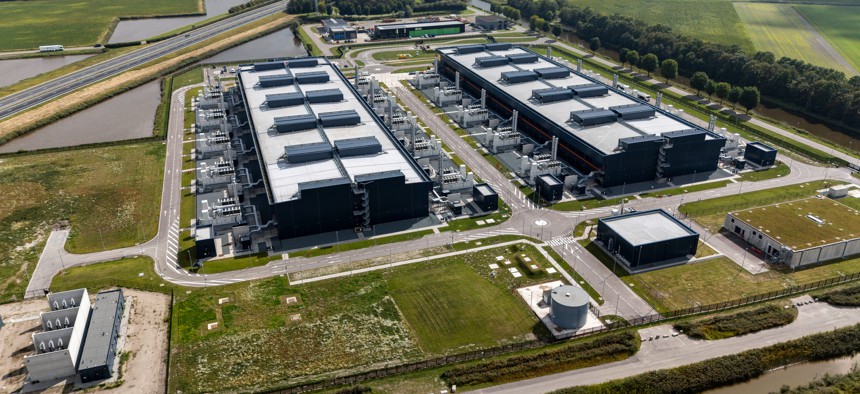
In Virginia, Microsoft has a hub of data centers for its Azure cloud services in Mecklenburg County. There, in rural Southside Virginia, there are more than 20 different data center buildings, according to datacentermap.com.
The company also has several data centers in Northern Virginia across Loudoun County near Dulles International Airport; Prince William County and Fairfax County. More data centers are planned for Mecklenburg and Prince William counties, which would more than triple the company’s statewide employee count to 2,042 by the end of the year.
Amazon has the largest data center footprint in the state, Cywinski said, followed by Microsoft and Google, which is also expanding. Meta has a data center outside Richmond.
Microsoft’s retreat is happening at the same time as the Trump administration’s attack on clean energy development and investment. Despite the consequences of rising climate change devastation and recovery costs, the company and its counterparts—Amazon, Google and Meta—are planning to power their computer warehouses with fossil-fuel plants.
In 2024, Virginia had 81 million metric tons of carbon emissions, according to Rhodium Group’s Climate Deck. That’s down from the 85 metric tons the state emitted in 2020, when it passed the Virginia Clean Economy Act (VCEA). The law was designed to decarbonize the state’s grid by mid-century, but that goal is now in question.
Rather than imposing a carbon budget, the law incentivizes Virginia’s two largest utilities to use renewable energy and retire fossil fuel sources in the state to reduce emissions. But utilities can ask regulators to build new fossil plants, or keep existing ones online, if there is a threat of running short on power.
By 2030, the state is projected to rank 30th nationally in power-generation-related emissions with about 57 million metric tons of carbon emissions. Separate research in Environmental Letters found that data center demand could contribute to a 28 percent increase in power sector carbon emissions, compared to no data center demand. That would be partly due to “coal-fired generation rebounds to meet demand in Northern Virginia,” the study found.
Data center growth in Virginia has created tension over the state’s pursuit of the goals in the VCEA, with Republicans advocating to abandon the law. Even if no constraints were holding up data center development, like needing transmission lines to deliver power, Virginia’s Joint Legislative Audit and Review Commission found in 2024 that it “will be very difficult, with or without meeting VCEA requirements” to meet the demand projected. During her campaign, now Lt. Governor Ghazala Hashmi, a member of the Democratic Party that has trifecta control of state government, indicated that data center development conflicts with the VCEA.
“The single greatest threat to our clean energy goals is not the lack of resolve or purpose or goals, but rather it is the sheer speed and the size of what is coming at us, explicitly…the growing demands within our commonwealth for energy,” Hashmi said at a Virginia Clean Energy Summit last fall.
Leading up to and following Microsoft’s 2020 climate commitment, the company made deals for various amounts of solar and energy storage technologies in Virginia and PJM, the regional grid operator for Virginia, 12 other states and the District of Columbia. When announcing its commitment, Microsoft concurred with the scientific community’s conclusion that emissions needed to decrease to reverse the harm caused by climate change.
“Already, the planet’s temperature has risen by 1 degree centigrade,” read a post from Brad Smith, president and vice-chair. “If we don’t curb emissions, and temperatures continue to climb, science tells us that the results will be catastrophic.” In unveiling “a new plan to reduce and ultimately remove Microsoft’s carbon footprint,” the company acknowledged that combating climate change would demand a worldwide effort. Still, Microsoft had a responsibility to act, Smith wrote: “those of us who can afford to move faster and go further should do so.”
But last fall, Microsoft supported new gas proposals from Dominion Energy, the state’s largest utility, despite VCEA deadlines to retire carbon-emitting sources by 2045.
In 2023, 36 percent of Dominion’s electricity came from natural gas. At the time, no new natural gas power plants were planned. Then, following the surge in data center development, Dominion called for six gigawatts of new natural gas generation to be built over the next several years. That alone would meet about 24 percent of Dominion’s record peak demand of 25 gigawatts from this past winter. While the utility has its own net-zero climate goal, its latest plan, called an Integrated Resource Plan, or IRP, includes eight gigawatts of new natural gas capacity.
Other big tech companies rushing to build more data centers are also turning to fossil fuel use, but some, like Google, have announced several battery storage projects. Microsoft’s reconsideration is the most public acknowledgement of the tension with clean energy. The reversal signals dishonesty, said Cywinski, of the Sierra Club.
“All of the industry, including Microsoft, have proven their voluntary commitments mean nothing unless it lines up with their bottom line,” Cywinski said. “Whether it’s climate, whether it’s affordability, whether it is doing right by customers—none of it matters if they think that their profits are going to be at stake.”
Microsoft said it remains committed to becoming carbon negative, which is a goal that allows emissions to continue. To be carbon negative, the company’s emissions are totaled, and Microsoft can receive credit for projects like planting trees, which absorb carbon. Those credits can be subtracted from emission totals to lower footprints to zero or into the negative. The company can also match or buy clean energy generation sources in an amount that corresponds to its energy consumption.
In 2024, the company created 11.8 million metric tons of carbon emissions, about 40 percent of which came from powering their data centers and other operations.
“Fulfilling our carbon commitment requires ongoing effort to review and refine our approach as markets mature, policy environments evolve, and emerging innovative solutions scale,” Melanie Nakagawa, chief sustainability officer at Microsoft, said in a statement in response to questions from Inside Climate News. “At times we may make adjustments to our approach toward our sustainability goals. Any adjustments we make are part of our disciplined approach—not a change in our long-term ambition.”
But the difference between matching and the 24/7 clean energy goal is “significant,” said Gary Cook, a U.S.-based independent renewable energy and sustainability consultant who formerly worked with environmental advocacy groups Stand.earth and Greenpeace.
Whereas matching allows emissions to continue while mathematically being offset, it can also be satisfied with clean energy from other, cheaper places in the country. Then, fossil fuel emissions from power plants in Virginia that are powering the data centers there can continue to operate.
“You’re subsidizing renewable deployment in a different part of the country, but doing nothing to meet your footprint,” Cook said of the matching goal.
Tech companies were a “catalyst” for utilities to shift and provide clean energy to large customers like them, but the rush to build out AI is now causing companies like Microsoft to seek their own fossil fuel generation sources, like in a planned gas-powered project in West Virginia, that aren’t connected to a grid that needs years-long upgrades, Cook said.
That West Virginia project aligns with Microsoft’s walk back, Cook said, which is “bad locally, it’s bad globally.”