
How NYC government is using AI
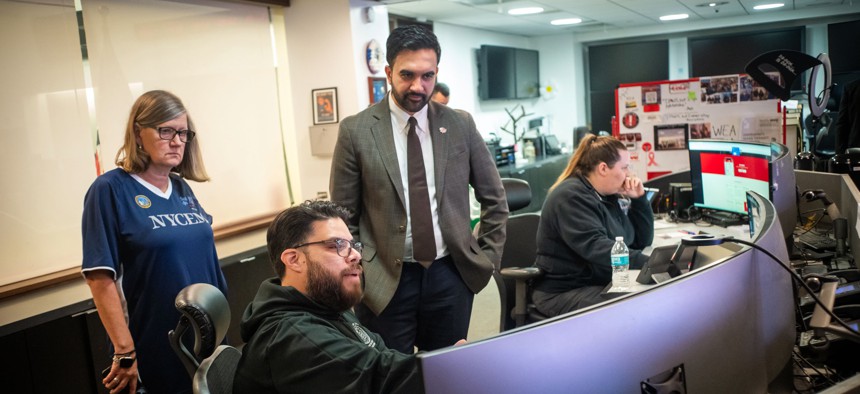
New York City Emergency Management is just one of the city agencies that uses generative AI chatbots. Ed Reed/Mayoral Photography Office






New York City Mayor Zohran Mamdani may not use ChatGPT, but his agencies have adopted chatbots and other artificial intelligence.
New York City has not historically been a beacon of transparency when it comes to how its government agencies use artificial intelligence tools or other technology. But since 2020, the city has been required to publish a list of “algorithmic tools” – including AI-based tools – used by agencies in the previous year, with brief descriptions on their use and details like how the tool is procured and whether it collects identifying information from New Yorkers.
The result is what critics call an imperfect list of how city agencies are using algorithmic tools, which include everything from decades-old models to match EMS workers to the nearest hospitals to more recent AI like the latest iterations of ChatGPT. Here are a few that caught our attention from the most recent report, which covers tools used in 2025.
ChatGPT
Who used it? The Department of Youth and Community Development, the Mayor’s Office to End Domestic and Gender-Based Violence, the Mayor’s Office of Community Mental Health, the Mayor’s Office of Talent and Workforce Development and the Mayor's Office of Nonprofit Services
How? Brainstorming social media content and writing captions, creating potential job interview questions, writing accessible alt text for images and drafting and editing emails. It was also used in the since-abandoned MyCity Chatbot.
First reported use: 2023 (MyCity), 2024 (others)
Google Gemini
Who used it? The Department of Environmental Protection
How? The department used a free version of Gemini to “generate an image that was edited and used as the icon for the NYC Noise app.”
First reported use: 2025
Idling Complaints Program
Who used it? The Department of Environmental Protection
How? A contractor, Acuvate, created an AI tool to analyze “pictures and videos submitted by citizens of alleged car idling complaint occurrences” and make recommendations on whether illegal idling occurred. The department reported it’s “still entirely up to the staff” to decide whether to take the recommendation or not and said the tool is still being reviewed.
First reported use: 2022
311 Mobile App AI Smart Select
Who used it? The Office of Technology and Innovation
How? The 311 app allows users to send in a photo of the problem they’re reporting and an AI tool will try to match the photo with relevant service requests.
First reported use: 2025
Virtual Assistant Chatbot
Who used it? The Department of Youth and Community Development
How? The DYCD chatbot provides preset answers on questions from the public about afterschool, family support and other department programs. The tool averages 2,100 requests a day, according to the report, and runs on Microsoft Azure Language.
First reported use: 2020
HELIX
Who used it? The Department of Health and Mental Hygiene
How? HELIX is a “generative tool” that allows staff to ask “general questions” based on data in Open AI GPT-4o model, according to the report, which doesn’t say much about what kinds of questions staff might ask. The tool can also be “grounded on approved documents” that staff can ask about.
First reported use: 2025
Microsoft 365 Copilot
Who used it? Department of Environmental Protection and NYC Emergency Management
How? Helped draft Department of Environmental Protection social media content and translate department content into other languages; simplified NYCEM’s “preparedness language” for the public.
First reported use: 2025
Voice to Vision
Who used it? Department of City Planning
How? Created as a research project with MIT’s Center for Constructive Communication, Voice to Vision visualized public comments shared at planning sessions for the Jamaica Neighborhood Plan and the White Plains Road Neighborhood Plan. The tool used GPT models and Claude to geotag, group and summarize comments to be shared on public websites.
First reported use: 2025
Mufflers Noise Violations
Who used it? Department of Environmental Protection
How? This program deploys noise monitoring cameras from Intelligent Instruments on city streets to record loud noises, analyze the recordings and identify the noises to help DEP staff decide whether a noise summons should be issued or not. Staff review the recordings themselves. The software also “tries” to read the vehicle license plates, according to the report.
First reported use: 2025
Fusus CORE Elite AI
Who used it? Office of Technology and Innovation
How? Security cameras made by Axon (maker of the popular police body cameras) use AI to detect “objects, people, or motion-based events in real time, such as a person or a vehicle entering a restricted area” and issue alerts to OTI’s Technology Operations Center and Emergency Management staff, according to the report. It’s not clear where OTI deploys the cameras.
First reported use: 2025
OpusClip
Who used it? Department of Youth and Community Development
How? OpusClip analyzes video of the department’s “Next Gen” podcast to detect “the most compelling, shareable, and emotionally impactful moments” to clip and share on social media.
First reported use: 2024
Algebra Teaching Assistant
Who used it? New York City Department of Education
How? The tool is part of the Department of Education’s “Division of Instructional and Information Technology AI platform” and generates responses to teacher or student prompts about algebra-related content. The large language model is trained on the specific math curriculum. The DOE also reported using ChatGPT for a tool generating responses to a broader range of teacher and student prompts.
First reported use: 2023