
New York data center pause inspires strong reactions
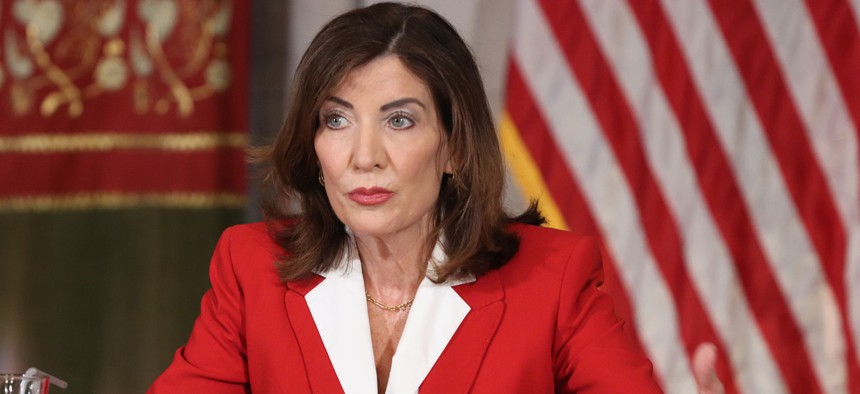
New York Gov. Kathy Hochul speaks during a roundtable discussion regarding her recent executive order establishing a moratorium on data centers in the state. Albany Times Union/Hearst Newspapers via Getty Images





 By
Chris Teale
By
Chris Teale
President Donald Trump was among the first to criticize Gov. Kathy Hochul’s one-year moratorium on hyperscale data centers, along with EPA Administrator Lee Zeldin and others.
Days after New York Gov. Kathy Hochul imposed a one-year moratorium on building large data centers in the state, criticism is building, including from senior figures in the federal government.
Hochul signed an executive order pausing the development of hyperscale data centers earlier this month to allow for the state to establish standards for their construction and make sure local communities benefit. But almost immediately, the first-in-the-nation moratorium came in for criticism, including from President Donald Trump.
“New York State has made a terrible decision,” Trump wrote in a post to his Truth Social platform. “All of this Income, and other Benefits, will be going to Red States, and some Blue, where Data Centers are sought as Cash Cows, with Lower Taxes and Record Setting Jobs. They must pay for their own Water and Power, and any leftover goes back to the State and local Community. Data Centers are tremendous WINS for the States and Communities that are lucky enough to get them. New York should change its Policy, IMMEDIATELY.”
Lee Zeldin, the administrator of the Environmental Protection Agency, also criticized Hochul’s moratorium. In a speech at the Tennessee Chamber of Commerce and Industry’s Infrastructure Summit, Zeldin described the one-year pause as a “cop out,” but noted that the EPA announced last month that it would not set national standards for data centers and would instead encourage states and local communities to do it for themselves.
He said communities should not end all data center development, but instead ask themselves various questions.
“For a local community that is thinking through bringing a data center to their area, I would encourage them to ask three questions: Is the project going to make my bills go up or down? Is the project going to be a net provider onto the grid, or a net taker? And what are they going to do with water? Is it a closed-loop data center? Is it 100% recyclable?” Zeldin said.
Supporters of reining in data centers in New York backed Hochul’s effort to temporarily pause the issuance of state environmental permits for hyperscale data centers, which are large centers that use 50 megawatts or more in power. During that pause, Hochul pledged to build a “nation-leading regulatory framework” to ensure communities receive the most benefits from new developments and make sure residents aren’t paying for transmission and infrastructure build outs in their utility bills. She also promised to pursue legislation that would repeal sales tax exemptions for large data centers.
The executive action has some parallels with the Responsible Data Center Development Act, which the New York legislature passed last month and included a one-year moratorium on hyperscale data centers, as well as requirements around environmental impact assessments, new rate classes for water and electricity usage, and labor protections.
State Sen. Kristen Gonzalez, who sponsored that legislation, called Hochul’s executive moratorium a “huge win for New York and the broader movement to fight data centers.” But she said more work is ahead.
“We need to require transparency and proper public engagement on every project,” Gonzalez said in a statement. “Communities must receive real benefits if they do want a data center, and ensure these projects are constructed with prevailing wages and union labor. Importantly, we have to require renewable energy standards for all data center projects. We cannot allow demand from data centers to add pollution to our air and move us further from achieving our climate goals.”
Similarly, State Assemblymember Didi Barrett, who sponsored the New York Assembly’s version of the legislation, said the initiative is “a timely and important first step” in addressing residents’ concerns.
“New Yorkers across the state have spoken up in support of a data center moratorium,” Barrett said in a statement released by Hochul’s office. “They want a pause in the building of large-scale data centers — to better understand their impacts on our natural resources, our communities and our energy costs. They want protections and they want us to learn from the experiences of other states.”
Others have said that any pause in data center development could result in lost economic activity for New York. In an interview with WSYR in Syracuse, New York, Ross Connolly, Americans for Prosperity’s Northeast regional director, reportedly said it shows that “New York is closed for business for the future economy and is saying no to hundreds of millions of dollars in central tax revenue and tens of thousands of jobs.”
Tech groups pointed to the White House’s Ratepayer Protection Pledge as a better way forward, as data center developers pledged to cover the full costs of their energy, infrastructure and water requirements.
“States should adopt a similar approach rather than imposing New York’s effectively indefinite permit freeze, which blocks such significant investment from occurring,” Amy Bos, vice president of government affairs at industry group NetChoice, said in a statement.