
AI and the new rules of digital trust: Watermarks
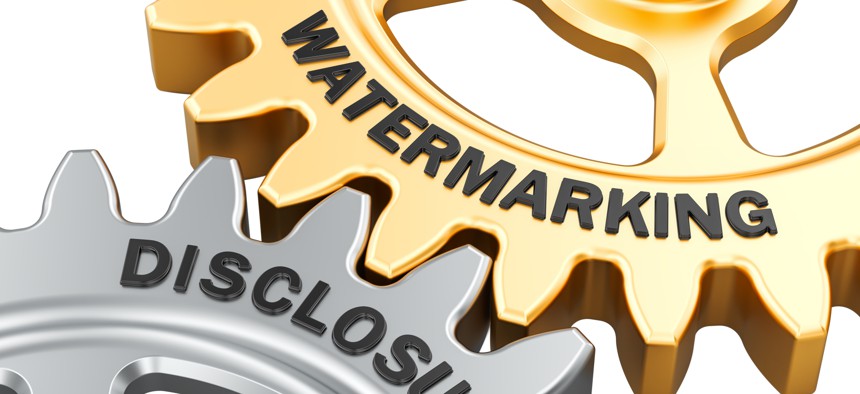
natatravel via Getty Images



 By
Alan R. Shark
By
Alan R. Shark
COMMENTARY | AI watermarking will become more than a tech issue for governments. In time, it could help them authenticate official communications and identify fraudulent ones.
For centuries, watermarks had a quiet, almost passive purpose. A faint emblem in fine paper identified a manufacturer. A portrait embedded in currency helped expose counterfeits.
A translucent logo across a photograph discouraged unauthorized reuse. In each case, the watermark said something about origin, ownership, or authenticity — but only if someone stopped to look.
Today, the watermark is being assigned a far more ambitious job: helping society distinguish human expression from artificial intelligence-generated content on an enormous scale.
That change moved from policy debate to legal requirement in Europe on Aug. 2, 2026, when important transparency provisions of the European Union’s Artificial Intelligence Act became applicable. Among them is a requirement that providers of systems generating synthetic text, images, audio, or video make their output detectable as artificially generated or manipulated, where technically feasible.
While this may appear to be a European regulation, it has enormous implications for the US too. Both OpenAI and Anthropic are planning to implement it worldwide. No doubt other AI companies will do the same.
The basic goal is easy to understand: people should have a better chance of knowing when what they see, hear, or read was created by AI.
What Europe is Trying to Protect
The rule is aimed less at punishing ordinary AI use than at combating deception and manipulation. The concerns include deepfakes, impersonation, fraud, fabricated evidence, misleading political material, and the growing difficulty of separating an authentic recording or document from something created artificially.
The regulation does not require a large warning label on every AI-assisted sentence. Nor does it treat every use of AI equally.
An important distinction exists between asking AI to correct punctuation or improve a sentence and asking it to write an entire essay, create a photograph of an event that never happened, or produce a convincing video of a public official saying something that was never said.
That distinction will matter more as AI becomes part of everyday work.
What Exactly is a Digital Watermark?
The word “watermark” can be misleading because the mark may not actually be visible.
Think of it instead as a digital clue placed in or attached to AI-generated material. Special software may be able to examine a photograph, audio recording, video, document, or other content and determine that an AI system played a role in creating it.
Text presents a greater challenge because words can easily be copied, rewritten, shortened, translated, or rearranged. The more something is modified, the harder it may become to identify its AI origins.
That leads to an important limitation.
A watermark does not necessarily prove that something is false. And the absence of a watermark does not prove that something is genuine.
At best, it provides another piece of evidence about where digital material came from and how it may have been created.
What About Copyright?
Watermarking and copyright are related, but not the same. A watermark does not automatically establish ownership. Nor does identifying something as AI-generated automatically mean copyright protection is impossible.
In the United States, copyright protection still depends heavily on human authorship and creative contribution. Someone who simply asks an AI system to generate an article, illustration, or other work may have a weaker claim than someone who substantially edits, restructures, combines, and adds original creative material.
This creates a fascinating new question: At what point does AI-generated material become human-created work?
Consider an author who asks AI for an initial draft but then rewrites large portions, adds original examples, verifies the facts, changes the argument, and shapes the final product according to his or her own judgment. AI clearly participated, but so did the human author.
Watermarks may someday help document that process. They are unlikely, however, to settle the question of authorship by themselves.
The Academic Implications
Education may be one of the areas most affected by this development.
Universities have spent considerable effort trying to determine whether students are submitting AI-generated assignments. Watermarking might seem like a simple solution: check the document and see whether AI created it.
Unfortunately, it will not be that easy.
A student might legitimately use AI for brainstorming, grammar assistance, translation, research organization, or developing an outline. Another student might have AI write an entire paper and then rewrite enough of it to make detection difficult.
That means a watermark should never automatically become proof of academic misconduct.
The more important change may be moving education away from trying to “catch AI” and toward requiring students to demonstrate learning. Faculty can establish clear rules about acceptable AI assistance, require disclosure when appropriate, examine drafts and notes, and occasionally ask students to explain their reasoning or defend their work.
The real question should not simply be, “Did AI touch this assignment?” It should be, “What intellectual work did the student actually perform?”
Implications for Government
For federal, state, and local governments, AI watermarking will become much more than a technology issue.
Imagine a convincing video appearing online in which a governor announces an evacuation, a mayor claims that drinking water is unsafe, or a police chief supposedly announces that a dangerous suspect has been captured.
How would citizens know whether it was real?
Digital markings could eventually help governments authenticate official communications and identify fraudulent ones. Government agencies may also need policies governing when AI-generated public information should be disclosed, how digital identification information should be preserved as part of public records, and what requirements should be placed on AI vendors.
The implications also extend to courts, law enforcement, public meetings, elections, emergency management, and records management.
But government must be careful not to place too much faith in the technology. A watermark should be treated as a signal — not a verdict. Human verification, due process, judgment and accountability remain essential.
A Signal, Not a Solution
The European approach represents an important attempt to address one of the defining problems of the AI age: we can no longer assume that seeing is believing.
But watermarks will face the same challenge confronting almost every technological safeguard. As soon as methods emerge to identify AI-generated content, others will try to remove, defeat, or manipulate them. Some companies already market tools that claim to detect hidden AI signals, while others promise to make AI-generated material harder to detect.
It could become another technological arms race. That does not make watermarking useless. It means we should understand what it can and cannot accomplish.
The central question is no longer simply, “Is this real?”
Increasingly, we must also ask:
“Where did this come from?”
“What role did AI play?”
And perhaps most importantly:
“Who takes responsibility for it?”
Digital watermarks may help answer the first two questions. But as with so many attempts to regulate rapidly changing technology, they cannot answer the third. That still remains a human responsibility.
Alan R. Shark, a senior fellow at the Public Technology Institute (PTI), is an associate professor at the Schar School of Policy and Government at George Mason University, where he also serves as a faculty member in the Center for Human AI Innovation in Society. He is also a senior fellow of the National Academy of Public Administration and founder and co-chair of its Standing Panel on Technology Leadership. He hosts the podcast series Sharkbytes.net.