
Kristen Gonzalez and the fight to regulate AI
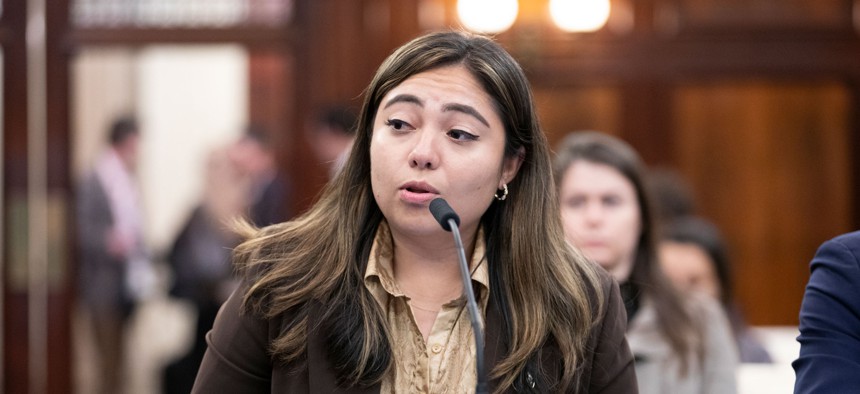
State Sen. Kristen Gonzalez testified at the New York City Council’s Committee of the Whole meeting on Oct. 5 to discuss the threat of artificial intelligence. John McCarten/NYC Council Media Unit




 By
Kate Lisa
By
Kate Lisa
In a Q&A, the New York state senator talks about touring data centers all over the state.
The artificial intelligence boom and rapid growth of data centers have both quickly become major political flashpoints, especially heading into the midterm elections next month. Lawmakers and industry leaders are questioning how to establish guardrails to protect consumers and the economy, while also offsetting the massive energy and water consumption that comes with them.
New York lawmakers want everyone to know they’re on it. Gov. Kathy Hochul’s executive order this summer pausing data center projects for a year was the first in the nation. And legislation that could create another moratorium is headed for her desk by the end of the year.
State Sen. Kristen Gonzalez sponsored that bill, known as the Responsible Data Center Development Act, and led a statewide “New York Fights AI Data Centers” tour this summer. As chair of her chamber’s Internet and Technology Committee, she visited over a dozen active or proposed data center sites while listening to residents’ concerns on both sides of the debate in preparation for negotiations with the governor that are expected at the end of the year. Gonzalez spoke with City & State about the latest developments at a recent data center roundtable in the Hudson Valley that the governor held with members of Congress – a day after the New York City Council held its Committee of the Whole hearing on AI, where she testified. This interview has been edited for length and clarity.
Let’s talk about the tour you went on this summer. The governor signed this data center moratorium, so what was the tour for?
I went on the “New York Fights AI Data Centers” tour alongside Food & Water Watch and a massive coalition of environmental justice organizers that have been fighting the fight against hyperscale data centers for years. And we went to the Hudson Valley, Orangeburg, Fishkill right here, we went to Albany in the Capital Region, we went to Buffalo (and) Genesee County and Alabama, New York. I went to the Tonawanda Seneca Nation, and then went to Ithaca and Lansing and Syracuse and Lysander.
You even said all that correctly. That’s pretty good.
I learned a lot about our state in that time. But I say this because we went to deep-blue areas and deep-red areas, and it was really clear that New Yorkers are united in the fight against AI data centers. And this issue transcends geographics, transcends demographics, and certainly transcends geographies. So what I have taken away and learned from that, especially in the context of this (roundtable), is that our voters really want to see government being proactive in protecting New Yorkers from the harms of AI data centers. And for all of the promise that we are hearing about AI from tech companies and tech billionaires, it is real people here in New York that are living with the everyday consequences and paying the real price of operating that technology.
So, did you get any protesters on the tour? You do have the Republicans like Bruce Blakeman who often talks about, “We need to invest and we need to not prevent business from coming here.” What did you say to some of those counterprotesters?
There was one stop where we did have a few folks show up in opposition to us. This was in Alabama, New York, outside of a cafe where we held a town hall. And I actually met with those opponents of the bill outside of the cafe, and we had a conversation about what it meant to responsibly develop data centers and give communities decision-making power, and empower them to also extract community benefits – versus doing nothing, which allows tech companies to write rules for themselves, to build hyperscale data centers and reap all of the profits. And at the end of the conversation, while we certainly had members who wanted to see those construction jobs come into the area, there was a consensus that it is responsible to say that there are guardrails, frameworks and real ways to empower their neighbors to have a voice in this larger process, and that is why this tour I think was so important. And to your point, the executive order is an important first step. I am really thankful for the governor’s leadership on this because it is the first-in-the-nation moratorium. However, our bill requires in statute public engagement and community benefits, which, no matter where folks stand on if they want data centers or opposed to data centers, everyone is unified around.
So that moratorium, you felt like it’s a good first step? You still have the bill headed to the governor’s desk, and what would that bill do? And then you’re still advocating for it to be signed as is? Did the executive order change anything?
So the executive order was important because it was an immediate moratorium on state permits for the largest data centers. And as we talked about today, there are in the New York Independent System Operator queue, 37 projects looking to bring over 12,000 megawatts onto our energy grid. For context, New York uses 31,000 megawatts a year, so it would be equivalent to bringing on almost half of the state, knowing that we are already in an energy crisis and dealing with an aging energy grid. So the moratorium was important for immediate relief and an opportunity to plan for the future. What the bill does is, similar to the moratorium, has a one-year moratorium, requires an environmental impact report, but it goes a little bit further in saying that we need to require public engagement and transparency for data center developers and proposals, and that we need to require community benefits in any agreement to bring a data center online. So again, the executive order is an important first step, but our bill works off of that and is widely supported across the political spectrum.
So you still want her to sign it. Do you expect that to happen after the election?
We are looking forward to working with the governor’s office on a conversation about chapter amendments. I think there are many places where we agree. But again, New York has been clear. We have passed this bill through both chambers of the Legislature with bipartisan support. We have visited and talked to hundreds of New Yorkers who are dealing with the real consequences of these data centers, and they and everyone wants to see our government put forward the most robust version of regulations and guardrails against hyperscalers. So, of course, we want this bill signed. And again, I’m hoping the governor engages us more on that.
I want to talk about the Oct. 5 New York City Council hearing on AI. You testified in that hearing. How much of the other testimony did you listen to?
I certainly listened to industry testimony, and it was an incredibly frustrating experience, because for all of the lip service that they paid to supporting legislation or wanting to see real regulation of artificial intelligence in the hearing, in addition to the lip service their CEOs have paid, we have seen firsthand that any time we put forward a bill that meaningfully reins them in or protects New Yorkers, that they have lobbied against it, and that means that they are speaking out of both sides of their mouth. They will say we want regulation, but not like that, and I think it’s important for New Yorkers to know that, because there are bills at the city level and the state level that protect us from algorithmic bias, protect us from mass surveillance, protect immigrant communities and protect our children from chatbots, like the bill I passed unanimously through both chambers this year to protect minors from large language models. And yet they have spent their time working to kill each one of those bills.
Did you learn anything new from the companies testifying?
It was news to me that they were supportive of some of these bills. I think Assembly Member (Alex) Bores pointed this out. They had indicated that they supported the RAISE Act, and as chair of the (state Senate) Internet and Technology Committee, it was not my understanding that they supported that bill. I think he voiced the fact that they were under oath, and it was a misrepresentation of the lobbying they had done at Albany. So that was new information, and I think important to note, because again New Yorkers deserve companies that are good faith actors that are representing the lobbying that they’re doing well, and I didn’t see their testimony as that.
Are there any bills that the council was hearing yesterday that you support and or would want to see at the state level?
Yeah, I think “Ban the Scan” by Council Member Shahana Hanif is a really wonderful example of protecting New Yorkers from biometric surveillance. And at a time where we know (U.S. Immigration and Customs Enforcement) is using AI to mass surveil our immigrant neighbors, I think bills like that really are important ways to protect us.
Are there any bills that you do not support or are not sure about?
There’s a number of bills, and we’re very focused on our state legislation because there are New Yorkers who are dealing with harms or risk even outside of New York City. So we’ll be working with the council to make sure that we’re aligning our approach. One thing that I talked a lot about (on Oct. 5) was, as a democratic socialist and as a former tech worker and chair of the state Senate Technology Committee, we’ve put forward a rights-based approach to regulating AI. We talk a lot about risk, but we have to be clear: AI is not inevitable. We should not accept a vision for innovation that is driven by tech companies and oligarchs that have benefited from rolling out risky tools, and we certainly shouldn’t be allowing the same people who have gotten us into this mess to regulate themselves. And in our rights-based approach, we set a baseline that we have a right to privacy, which is why I have the New York Privacy Act. We have a right to protect our children from chatbots, which is why we passed our chatbots and minors bill this year. We have a right to protect our environment and our climate goals from the AI data center development boom, which is why we have the Responsible Data Center Development Act, and we have a right to say that we should have transparency when these tools are making big decisions about our lives and subjecting us to algorithmic bias, which is why we have the New York AI Act.
At the state level, what’s your priority for the next session, either in the budget or separately?
I think our priorities have certainly remained the same, because we have always believed in reining in these tech companies and these tech oligarchs, which means more data center legislation, more privacy legislation, more private sector regulation. And the two bills that come to mind are the New York Privacy Act and the New York AI Act. That would, for the first time in New York, have a comprehensive privacy bill, which is the foundation of good AI regulation, and the New York AI Act would establish clear guardrails like audits and impact assessments on tools being used in the private sector. That means tools that are making decisions about whether or not we get healthcare, whether or not we get housing and whether or not we get public benefits. Last night in the City Council’s hearing was a really good example of industries saying they want to be audited, and yet again, they have staunchly opposed that bill.
Do you think New York City Mayor Zohran Mamdani should be more involved in pushing AI regulation from the city level rather than just calling on the federal government to act?
I think the mayoral administration has been responsive to conversations around AI in education. For example, we are really happy to see the moratorium from K-8. However, I will be putting forward an AI in education bill that sets a foundation for not only K-8 but K-12 and even beyond to say that we should have real oversight of how these tools are being used in any educational context, and also work with our teachers and our educators for an understanding of how they’re being used by staff.