
Government's financial systems fall flat
Featured eBooks





The government's financial systems woes could make year 2000 coding worries look like a night at the Roxy.
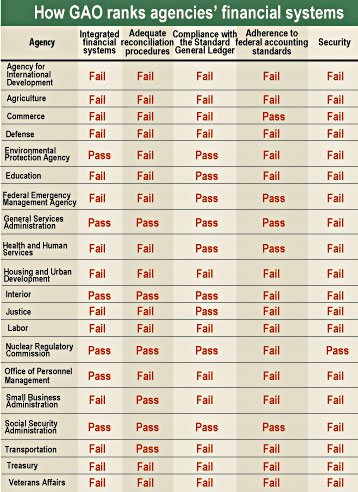
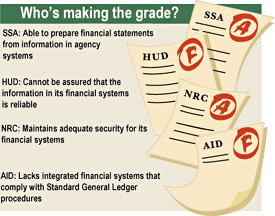
'It is a tremendous challenge to improve financial systems to produce accurate, reliable, consistent and timely information for program and financial managers,' said Joshua Gotbaum, executive associate director and controller of the Office of Management and Budget. He spoke at a June 6 hearing of the House Government Reform Subcommittee on Government Management, Information and Technology.'It must be achieved with an infrastructure dominated by legacy systems that were not designed to support current requirements or technology and in an era where budget resources are limited,' Gotbaum said of efforts to bring more than 700 federal financial systems into compliance with modern management standards.In most instances, agencies designed the systems from scratch. Maintaining all these disparate systems is not cheap, Gotbaum said. The government spends roughly $2 billion per year to run its financial systems, he said.Preparing system code to handle year 2000 dates was simple by comparison to the challenge agencies face in gaining control of their financial destiny, he said.'With Y2K, we had a relatively simple coding issue'two digits where we needed four'which affected virtually all systems worldwide,' Gotbaum said. 'The Federal Financial Management Improvement Act, on the other hand, attempts to address multiple problems affecting multiple systems. It is a harder and longer-term challenge.'A history of decentralized systems development has left large agencies with multiple bureaus that run myriad disparate systems, he said. These systems cannot share information, sometimes even within one agency'a factor that makes financial compliance a nightmare, Gotbaum said.The Agriculture Department is one of many departments'including Defense, Health and Human Services, Interior, Justice and Treasury'that fails to comply with financial management standards, according to reports by GAO and department IGs.Agriculture has six primary accounting systems that manage program costs of more than $60 billion, department IG Roger C. Viadero in March told the Government Management, Information and Technology Subcommittee.Because Agriculture's Central Accounting System at the National Finance Center could not meet accounting requirements, the department jettisoned it in the early 1990s and began migrating to the Foundation Financial Information System, Viadero said.Although the new system'the core of which is a commercial product from American Management Systems Inc. of Fairfax, Va.'established a common coding structure and integrated data from other USDA systems, the department still struggles with workarounds necessitated by its use of some older systems that gather financial data, Viadero said.'The interfaced feeder system transactions require complex analytical processes to generate FFIS general ledger entries,' he said. 'Because the feeder systems are old and poorly documented, problems have been encountered when mapping these transactions' to the new system. They also cost USDA $6 million a year in maintenance costs, he said.Viadero likened the process to reintroducing tainted blood into a patient following a transfusion.Department officials have agreed that most of the legacy systems must go or be integrated completely into the new system, he said.The problems Agriculture has faced in converting data from the Central Accounting System to the new program exemplifies the hurdles agencies must overcome to comply with the financial improvement act and other management mandates, Viadero said.At USDA, the systems and financial teams had problems converting personal property data, assuring the integrity of data and writing off unreconciled accounts.The Education Department has been going through a similar experience.'Starting a new system is easy, if you ignore everything that happened before,' Thomas P. Skelly, Education's acting chief financial officer, said at the June 6 hearing. 'But the department will have to continue to track obligations made in previous years under different systems, so data cleanup will be essential.'To meet financial management standards, Education is moving all its accounting and general ledger systems to Oracle Financials, Oracle's suite of integrated financial applications.'We undertook extensive testing to satisfy ourselves that Oracle could be used to close out the year automatically and prepare all of our financial statements for both budgetary and proprietary accounts simultaneously,' Skelly said. 'Although we are still in the design stage, we are on track for implementation by the end of 2001.'The inability of government systems to compile closeout reports and financial statements from information contained in all databases is a major problem generally, agency and oversight officials said.Of the 20 agencies not in compliance with financial management standards, 11 are expending a great deal of money and labor to work around existing systems or process shortcomings, said Jeffrey C. Steinhoff assistant comptroller general of the General Accounting Office's Accounting and Information Division.'When agencies do not have an integrated financial management system'which includes a budget system and program systems that maintain financial information such as logistics, personnel and acquisition systems'they are often forced to rely on ad hoc programming or analysis or actions, such as taking physical inventories to determine what assets they have on hand, in order to satisfy financial reporting and analysis responsibilities,' he said at the hearing.NASA, one of the three agencies that GAO found was in compliance with financial regulations, continues to struggle with this issue, space agency officials said.'While NASA does not have a single, integrated financial management system, the space agency's systems'including supplemental, compensating procedures and practices 'substantially and materially achieve federal requirements,' NASA's chief financial officer Arnold G. Holz said.The overarching accounting process that NASA uses requires that the agency make numerous reconciliations between the records in its headquarters' systems and those in subordinate organizations' systems.The process is labor-intensive, but necessary to meet the management improvements called for in the financial improvement act, Holz said.A lack of inventory control can also signal trouble. At a May 9 hearing of the House subcommittee, Steinhoff offered some examples from DOD.In 1998, a centralized Army inventory system did not record the existence of 56 airplanes, 32 tanks and 36 Javelin command launch units, he said. That same year, the Air Force used manual procedures to compile its missile data from a number of systems to attempt to avoid double counting, and the Navy obtained data on ballistic missiles at two facilities from paper spreadsheets, he said.In December of last year, a check of an Army ammunition depot found that the storage facility contained more ready-to-fire, handheld rockets than its system logged, Steinhoff said.In all, there were 835 quantity and location discrepancies for 3,272 rocket and launcher units at two storage facilities.The lack of databases to keep track of the government's inventory of wares makes it impossible to determine just what and how much the government owns and where it can be found, Steinhoff said.XXXSPLITXXX-To circumvent problems in tracking finances, agencies often use workarounds, according to the General Accounting Office. The IRS does not have a subsidiary ledger that tracks and accumulates unpaid assessments or their status on an ongoing basis.The service instead uses ad hoc programs that extract data from its Master File, its database of taxpayer information.The results require significant adjustments that total tens of billions of dollars before the service can reliably report receivable taxes on its balance sheet. The Defense Department lacks integrated accounting systems. DOD relies on an inventory of 168 systems: 98 finance and accounting systems, and 70 other feeder systems.The feeder systems provide about 80 percent of the data needed for sound financial management. To properly control assets, millions of transactions are keyed, then rekeyed into many systems. The Housing and Urban Development Department fell behind schedule in its reconciliation processes to identify discrepancies with the Treasury Department because of the implementation of a new core accounting system.HUD had to make adjustments to get its fund balance to agree with Treasury's records. The department for fiscal 1999 made 242 adjustments totaling about $59.6 billion. The Education Department did not perform proper or timely reconciliations of its financial accounting records throughout fiscal 1999.At year-end, its fund balance varied considerably from Treasury's figure. Education made an unsupported adjustment of about $244 million simply by changing its records to agree with Treasury without investigating the discrepancy.XXXSPLITXXX-Weak information systems security is the prime reason many agencies do not comply with the government's financial management directives, a senior General Accounting Office official recently told lawmakers.'The most serious reported information security problem is inadequately restricted access to agency data, including sensitive data such as taxpayer records, personal medical information and law enforcement data,' said Jeffrey C. Steinhoff, assistant comptroller general of GAO's Accounting and Information division.He testified last month before the House Government Reform Subcommittee on Government Management, Information and Technology.Other security weaknesses include: the failure to segregate duties to ensure that workers stay within the bounds of their jobs, lack of efforts to prevent unauthorized software installation and poor recovery from unplanned interruptions in computer service, he said.Steinhoff toted up 19 agencies that fail to control access to their financial data, but he was especially critical of the Defense Department's security weaknesses.Hackers have installed back doors in DOD systems to circumvent standard protections and allow attackers future access, he said. They have jeopardized systems that deal with research, logistics, procurement, personnel management and health records.DOD users are often granted both systems programming and security administration duties, giving an unscrupulous person the chance to alter payroll or shipping records, generate unauthorized payments, misdirect inventory shipments and suppress related audit data to avoid detection, he said.
Stovepipe heaven
Ouch, that hurts
Contortion act
Fuel to fire
By Tony Lee Orr
GCN Staff
The government's financial systems woes could make year 2000 coding worries look like a night at the Roxy.
Inspectors general, General Accounting Office investigators and other government officials have recently wrung their hands before various congressional committees over agencies' failure to meet mandated management standards.
 |
Stovepipe heaven
Ouch, that hurts
Contortion act
Fuel to fire
NEXT STORY: PACKET RAT