
All eyes on Flock as Idaho navigates surveillance technology across the state
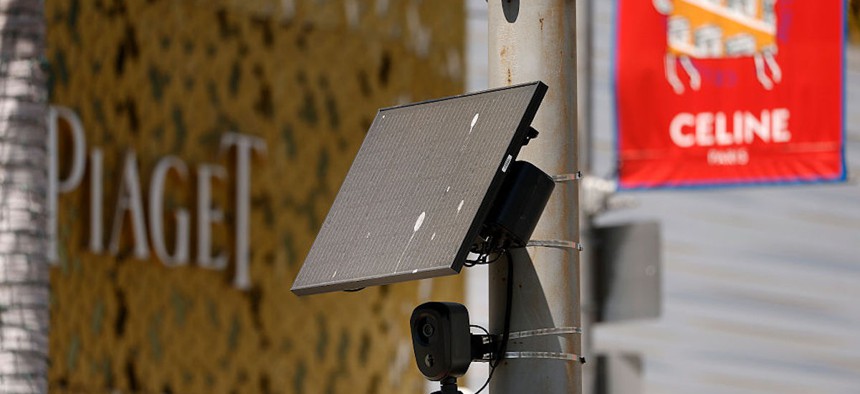
A Flock Safety camera is shown mounted to a light pole on Aug. 3, 2026 in Beverly Hills, California Justin Sullivan/Getty Images





The technology faces nationwide controversy because of concerns around data privacy, shaky oversight and the potential for warrantless searches.
This story was originally published by the Idaho Capital Sun.
On July 6, a crowd in the dozens gathered at a Caldwell City Council meeting. Those who could not find seating lined the back walls, forming a human chain that wrapped around the small office space, faced council members, and continued out the front doors. Expectant, each attendee waited for the meeting to start.
Routine agenda items, from public work updates to contractor presentations, ordered official business. For all intents and purposes, the meeting would be unintrusive.
Not listed among agenda items, yet the cause for much commotion in attendees, was the use by Caldwell Police of Flock Automated License Plate Readers – known as ALPRs.
ALPRs, such as those produced by the Flock corporation, use AI technologies to automatically scan vehicle license plates for information. Police and other law enforcement agencies can then conduct system-wide searches for specific license plates, track suspects or inspect cameras.
The technology faces nationwide controversy because of concerns around data privacy, shaky oversight and the potential for warrantless searches.
“99% of people who are driving around are never pinged on any sort of hotlist, but their information can still be searched,” Saira Hussain, a senior staff attorney at the nonprofit Electronic Frontier Foundation said in an interview with the Idaho capital Sun. “That really is the concern around ALPRs. It is a mass surveillance technology that is being used without a warrant or without suspicion, but it casts a wide net over everybody in the driving public…”
In Idaho, the technology could also be under fire for violations of Idaho Code, given that Senate Bill 1180 passed in 2025 restricted uses for ALPRs, as activists from the DeFlock Idaho group claimed in tort filings against Caldwell and Wilder.
With public pressure mounting locally, the spotlight now falls on state legislators for whom the systems might become a contentious topic come the 2027 Legislative Session.
Idaho cities use cameras statewide
As of July 2026, most major cities across Idaho have signed official contracts for ALPRs with the Flock company.
Caldwell, Twin Falls, Pocatello and Idaho Falls have the largest number of ALPR cameras, according to reports on the community crowdsourced Deflock Maps.
Contracts and agreements between these cities and the company attest to the scale of their deployment. For Caldwell alone, it means at least 10 ALPR cameras and an initial $30,000 per-year-agreement with Flock as of a 2025 city document. Other cities track similar, if not greater, numbers according to Flock transparency portals:
Twin Falls: 40 Flock ALPRs, at least $43,800 per year contract.
Pocatello: 36 Flock ALPRs, at least $10,000 per year contract.
Idaho Falls: 20 Flock ALPRs, at least $40,200 per year contract.
Flock claims ALPR technology helps law enforcement operations by improving intelligence, a claim emphasized in the company’s 2025 “Impact Census.”
Roughly one out of five criminal cases solved in communities where Flock had been deployed, the census claimed, used the ALPR technology.
In practice, police agencies can interact with ALPRs in two main ways: detection and lookups.
When any vehicle drives past an ALPR camera, the system takes a snapshot of the back, registering and briefly analyzing its license plate, car make or model, colors and other apparent characteristics.
If an alert is already tied to that vehicle, such as a wanted person report or car theft, then the system notifies police officers of the suspect traveling past the location.
Police departments can also conduct manual searches, referred to in documentation as “lookups” or “searches,” where officers run a specific license plate through the system.
An officer might, for instance, search the network for a license plate associated with “Drugs/Narcotic” or “Trespassing,” as seen in Flock network audits of the Ada County Sheriff’s Office obtained by DeFlock Idaho through public records requests.
If any ALPR in the network, including those of neighboring law enforcement agencies, captures the vehicle driving by, it sends an automatic notification to officers.
According to Flock, these functions give law enforcement a “force multiplier,” whereby the broad web of cameras can gather intelligence more efficiently and across jurisdictional lines.
‘More time efficiency’ in solving cases
Steven Gassert, lieutenant of the Administrative Services Division for the Twin Falls Police Department, said ALPRs have led to more time efficiency in solving cases locally – even if comprehensive data demonstrating concrete changes in “crime solvability” in Twin Falls post-ALPR implementation does not exist.
“You have your old school cop way of going and knocking on every door and talking to every homeowner to see if they have camera footage,” Gassert said, explaining the impact of ALPRs. “That can be pretty cumbersome for two or three detectives, to go out and contact 30 or 40 different homes or businesses… (with) this ALPR system we can access data rather quickly, eliminating the need to go door-to-door for hours on end.”
Certain cases, Gassert said, would have gone unresolved “had it not been for our ALPR system.”
That really is the concern around ALPRs. It is a mass surveillance technology that is being used without a warrant or without suspicion, but it casts a wide net over everybody in the driving public.– Saira Hussain, senior staff attorney at the nonprofit Electronic Frontier Foundation
He shared the example of a late 2023 investigation solved with the help of ALPR data, after a suspect with a $1 million warrant passed through Twin Falls from California – pinging local cameras.
Twin Falls PD could not arrest the suspect in time, but officers relayed the ALPR information to surrounding agencies that did. Gassert considered the arrest their “first success” with the technology.
Concerns around data privacy, warrantless surveillance
Yet, the trade-off between purported time efficiency and privacy remains a concern for many, as the panopticon-like technology casts a wider net of surveillance than other cameras or security systems employed by law enforcement.
“With a regular camera, if I put one in my house, it’s just recording. I have access to it, and then I have to go back and review if something happens,” Tyler Cain, a lead organizer in DeFlock Idaho said in an interview with the Idaho Capital Sun, comparing ALPRs to regular security cameras. “You have to put some effort or time into actually solving whatever you’re trying to solve, with these ALPRs it creates a permanent record … so they have a very easily searchable record of everywhere that you’ve traveled in the span of 30 to 60 days.”
The Twin Falls and Idaho Falls police departments confirmed to the Idaho Capital Sun that they store data for 30 days, after which the system purges records automatically unless pertinent to a specific investigation. They follow the default settings established by Flock.
For Cain, however, the collection of data itself poses a risk: police agencies, he said, can “replicate pretty much the entirety of someone’s movement.”
That’s because, with enough cameras distributed across a city and passively collecting data, the police would automatically have a record of every license plate passing past ALPR locations.
“If I left my house and drove to Home Depot, there’s a record kept for however long that trip (took), and they know exactly where I went from basically start to finish,” he explained.
Cain also took part in the July 6 Caldwell meeting, which had amassed a considerable crowd because of calls by DeFlock Idaho to attend for public comment – despite a lack of scheduled agenda items related to ALPRs.
“A system where 99.9% of the stored data belongs to private, law-abiding citizens, not criminals, is an unreasonable way to find a needle in a haystack,” Cain said during the meeting.
Behind Cain’s concerns lies a broader challenge to ALPRs which questions their constitutionality, as the long-term collection of passive data could violate the Fourth Amendment of the U.S. Constitution protecting people from unreasonable searches.
When an ALPR camera captures a license plate or car, it also registers additional information like images of drivers or passengers, according to Hussain.
“When it’s collecting all this information, it’s also storing it into a backend database where law enforcement can search either by plate number or by markers of the vehicle,” Hussain said. “And through that search, which happens without a warrant, without any sort of suspicion necessarily, law enforcement is able to locate exactly every instance in which a plate was captured, where and when.”
That means, Hussain added, “it puts everybody, the driving public, under a cloud of suspicion.”
The Electronic Frontier Foundation is engaged in multiple lawsuits challenging the implementation of ALPR systems. One of its most recent against the city of San Jose alleges that, by retaining data for long periods, the technology violates Article 1 of the California Constitution – and the Fourth Amendment – prohibiting warrantless or unreasonable searches.
“A collection of all this information lives in a database, and because of long retention periods, police being able to search the database means they’re able to basically recreate people’s movements,” she said, summarizing the lawsuit and echoing Cain’s concerns. “We believe that constitutes a search; they need to get a warrant in order to do it.”
Gassert, for his part, said he believes in receiving public input on the matter.
Nonetheless, he also said that Twin Falls ALPRs conform and operate “within the bounds of Idaho law,” and that no expectation of privacy exists in such situations.
“We give the example of (how) it would be if you as a citizen stood on the side of the road and took pictures of the license plate of every single car that drove by the front of your house,” Gassert said regarding concerns around warrantless searches. “There’s no expectation of privacy when you’re doing that.”
Compounded by previously reported cases of cybersecurity breaches and immigration searches by law enforcement, the technology leaves many questions unanswered.
Legislation limits use of ALPRs, critics cite violations of code
In Idaho, Senate Bill 1180 passed in 2025 set guidelines for permitted uses of ALPR data by law enforcement or other state agencies.
Codified into Idaho Code § 49-1432, the bill states “data shall not be used for any purpose other than the investigation of felony or misdemeanor crimes or traffic accidents or to search for missing or endangered persons.”
That means neither small traffic infractions, immigration searches nor other administrative lookups constitute a valid search.
In theory, it should limit misuses of the technology by setting guidelines for officers to follow. But activists claim the code falls short of meaningfully preventing wrongdoing or misuse.
DeFlock Idaho’s tort filings against Caldwell and Wilder, for example, show how standard agreements with Flock might include clauses for machine learning and development. Wilder has since amended its agreement for this reason.
Other well-reported cases, like that of a Jerome County sheriff who searched the ALPR system for his wife’s vehicle multiple times, cast doubt on how well the technology may be monitored internally.
Sen. Tammy Nichols, who has been vocal about her opposition to Flock or other ALPR systems, told the Idaho Capital Sun in an email that ALPRs pose a “real risk that it will be used beyond its original purpose.”
“Public safety cannot come at the cost of creating a broad surveillance system that can be abused by those with access to it,” she said. “The Legislature must place privacy, accountability and Fourth Amendment protections first.”
“Idaho law already limits certain uses of Flock/ALPR systems, but stronger action is probably needed,” she added.
Changes could include shorter data retention periods, warrant requirements or banning ALPR cameras altogether, according to Nichols.
Examples of such proposals in action can be found out of state:
Santa Cruz, California; Eugene, Oregon, and 28 other cities across the country have canceled Flock contracts since the beginning of 2025, according to reporting by NPR.
The city of Wilder modified its contract amid scrutiny, and Twin Falls Mayor Jason Brown signaled that opportunities existed to modify or cancel their contract, as reported by Idaho News 6.
But at the state level, and despite almost daily “conversations with Idahoans, organizations, and other Legislators,” Nichols said no official legislative proposal had been decided yet.
It is likely that as the 2027 legislative session begins on Jan. 11, the ALPR controversy may once again rise to the forefront.
Idaho Capital Sun is part of States Newsroom, a nonprofit news network supported by grants and a coalition of donors as a 501c(3) public charity. Idaho Capital Sun maintains editorial independence. Contact Editor Christina Lords for questions: info@idahocapitalsun.com.