
Local Texas leaders believe data center plans may be behind delays to emergency water supply
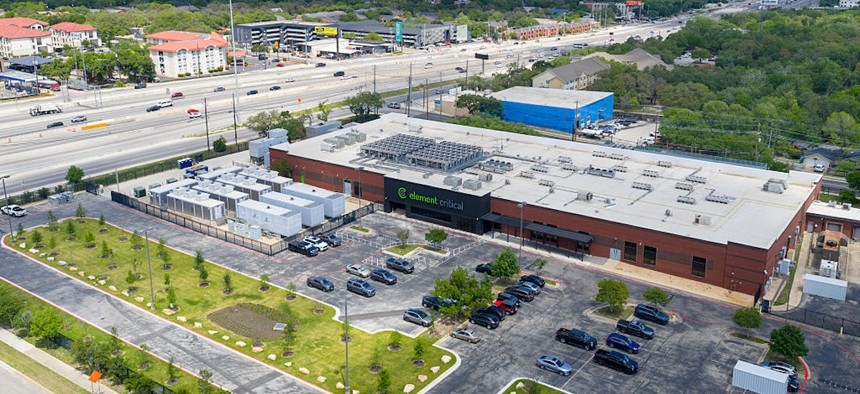
In an aerial view, the Elemental Critical Data Center facility is seen on April 8, 2026, in Austin, Texas. Brandon Bell via Getty Images




Across Texas, a booming buildout of server farms is adding strain to water resources that are already stretched to their limit.
This article originally appeared on Inside Climate News, a nonprofit, non-partisan news organization that covers climate, energy and the environment. Sign up for their newsletter here. This story was produced in partnership by Inside Climate News and the Texas Newsroom, the state’s network of public radio stations.
Corpus Christi needs the groundwater beneath the small town of Sinton so urgently that it’s already laying pipeline, even before it has the permits to start drilling for water.
Sinton, with 5,500 residents about half an hour north, is fighting those permits in court, citing concerns for its own water supply. But leaders in Corpus Christi, which supplies water to half a million people, now suggest an ulterior motive: Sinton wants a thirsty, new complex of data centers.
Officials and executives in Corpus Christi point to recent land deals, well permits and a rezoning ordinance as evidence for the data center plans. Officials in Sinton neither confirm nor deny Corpus Christi’s supposition.
“It is rumors,” said John Hobson, Sinton’s city manager, declining to say whether or not it is true.
Everyone involved in the deal probably signed non-disclosure agreements, said Greg Ellis, an attorney for the San Patricio Groundwater Conservation District, which is based in Sinton and issued the drilling permits in dispute.
“Seems like it’s gotten out anyway,” he said. “I find the rumor very believable.”
Hundreds of data centers are planned in Texas, far more than any other state, according to data from Aterio. These high-powered server farms for artificial intelligence and internet services have provoked furious backlash from communities across the state, fueled in part by concerns over their water consumption.
Many parts of Texas are staring down water supply deficits, but none as pressing as in Corpus Christi, a 500,000-person metro area on the South Texas coast, where reservoirs could dry up next year, unless drought abates. Recent projections suggest the region’s five-year drought could be nearing an end, thanks to a powerful El Niño that could bring heavy rains from the Pacific.
In February, as the region’s main reservoirs dropped below 10 percent full, Sinton challenged permits for Corpus Christi’s emergency Evangeline groundwater project and sent the region on a path towards confrontation.
At a May 5 Corpus Christi City Council meeting, Council Member Eric Cantu said he heard Sinton challenged Corpus Christi’s permits because the town “is going to do a data center.”
“That’s the whole reason,” Cantu said.
On the same day, local construction executive and Corpus Christi planning commission member Michael Miller posted on Facebook: “There is significant evidence that this is true,” describing a series of recent land deals and rezoning in Sinton.
“We should all be focused on solving this water crisis before we entertain adding any large volume users,” Miller wrote.
A week later, Corpus Christi City Manager Peter Zanoni told a city council meeting, “We do know there’s one, maybe a second data center going to Sinton.”
After weeks of swirling hearsay, Sinton has not issued an official statement.
“Try asking the city,” said a receptionist at the chamber of commerce.
“We’re not working on that project,” said a spokesperson for the local economic development corporation.
“I have heard rumors,” said Commissioner Thomas Yardley of San Patricio County, which is seated in Sinton. “I have not heard anything official.”
John Michael, vice president of the engineering firm Hanson Professional Services and a former Sinton city engineer, also believes the data center plans are real. He heard from “very credible sources” that the project was “worth several billion dollars” and could require more than three million gallons per day of water.
Sinton relies on local groundwater and currently uses less than one million gallons per day, Michael said.
“Let’s hold all of our regional system hostage while they wait for their data center,” he said.
Michael, who built Sinton’s current water supply in the 1980s, pointed to an April 21 ordinance by the Sinton City Council that rezoned 1,000 acres of agricultural land—the size of 756 standard American football fields—to industrial.
“No city would ever do that unless somebody needed them to,” Michael said.
Last year, regional power provider AEP acquired a 12-acre adjacent parcel and announced plans to build a substation, and the San Patricio County Groundwater Conservation District issued a drilling permit to the City of Sinton within the newly rezoned tract. (The groundwater district’s general manager, Lonnie Stewart, said he hadn’t heard about any data center.)
“Apparently the city plans to sell groundwater to the data center, so they don’t want the City of Corpus Christi to get the permits they need,” said James Dodson, a former director of the Corpus Christi water department and a retired consultant who worked on Corpus Christi’s groundwater project near Sinton.
Sinton Stymies Emergency Project
Plans for the Evangeline groundwater project have appeared in regional planning documents for decades. They include 22 proposed wells that would pump water from the Evangeline Aquifer into a nearby pipeline, which Corpus Christi currently uses to draw water from Lake Texana, 100 miles away.
Corpus Christi declined to pursue the Evangeline project for years while it focused on developing a seawater desalination plant. Last fall, as drought deepened and desalination plans floundered, Corpus Christi turned back to the Evangeline for an emergency solution.
City leaders said the project could produce 24 million gallons per day by 2027. Corpus Christi provides up to 120 million gallons per day to cities and industries in seven counties, including San Patricio County.
Across Texas, large-scale groundwater import ventures like the Evangeline project are the primary tactic for growing cities seeking to expand water supplies. Such plans almost always spark legal conflicts between the small, local users who depend on their groundwater, and the big-city interests that want to pump it away.
Officials in Corpus Christi say they conducted prior negotiations with Sinton and didn’t expect legal challenges when they applied for drilling permits early this year, anxious to fend off an imminent water crisis. So Corpus Christi began to build the project anyway. City Manager Zanoni called it a “calculated risk.”
There was no time to wait, he said. So the city approved big expenditures and began to truck in pipeline from South Carolina, hopeful that a state administrative law judge would reject Sinton’s petition and greenlight the Evangeline project permits.
But on Friday, Judge Alicia York ruled that Sinton’s challenge could proceed and sent the matter into a litigation process that could last years.
“Sinton stopped negotiating with us on our good-neighbor agreements and has been fighting against our regional water supply project,” Zanoni said in an interview. “Their need for water for a large water user like a data center might best explain their actions.”
Data Center Water Demand Surges Statewide
The rapid buildout of data centers across Texas is poised to transform statewide water demands in coming years, according to a report released this month by the Bureau of Economic Geology at the University of Texas, “Water use requirements for data centers in Texas.”
“While energy consumption has dominated the recent discourses on data centers, water requirements—both direct and indirect—are now recognized as equally critical,” it said. “Particularly in the context of regional water scarcity.”
Researchers estimated statewide data center water demand in Texas could grow from 120 million gallons a day in 2025 to 640 million gallons a day by 2030. Withdrawals could exceed those of mining and livestock, and likely exceed those associated with steam-electric generation.
“This signals a potential shift in the composition of Texas’s water demand portfolio,” the report said.
Large data centers typically use water for cooling their networked computers that run continuously, said Bill Radford, chief technical officer for Duos Edge AI, at a ribbon cutting in downtown Corpus Christi last week. He said the new Duos facility, with a relatively small footprint, doesn’t consume any water because it uses high-powered air conditioning units.
More expansive complexes, Radford said, trickle water through their hardware to remove heat and prevent meltdowns.
“Water goes in, steam comes out,” he said. “It is something that data centers are moving away from, because they understand it. But today it’s still there.”
Radford has also heard rumors of the complex planned in Sinton. However, he cautioned, it might never get built. Half of all proposed data centers in Texas never break ground, he said, typically due to community opposition or limits on resources like power and water.
Neena Satija of the Texas Newsroom contributed to this report.