
In 2026, more data center regulations could be coming in Maryland
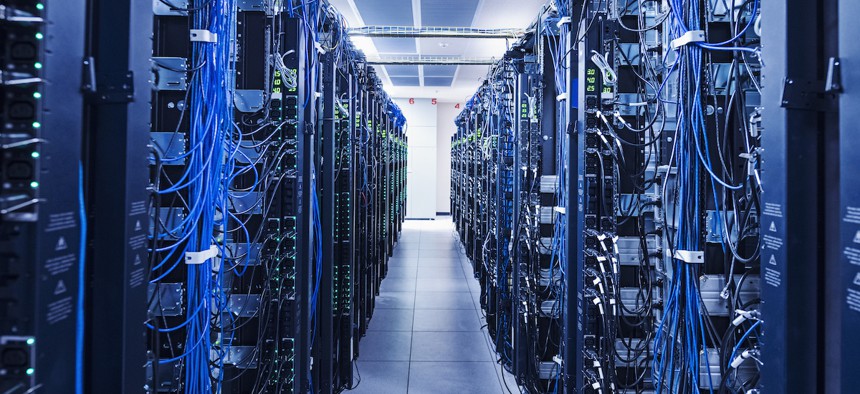
Erik Isakson via Getty Images





It’s likely that large scale data centers, which have a large presence in neighboring Virginia, will make their way to Maryland in greater numbers in the years ahead.
This story was originally published by Maryland Matters.
The proposals seem to be cropping up left and right.
A vacant Social Security building in Baltimore County. A former power plant in Montgomery. An old mall site in Prince George’s. And that’s on top of a data center campus that has long been under development on a former industrial site in Frederick County.
It’s likely that large scale data centers, which have a large presence in neighboring Virginia, will make their way to Maryland in greater numbers in the years ahead. Yet, there isn’t a cohesive statewide policy regulating the arrival of these facilities, which demand immense amounts of energy. Instead, local jurisdictions wield much of the power to approve or deny projects through zoning rules.
“Local governments can make decisions that affect the entire state,” said Dave Arndt, co-chair of the Maryland Legislative Coalition Climate Justice Wing, who focuses on data centers. “If they approve a very large hyperscale data center that requires new transmission lines, new distribution lines and a new substation — and uses the same amount of electricity as the city of Baltimore — that’s going to increase our rates.”
During the coming General Assembly session, data center regulations are likely to draw some interest, as Maryland’s grid operator continues to issue dire warnings about just how much energy they’re projected to demand — and how that could send energy prices soaring ever further.
Perhaps one needn’t look any further than December’s special session, during which lawmakers overrode Gov. Wes Moore’s (D) veto of a study to evaluate data centers’ potential impact on the state, one of several studies the governor rejected.
Speaking from the Senate floor about the study, Sen. Charles Sydnor (D-Baltimore County) said his office learned over the summer about the data center proposal in Woodlawn — in his district — and has been in “fact-finding mode” ever since.
“The experts are adamant that across the country, and here in Maryland, we are currently rushing to approve data center projects through a poorly planned, chaotic process that lacks a foolproof regulatory framework to protect our communities from harm,” Sydnor said.
Sydnor argued that data center projects seem to offer benefits “only for the wealthy,” while the costs “are socialized for everyone else.”
Sen. William G. Folden (R-Frederick), speaking for an override of the governor’s veto, said looming data centers have “a very real impact. Frederick County is the first that has really started to develop our data center platforms, and right now we’re looking at a 2,200-acre parcel.”
Last session, the legislature integrated a few data center regulations in a broader package of energy reforms. For example, one provision required electric utilities to create new rate schedules for large-load customers such as data centers — subject to approval from the Maryland Public Service Commission (PSC).
“It is the intent of the General Assembly that residential retail electric customers in the State should not bear the financial risks associated with large load customers interconnecting to the electric system serving the State,” read the bill, which Moore signed in May.
But it seems clear more rule changes are coming.
For his part, the governor argues that the state should open its doors to data centers — but not without constraints.
“I do not believe in the false choice that oftentimes is being laid out: That it’s either we let Big Tech do whatever they want, and we turn into Northern Virginia, or it’s, don’t allow any type of economic development in the state,” Moore said during a recent news conference. “I don’t think either one of those answers are right.”
In 2024, Moore’s administration proposed a bill exempting data centers’ diesel-powered backup generators from scrutiny by the PSC, which passed.
In his recent remarks, Moore said he envisions a process where state officials work with the impacted community, local officials and environmental groups to determine how data centers considering Maryland can contribute using “best practices,” including by bringing their own power generation along with them.
Data Center Woes at PJM
Under current policies, all electricity ratepayers share the costs of system expansion and maintenance. But there’s a growing push to require very large users to fund the power boosts that they require.
Leaders at PJM Interconnection, the operator of the nation’s largest electric grid, which includes Maryland, Washington, D.C., and a dozen other states, are currently considering a host of possible policy changes related to data centers. They’re expected to make a decision in January, after which the Federal Energy Regulatory Commission gets to make the final call.
A proposal from state governors, including Moore, called for PJM to provide incentives for data centers to bring their own power generation. A proposal from state lawmakers, including several Marylanders, would require PJM to curtail power to data centers in emergencies if they do not bring their own generation.
The need for regulatory change appears dire. At its energy capacity auction in December, PJM failed to procure all of the energy that it deemed necessary for the 2027-2028 delivery year — and the projected demand from data centers was largely to blame.
The shortfall doesn’t mean that the grid won’t be able to serve customers during the delivery year. But PJM aims to have a 20% reserve margin for power system emergencies, and it only secured 14.8%.
The shortage happened because PJM projections show there will be an increase of nearly 5,100 megawatts worth of data center demand for those years, though there is worry that the demand is being over-counted as data centers talk to multiple power companies about the same project.
PJM officials are optimistic that their policy changes could reduce the shortfall by lowering the projected toll of data centers.
“There are factors here that lead us to believe that we will actually be closer to the … standard once the delivery year arrives, because of things that we expect to change between now and 2027,” said Stu Bressler, executive vice president of market services and strategy at PJM.
Maryland Isn’t ‘Negotiating With an Empty Hand’
At the same time, Maryland is eyeing policy changes of its own.
Sen. Katie Fry Hester (D-Howard and Montgomery), said she is working on a bill that would require all data centers of a certain size to receive a certificate to operate from the PSC.
She argues that the bill would provide a new layer of state scrutiny focused on energy usage, going beyond the current permitting regime at the Maryland Department of the Environment, which is more focused on emissions and site conditions. But it would also create a state-level repository of data center proposals, making it easier to keep track of proposals.
“It’s basically a transparency bill, so that we’ll have everything in one place at the state,” Hester said.
Del. Lorig Charkoudian (D-Montgomery) said she is crafting a bill that would encourage data centers to curtail their power usage during peak periods, such as hot days, when the electrical system is taxed by heavy usage of air conditioners. The electrical system is built around withstanding the peaks, Charkoudian said, even though most of the year, the system is far from maxed out.
“I’m really focused on: When data centers are coming online in Maryland, how can they be part of the solution for the 100 hours a year where their presence is going to lead to driving up costs?” Charkoudian said.
Data centers could reduce their usage by moving particular work to non-peak periods, or pre-cooling their equipment to avoid cooling during the hottest time of the day, when the grid will be most taxed, Charkoudian said.
Charkoudian said her bill will also incentivize data centers to build battery energy storage facilities in their areas, so that they could turn to stored power during peak periods.
Arndt from the Climate Justice Wing called Charkoudian’s bill a “win-win-win situation.”
“They [data centers] stay operational. The grid stays operational. We win because we don’t have to build new peaker plants,” Arndt said, referring to plants that are called on in peak demand periods.
But it’s important that the bill continue to ensure that data centers use clean backup power during peak periods, rather than relying on fossil fuel backup generators, Arndt cautioned.
“We don’t want diesel generators running for four hours in a community just because we’re running low on energy.” Arndt said.
Angie McCarthy, Maryland conservation advocate at Nature Forward, said her group supports Charkoudian’s bill, though she knows it won’t come without controversy. She expects data center players to argue that onerous regulations could cause data centers to seek sites in nearby states such as Pennsylvania and Ohio, rather than Maryland.
“From our perspective, Maryland is seen as a prime spot for data center development, because we have such access to the fiber-optic cables and other infrastructure that Virginia has installed in their state,” McCarthy said. “We aren’t negotiating with an empty hand.”
The Maryland Tech Council, a trade association representing technology companies, has focused much of its recent messaging on the economic boost that data centers can bring to the state.
A typical 800,000 square foot data center produces about 5,000 jobs during construction, along with $775 million in economic activity and $18 million in state tax revenue, according to a Tech Council report issued in August. During operation, a typical facility spurs 500 permanent jobs, $31 million in annual compensation and $14 million in annual state tax revenue, according to the study, conducted by the Sage Policy Group, a Baltimore-based firm led by economist Anirban Basu.
In a more recent report, the Tech Council zeroed in on Prince George’s County, arguing that a “mid-sized” data center development would generate over $1 billion in economic activity during construction, and $20 million in annual tax revenue for the county.
“As other states aggressively compete for data center investment, Maryland cannot afford to sit on the sidelines,” reads the August report. “By welcoming responsible data center development, Maryland can address its immediate fiscal and economic challenges while positioning itself as a leader in the digital economy for decades to come. The time to act is now; before this opportunity, like so many others, migrates to neighboring states with more favorable business environments.”
Maryland Matters is part of States Newsroom, a nonprofit news network supported by grants and a coalition of donors as a 501c(3) public charity. Maryland Matters maintains editorial independence. Contact Editor Steve Crane for questions: editor@marylandmatters.org.