
Lack of broadband service, funding gives rise to telehealth services in rural clinics
Ekaterina Goncharova via Getty Images




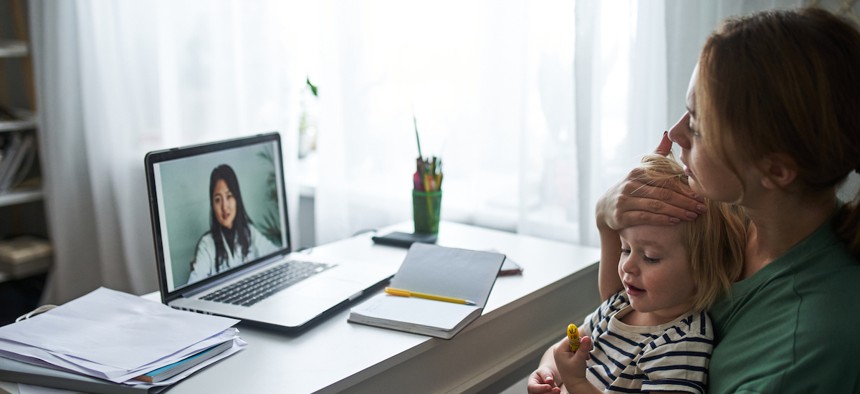
Clinics with better internet connections are now offering telehealth services to patients who can’t do it from their homes.
This article first appeared on The Texas Tribune.
LUBBOCK — The Davis Mountain Clinic is not your typical rural medical clinic. It doesn’t have windows or a big waiting room, and there aren’t teams of physicians and nurses waiting on patients.
Instead, there’s one nurse, Carol Brewer, who connects patients to psychologists and physicians online. What’s even more remarkable is where Brewer runs the clinic — a renovated shipping container.
“It saves them time and the expense of traveling,” Brewer said. “They don’t have to travel 30 miles to the closest clinic, or get an appointment two weeks later. They are more likely to drop in, as opposed to delaying care.”
A lack of funding and the struggle to expand broadband into rural communities has pushed some healthcare providers to use more creative tactics to bring healthcare services to the areas that need it.
Brewer’s telehealth clinic in Fort Davis, a town with less than 900 residents, is just one example of how two organizations — in this case rival schools Texas Tech University Health Sciences Center and Texas A&M University — worked together to renovate and establish a telehealth clinic to bring much-needed healthcare services to rural Texas.
For years, telehealth has been looked at as the next frontier in healthcare, particularly in rural communities. Some say it couldn’t come at a better time as inflation continues to drive up gas prices and the cost of car repairs. And Texas leads the nation in rural hospital closures due to high operating costs and not having enough patients to bring money in.
Lawmakers have noticed the problem. In June, Gov. Greg Abbott announced the Texas Health and Human Services Commission made $10 million in grant funding available for eligible rural hospitals and health clinics to provide pediatric telehealth.
People in the medical field say funding for telehealth, or virtual care, is desperately needed to close the gaps in rural healthcare. According to Texas Health and Human Services, as of 2024, 143 counties in Texas lack a practicing pediatrician and only 4,899 pediatricians provide direct care to patients. It’s a big problem in West Texas, where Brewer’s clinic is. Nearly 82% of counties in the region did not have a pediatrician in 2024.
The Davis Mountain Clinic is set up for both physical and virtual care, but primarily serves as a conduit for residents who don’t have internet access. On the left side of the clinic is a telehealth camera to connect with physicians from Texas Tech’s Health Sciences Center. On the right is another telehealth camera to connect patients to counseling services provided by Texas A&M’s Telehealth Institute.
The land is owned by the county, so the clinic doesn’t have to pay rent or for utilities. However, they do pay for the internet services and other supplies that are needed. The clinic doesn’t accept insurance and charges a $30 flat fee for patients. Patients are not charged for routine or minor care that Brewer can take care of, such as administering wound care or showing newly diagnosed diabetics how to use glucometers.
Another retrofitted container clinic from the universities opened this summer in the small town of Burton, nearly 85 miles east of Austin. Adrian Billings, the chair for rural health at Texas Tech Health Sciences Center, said there are about 40 other counties in the state they want to launch the collaboration in. They have to find the funding first.
“The goal is to have some sort of healthcare access point in all 254 of our counties,” Billings said. “Telehealth is a very important piece of healthcare, especially for our rural communities.”
Billings is also a physician with Preventative Care Health Services, serving the rural West Texas communities of Alpine, Marfa and Presidio. He said the healthcare workforce is mostly found in urban areas, so telehealth clinics give them access to those physicians. While he believes every patient should have the opportunity to shake their physician’s hand, Billings said rural communities still need healthcare even if it’s not physically available.
“I firmly believe that we can’t give up on development of the rural healthcare workforce to be there in person, especially for urgent situations like childbirth and emergency care,” Billings said. “It will still be an access point for a rural patient.”
Billings said broadband access in the Big Bend region has improved over the last 20 years. However, he said there are still dark spots where people don’t have access or can’t afford it, or don’t even have a smartphone to use internet service. That’s where telehealth clinics come into the picture, Billings said.
“Whether it be a library or a container clinic, it’s important because patients don’t have to pay for that Wi-Fi and the infrastructure needed for telehealth,” Billings said. “I think if we can begin in places that do have it, maybe it will be easier for patients who live outside of broadband access to travel fewer miles where there is access.”
Despite its struggle with expanding broadband services in rural areas, Texas has made progress over the years. The state’s broadband map shows most of the state has at least 75% or more served. Most rural hospitals in the state all have broadband for quick access to physicians, radiologists and specialists. Zoom calls can now include digital tools, such as a stethoscope, to make examinations more robust.
Despite the expansion of broadband in rural areas, some counties still lack reliable internet service, such as Wheeler in the Panhandle, where nearly 2,000 residents still don’t have service. Patients all over the state — both in-person and virtual — need a connection to the internet to access records. But access largely comes down to where someone lives and if they can afford internet service.
“If you don’t have access to the internet, you can’t get to your patient portal, get your lab results, you can’t go online and schedule an appointment,” said Nora Cox, CEO and founder of Texas e-Health Alliance. “There’s so many things missing if you don’t have connectivity.”
Cox said broadband, which provides high-speed access to the internet, has gotten better in some ways. However, she said there are still pockets of consumers who either don’t have internet or don’t use a smartphone, and they need to be taken care of better.
“If you are lower income and using a track phone with limited minutes, what happens if you run out in the middle of talking to your doctor?” Cox said. “We tend to think everyone has an iPhone, but it’s a problem when all people have is a track phone from Walmart.”
Thomas Kim, a psychiatrist who has been working on telehealth development for the last 20 years, said expanding pediatric telehealth with the grant is beneficial, but also misses the point.
“I think in telehealth, we should move away from this idea that a single grant should target a specific-use case because that’s not really sustainable,” Kim said.
Kim said grant funding should be used to support areas with proven success in the field, such as the Texas Child Health Access Through Telemedicine, or TCHATT, at Texas Tech’s Health Sciences Center. The program is in collaboration with more than 200 independent school districts across Texas, and connects pre-K through 12th grade students with free mental health services.
“It’s something I hope gets their slice of this most recent investment because we’re in trouble,” Kim said. “The healthcare crisis is real in so many ways. It would be nice if we took seriously the fundamental flaws we have in the financing and delivery system.”
Cynthia Jumper, executive vice president for health policy and strategic initiatives at Texas Tech’s Health Sciences Center, said she would like to see telehealth expand into more healthcare fields. Telehealth has expanded into practices such as psychiatry and mental health counseling, ophthalmology, even dentistry to an extent.
“There are many ways to use this, and we continue to push that limit in order to get care where it needs to be provided,” Jumper said. “Not everybody’s in a city with a level one trauma center, so trying to get more care to the patient where they are is really how telehealth is working.”
In 2021, the Texas Legislature put $150 million in grant funding toward the Next-Gen 911 program. This allowed another expansion into telehealth, Jumper said, where paramedics can also use telehealth equipment in the back of ambulances. If a paramedic thinks the patient can be treated in the ambulance instead of enduring a long drive, then they will be able to connect a camera to a physician to walk them through treatment.
“We are doing that to try and prevent emergency room visits which are costly,” Jumper said.
As far as the Davis Mountain Clinic, the community has welcomed Brewer and the clinic with open arms. Brewer calls it old frontier medicine. People bring her plants, snacks — someone even made her a quilt that is displayed in the clinic. In the more than 30 years of her career, Brewer said it’s the best job she’s had.
Brewer said the clinic plans to expand its services to other rural communities. This fall, they are hoping to use the community center in Valentine, a town of about 70 people 40 miles west of Fort Davis, a few times a month for patients in the area. The clinic might also have a Texas Tech healthcare student serve as a physician’s assistant later this year.
“This clinic is serving in part as a model for future clinics they’re planning,” Brewer said. “And the convenience of having access has been crucial for people out here.”
Disclosure: Cynthia Jumper, Texas A&M University and Texas Tech University Health Sciences Center have been financial supporters of The Texas Tribune, a nonprofit, nonpartisan news organization that is funded in part by donations from members, foundations and corporate sponsors. Financial supporters play no role in The Texas Tribune's journalism. Find a complete list of them here.
