Rural Americans wait after judge delivers mixed ruling on digital equity dollars

Grant Faint via Getty Images


A split decision has halted digital-skills programs for ethnic and racial minorities.

This article first appeared on KFF Health News and is republished here under a Creative Commons Attribution-NonCommercial-NoDerivatives 4.0 International License.

A federal judge in July gave digital equity advocates a partial victory against President Donald Trump, stopping his attempt to unilaterally kill a multibillion-dollar grant program Congress created.

But U.S. District Judge John D. Bates, in a 35-page opinion, also agreed with the administration that it was unconstitutional for the government to use race or ethnicity as the basis to award money under a program created to expand internet skills and access.

“It was definitely disappointing,” said Angela Siefer, executive director of the National Digital Inclusion Alliance, a nonprofit that filed suit last year after not receiving a nearly $26 million award meant to bolster digital and internet skills nationwide. “With this administration it’s really worrisome.”

Congress passed the $2.75 billion Digital Equity Act in 2021 as the skill development component of a multilayered “Internet for All” initiative under President Joe Biden’s signature infrastructure law, which included a bigger pot of money for expanding internet infrastructure.

A few months into his second term, Trump directly attacked the Digital Equity Act on social media, pledging “no more woke handouts” and calling the program “illegal.” The language echoed two Trump executive orders characterizing diversity, equity, and inclusion programs as illegal.

The National Telecommunications and Information Administration, which oversees implementation of the law, responded by abruptly halting Digital Equity Act grant programs, leaving states and organizations like the National Digital Inclusion Alliance in limbo.
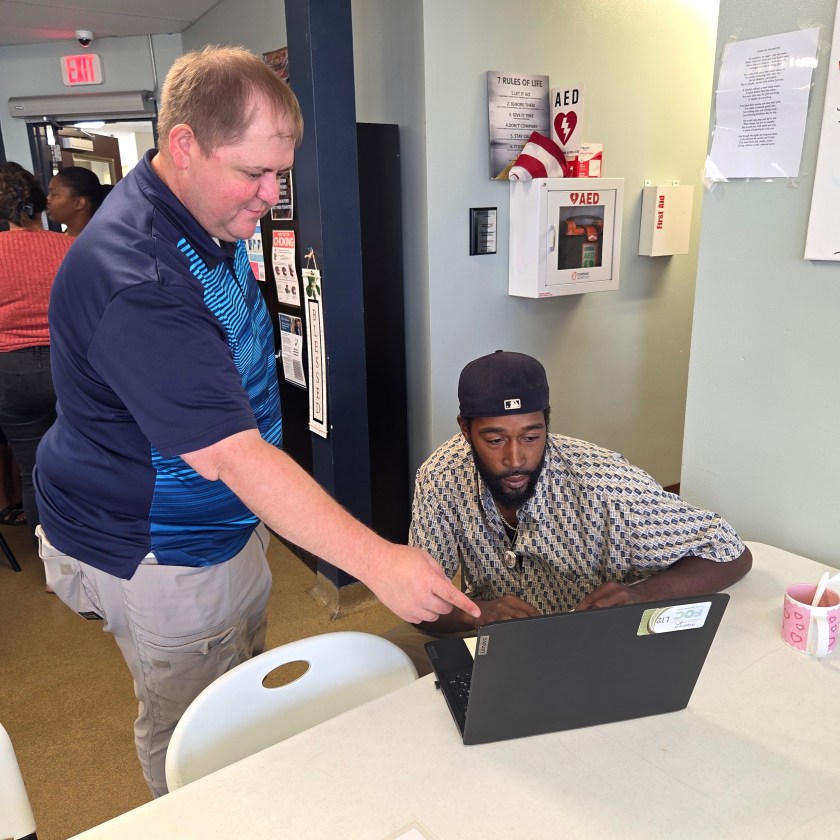
Joe Burgei (left) helps Shaunta Harris Jr. with an online digital literacy course at a soup kitchen and homeless shelter in Defiance, Ohio. Burgei is a grant-funded digital navigator for the Northwestern Ohio Community Action Commission, which operates the shelter. (Northwestern Ohio Community Action Commission)

In response to Bates’ decision, federal attorneys said the government would reinstate the NDIA-related competitive grant program without racial classification. The government aims to release a new grant application in December, according to a joint status report filed in the case.

The NDIA now must reapply for the grant award, which was slated to be disbursed among more than a dozen organizations and tribes, including the Cherokee Nation in Oklahoma, El Centro Hispano in Arkansas, Portland Community College in Oregon, and Community Service Programs of West Alabama. The grants are meant to go toward digital navigator programs, in which community workers teach technology and internet skills, according to the NDIA.

In western Ohio, Jamie Huber said her organization was a subrecipient of the NDIA grant funds. Huber, director of community services at the Northwestern Ohio Community Action Commission, said that without the funding, she is left searching for money to continue navigator programs such as one she runs for people who are unemployed, homeless, or both.

“How do you find a home? Well, you got to look online. And how do you find a job? You have to look online,” Huber said.

Huber’s digital navigators also teach internet skills at 10 senior centers in rural counties stretching along the corner of Ohio bordering Michigan and Indiana. They help active older adults learn how to go online to pay bills and get healthcare, so they “continue having agency over their own life,” Huber said.

Rural residents live sicker and die younger on average than people in the rest of the country when they live in counties lacking high-speed internet access and healthcare, an analysis by KFF Health News found.

At Computer Reach in western Pennsylvania, Executive Director Dave Sevick said his organization has cut staff and programs. He said the nonprofit, which started in 2001, has refurbished more than 24,000 computers, giving them away to families it finds through schools and churches.

“We’re aware that affordability is the biggest issue around, and this doesn’t make it any better for folks,” Sevick said. “We’re helping a little bit by getting a free computer out to people.”

The Digital Equity Act lists exactly whom the money should benefit, including low-income households, older people, some incarcerated people, rural Americans, veterans, and members of racial or ethnic minority groups.

According to 2025 polling by the Pew Research Center, people in rural communities were less likely to have internet subscriptions compared with their urban and suburban counterparts.

The Pew Research polling also revealed that home broadband use among Black and Hispanic adults lagged that of white and Asian adults. While 81% of white adults surveyed said they subscribed to broadband at home, only 71% of Black adults and 68% of Hispanic adults said the same.

A group of people sit at tables facing a speaker at the front of the room in an educational setting.
Megan Hahn teaches class attendees how to use an online health portal at the Swanton Senior Center in Swanton, Ohio. Hahn is a digital navigator with the Northwestern Ohio Community Action Commission. The group’s work is supported by local, state, and federal grants. (Northwestern Ohio Community Action Commission)

In court, lead federal attorney Patrick Butler argued that Congress failed to prove a compelling government interest when including the racial or ethnic criteria. Congress did not “identify anything close to” a specific instance of discrimination in the broadband industry, Butler said, according to the transcript.

Butler then surprised the court, saying that if the racial or ethnic status could be severed from the law, “we would obviously apply the grant program without considering race.”

In his opinion severing the race factor, Bates wrote that the court agreed that “the President lacks the power to cancel laws passed by Congress based on his bald disagreement with Congress’s policy determinations.”

Sen. Patty Murray (D-Wash.), a primary sponsor of the law, said she will be “watching very carefully to ensure this administration does what Congress intended.”

“It is indisputable that these challenges are particularly pronounced in low income, rural, and Tribal communities — and there’s a reason Democrats and Republicans across the country support this program so strongly,” Murray said in a statement to KFF Health News. 

Sen. Ted Cruz (R-Texas) voted against Biden’s infrastructure bill in 2021 and sent a letter to the National Telecommunications and Information Administration in late 2024 asking the agency to pause the $1.25 billion competitive grants program, arguing the use of racial classifications “does not serve a compelling governmental interest.” Cruz did not respond to requests for comment.

Arielle Roth, administrator of the agency, previously worked as the telecommunications policy director for the Senate Commerce, Science, and Transportation Committee’s majority staff under Cruz. She was appointed by Trump to lead the agency.

Two men sit side by side at a table. The man on the viewer's right smiles in the direction of the photographer.
Burgei gives Paul Helbling (right) tips for using his smartphone during a session at the Henry County Senior Center in Napoleon, Ohio. Burgei’s job as a digital navigator has been supported by local, state, and federal grants. (Northwestern Ohio Community Action Commission)

In June, during a House committee hearing, Roth had tense exchanges with Democrats who took issue with changes to the Biden-era infrastructure law’s internet deployment program, which now allows more satellite services rather than prioritizing fiber-optic cable lines.

Lawmakers also asked about the Digital Equity Act’s grant programs.

“Communities across the country deserve a clear answer and a path forward,” Rep. Nanette Barragán (D-Calif.) said during the hearing. While the National Digital Inclusion Alliance’s lawsuit does not include the state grants, Barragán asked how those grants would be rolled out, considering the federal judge’s decision on race.

California was awarded a $70 million state capacity grant. Early this year, the Justice Department sent a letter to Congress asserting that the state grant and the competitive grant program both are illegally based on race, citing the Supreme Court’s decision invalidating affirmative action in higher education admissions. Roth declined to answer Barragán’s question, noting there is active litigation.

Barragán said she was “extremely” frustrated by “some of the responses or nonresponses.”

Stephen Yusko, a spokesperson with the National Telecommunications and Information Administration, declined to comment or respond to questions for this article.

The government and the National Digital Inclusion Alliance agreed to pause court proceedings to give the agency time to reinstate the competitive grant program. The NDIA has also proposed that the agency provide status reports every 30 days during the court pause “to ensure prompt attention to reinstatement,” according to the most recent court filing.

“We need to make sure it’s all moving forward,” Siefer said.

KFF Health News is a national newsroom that produces in-depth journalism about health issues and is one of the core operating programs at KFF—an independent source of health policy research, polling, and journalism. Learn more about KFF.

X
This website uses cookies to enhance user experience and to analyze performance and traffic on our website. We also share information about your use of our site with our social media, advertising and analytics partners. Learn More / Do Not Sell My Personal Information
Accept Cookies
X
Cookie Preferences Cookie List

Do Not Sell My Personal Information

When you visit our website, we store cookies on your browser to collect information. The information collected might relate to you, your preferences or your device, and is mostly used to make the site work as you expect it to and to provide a more personalized web experience. However, you can choose not to allow certain types of cookies, which may impact your experience of the site and the services we are able to offer. Click on the different category headings to find out more and change our default settings according to your preference. You cannot opt-out of our First Party Strictly Necessary Cookies as they are deployed in order to ensure the proper functioning of our website (such as prompting the cookie banner and remembering your settings, to log into your account, to redirect you when you log out, etc.). For more information about the First and Third Party Cookies used please follow this link.

Allow All Cookies

Manage Consent Preferences

Strictly Necessary Cookies - Always Active

We do not allow you to opt-out of our certain cookies, as they are necessary to ensure the proper functioning of our website (such as prompting our cookie banner and remembering your privacy choices) and/or to monitor site performance. These cookies are not used in a way that constitutes a “sale” of your data under the CCPA. You can set your browser to block or alert you about these cookies, but some parts of the site will not work as intended if you do so. You can usually find these settings in the Options or Preferences menu of your browser. Visit www.allaboutcookies.org to learn more.

Sale of Personal Data, Targeting & Social Media Cookies

Under the California Consumer Privacy Act, you have the right to opt-out of the sale of your personal information to third parties. These cookies collect information for analytics and to personalize your experience with targeted ads. You may exercise your right to opt out of the sale of personal information by using this toggle switch. If you opt out we will not be able to offer you personalised ads and will not hand over your personal information to any third parties. Additionally, you may contact our legal department for further clarification about your rights as a California consumer by using this Exercise My Rights link

If you have enabled privacy controls on your browser (such as a plugin), we have to take that as a valid request to opt-out. Therefore we would not be able to track your activity through the web. This may affect our ability to personalize ads according to your preferences.

Targeting cookies may be set through our site by our advertising partners. They may be used by those companies to build a profile of your interests and show you relevant adverts on other sites. They do not store directly personal information, but are based on uniquely identifying your browser and internet device. If you do not allow these cookies, you will experience less targeted advertising.

Social media cookies are set by a range of social media services that we have added to the site to enable you to share our content with your friends and networks. They are capable of tracking your browser across other sites and building up a profile of your interests. This may impact the content and messages you see on other websites you visit. If you do not allow these cookies you may not be able to use or see these sharing tools.

If you want to opt out of all of our lead reports and lists, please submit a privacy request at our Do Not Sell page.

Save Settings
Cookie Preferences Cookie List

Cookie List

A cookie is a small piece of data (text file) that a website – when visited by a user – asks your browser to store on your device in order to remember information about you, such as your language preference or login information. Those cookies are set by us and called first-party cookies. We also use third-party cookies – which are cookies from a domain different than the domain of the website you are visiting – for our advertising and marketing efforts. More specifically, we use cookies and other tracking technologies for the following purposes:

Strictly Necessary Cookies

We do not allow you to opt-out of our certain cookies, as they are necessary to ensure the proper functioning of our website (such as prompting our cookie banner and remembering your privacy choices) and/or to monitor site performance. These cookies are not used in a way that constitutes a “sale” of your data under the CCPA. You can set your browser to block or alert you about these cookies, but some parts of the site will not work as intended if you do so. You can usually find these settings in the Options or Preferences menu of your browser. Visit www.allaboutcookies.org to learn more.

Functional Cookies

We do not allow you to opt-out of our certain cookies, as they are necessary to ensure the proper functioning of our website (such as prompting our cookie banner and remembering your privacy choices) and/or to monitor site performance. These cookies are not used in a way that constitutes a “sale” of your data under the CCPA. You can set your browser to block or alert you about these cookies, but some parts of the site will not work as intended if you do so. You can usually find these settings in the Options or Preferences menu of your browser. Visit www.allaboutcookies.org to learn more.

Performance Cookies

We do not allow you to opt-out of our certain cookies, as they are necessary to ensure the proper functioning of our website (such as prompting our cookie banner and remembering your privacy choices) and/or to monitor site performance. These cookies are not used in a way that constitutes a “sale” of your data under the CCPA. You can set your browser to block or alert you about these cookies, but some parts of the site will not work as intended if you do so. You can usually find these settings in the Options or Preferences menu of your browser. Visit www.allaboutcookies.org to learn more.

Sale of Personal Data

We also use cookies to personalize your experience on our websites, including by determining the most relevant content and advertisements to show you, and to monitor site traffic and performance, so that we may improve our websites and your experience. You may opt out of our use of such cookies (and the associated “sale” of your Personal Information) by using this toggle switch. You will still see some advertising, regardless of your selection. Because we do not track you across different devices, browsers and GEMG properties, your selection will take effect only on this browser, this device and this website.

Social Media Cookies

We also use cookies to personalize your experience on our websites, including by determining the most relevant content and advertisements to show you, and to monitor site traffic and performance, so that we may improve our websites and your experience. You may opt out of our use of such cookies (and the associated “sale” of your Personal Information) by using this toggle switch. You will still see some advertising, regardless of your selection. Because we do not track you across different devices, browsers and GEMG properties, your selection will take effect only on this browser, this device and this website.

Targeting Cookies

We also use cookies to personalize your experience on our websites, including by determining the most relevant content and advertisements to show you, and to monitor site traffic and performance, so that we may improve our websites and your experience. You may opt out of our use of such cookies (and the associated “sale” of your Personal Information) by using this toggle switch. You will still see some advertising, regardless of your selection. Because we do not track you across different devices, browsers and GEMG properties, your selection will take effect only on this browser, this device and this website.