Fears about kids’ online safety unite Democrats and Republicans
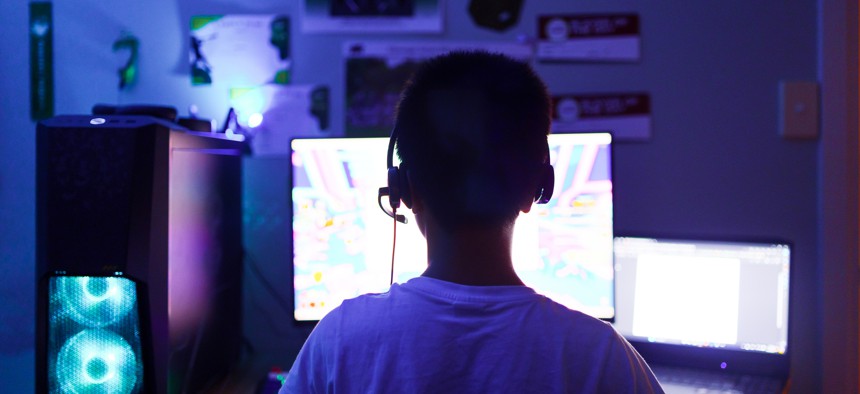
Nazar Abbas Photography via Getty Images



Amid a decline in youth mental health, momentum builds for a federal crackdown on social media companies over protections for kids.
This article was originally published by KFF Health News.
The U.S. Senate candidates in Texas could hardly be more different: James Talarico, a former seminarian turned Democratic state lawmaker who speaks in calm cadences about love and empathy, and Ken Paxton, the pugnacious Republican state attorney general who speaks about a refusal to compromise.
They share an enemy, though. They dislike social media’s effects on children’s mental health. Talarico, who did not respond to a request for comment, has endorsed a social media ban for kids under 16, while denouncing “predatory algorithms that divide us on an hourly, daily basis.” As a legislator, he co-authored a bill targeting explicit deepfakes — digital imitations of individuals that are often made or manipulated by artificial intelligence and used for harassment on social media.
Paxton has been suing Big Tech, alleging the companies hook youth on their apps or don’t restrict sensitive videos from being viewed by kids. “When elected to the U.S. Senate, he will continue his proven record of advancing policies that protect children online, strengthen parental rights, and hold Big Tech accountable when it breaks the law,” Paxton campaign spokesperson Madison Cercy said in a statement to KFF Health News.
Youth mental health is in decline. Even as researchers explore what’s causing the problem, momentum is gathering among policymakers from both parties to crack down on social media companies. Several major companies are being sued, investigated, and, soon, potentially regulated. That they may be harming kids’ mental health is a key reason.
Companies are starting to feel the bite. In late August, the social media conglomerate Meta reached a $17 billion settlement with a coalition of 48 states, the District of Columbia, and three territories and promised to change its policies and settings to protect children. Meta immediately took out advertisements in major newspapers, pressuring its competitors to adopt similar guardrails. Children’s health advocates want to go further, with federal legislation.
Indeed, at least 35 nominees for the U.S. Senate this year have sponsored bills to curb social media, initiated investigations, or publicly lambasted Big Tech firms that, in their telling, have exploited teens and kids.
“We’re protecting our children, not those profiting off their online presence,” Juliana Stratton, the Democratic lieutenant governor and Senate candidate in Illinois, posted in June, trumpeting state legislation.
Congress is edging closer to passing the Kids Online Safety Act, the vanguard social media regulation bill. The bill would require social media companies to implement various safeguards, such as limiting users’ ability to communicate with minors. One attempt to pass a version of the bill earned 91 yes votes in the Senate. Donald Trump Jr., the president’s son, tweeted in December 2024 that the bill needed to be passed “ASAP.”
Amid the momentum toward new federal regulations, Big Tech companies are lobbying for their preferred policy. Apple supports the bill, a spokesperson told KFF Health News, while Meta, which owns Facebook and Instagram, has spent $10 million on television advertising touting its teen accounts.
“Any youth safety legislation must put parents in the driver’s seat — blanket social media bans do not do that,” said Meta spokesperson Ed Patterson, who argued blanket bans push youths onto less safe platforms. “We support legislation that empowers parents — not the government — to approve the apps their teens can download from the App Store.”
Meta and other industry groups are scrambling to shape regulations for social media, and tech in general. The Wall Street Journal reported Meta also gave some $10 million to a President Donald Trump-aligned campaign nonprofit, Securing American Greatness. Based on a KFF Health News search of the Senate’s lobbying database, about 70 corporations, trade groups, nonprofits, and other groups have been lobbying senators about the bill.
According to The Washington Post, the Trump administration has tried to tie the online safety bill to other parts of its AI agenda, which includes legislation that would make it harder to regulate the technology at the state level. The White House did not respond to requests for comment.
The public’s views of major tech firms are souring. In 2024, the Pew Research Center found 78% of Americans said tech companies had too much influence in politics, while 64% said social media had a mostly negative effect on the country.
A widespread movement encompassing much of the public health establishment, parents’ groups, attorneys general, and whistleblowers is calling for greater regulation, as parts of the tech industry fight back by spending big on lobbying and marketing.
“You have the whole industry and all their lobbying dollars,” said Allison Ivie, chief policy officer at the Eating Disorders Coalition. Many experts believe that social media, by showing kids images of unrealistically thin peers and by amplifying content encouraging extreme diets, helps fuel eating disorders. “It’s not a balanced fight by any means,” Ivie said of the lobbying muscle. “How do you compete against that on any given day?”
Growing Up Online, Breaking Down Offline
According to 2025 data from the Centers for Disease Control and Prevention, a third of youth have persistent feelings of sadness or hopelessness — about 10% more than a decade earlier. But many researchers question whether social media is causing the trouble. (Other metrics tracked by the agency show improvement.)
“The science is crude and messy,” said Sandro Galea, dean of public health at Washington University in St. Louis, who previously chaired a National Academy of Sciences report on the effects of social media on kids’ mental health. Academics and researchers have proposed a wide variety of causes for the crisis, like changes in the economy, decreasing social connections, access to firearms, and the pandemic.
Despite the uncertainty, much of the public health establishment is massing against social media. In early September, the Department of Health and Human Services hosted a three-hour event advising parents and children to live life off-screen. It’s only the latest in a series of warnings from the U.S. surgeon general’s office — under both the Biden and Trump administrations — about these technologies.
“The evidence keeps building on the real and potential dangers of unregulated access for children,” Jerome Adams, Trump’s first surgeon general, told KFF Health News. These include, he said, “serious risks like higher rates of anxiety, depression, sleep problems, and developmental concerns. Kids spending too much time on these platforms face real challenges during key stages of growth.”
The policy backlash against social media has extended worldwide. The United Kingdom and Australia recently banned social media for kids under 16. The European Union has threatened Meta with a potential fine, up to 6% of revenue, for pushing “addictive designs” in a breach of the confederation’s regulations.
Besides the $17 billion settlement with Meta, other lawsuits in the United States have targeted Snapchat, owned by Snap, and TikTok, a short-video app owned by a consortium of American and Chinese companies. A school district in Kentucky won a $27 million settlement from social media companies; 1,000 more districts, including in Los Angeles, have filed their own class-action suits, citing alleged addictive effects on youth, among other harms.
Coalitions of state attorneys general, including Paxton, have sued Big Tech companies, in some cases winning settlements related to allegations of mental health harm and addiction. In early August, Meta was ordered to pay nearly $950 million after a New Mexico state court found it to be a “significant contributing factor to the current mental health crisis.” This preceded the multibillion-dollar settlement.
And a broad base of companies are feeling effects from the government and civil suits. The online gaming company Roblox disclosed paying $91 million in legal settlements, including expenses targeting “youth-related consumer protection and digital safety matters,” in the first half of 2026. YouTube, the video hosting website, itself settled multiple youth-related cases this year.
Taking Big Tech to Task
Yet the push in Congress has garnered much of the attention. Congressional committees on occasion have summoned tech company executives — sometimes with a friendly ear, but more often to berate them.
Accompanying the push for legislation are ongoing investigations, many of which collect testimony from whistleblowers. In 2025, Sarah Wynn-Williams — a former United Nations diplomat who later joined Meta — testified before the Senate about the company’s record.
Asked about allegations the company covered up or denied its knowledge of harms, she said: “Facebook was targeting 13- to 17-year-olds. It could identify when they were feeling worthless or helpless or like a failure, and they would take that information and share it with advertisers.”
For example, Wynn-Williams told lawmakers, “if a 13-year-old girl would delete a selfie, that’s a really good time to try and sell her a beauty product.”
Meta has been dogged by claims it has attempted to hide relevant internal research, including from the government. In a series of rulings in 2025 and 2026, a judge in Washington, D.C., found the company’s lawyers directed employees to “remove portions of research showing Meta’s knowledge of teen users’ developmental vulnerability because the research could be used by government enforcers investigating Meta.” But Meta says it has approved three dozen studies on social issues related to young people, and that they have “made real changes to protect teens online,” like creating teen accounts, whose settings parents can control.
Complicating any regulatory push, though, are protections for speech and privacy. For the legislation to work, said Jenna Leventoff, senior policy counsel with the American Civil Liberties Union, “the platforms are going to want to know who is a kid and who isn’t.” Simply asking users will not be enough, she said. “I know when I was a kid, I always said I was older than I was to try to create accounts.”
But the momentum for constraints continues. Over time, Ivie said, “we get all this damning evidence. It shifts perspectives.”