
Leading presidential scholar urges government leaders to be curious, empathetic
Paul Morigi via Getty Images



 By
Chris Teale
Jon Meacham said in a speech that while AI “is going to be more important than the Industrial Revolution,” local governments must work to rebuild trust in these fraught times.
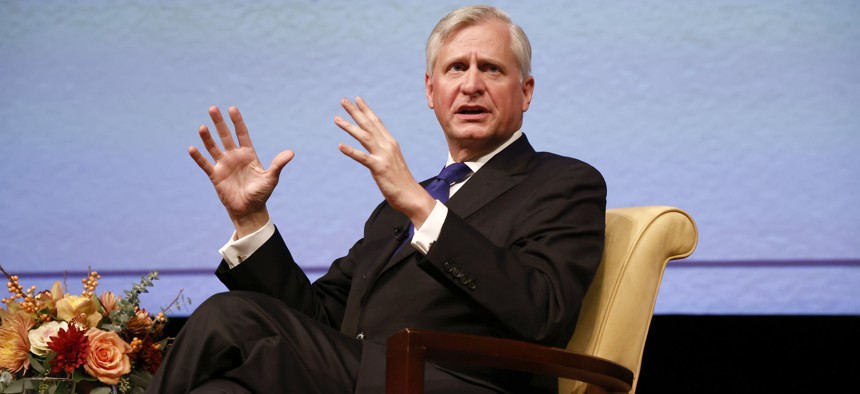
LONG BEACH, CALIFORNIA — A leading presidential historian in a speech this week urged local government leaders to be curious, empathetic and candid, warning of the impact artificial intelligence can have as they look to rebuild trust.
Jon Meacham, who has written more than a dozen biographies of presidents as well as historical analyses and anthologies, said the country is in an “enormous crisis” with trust in government institutions eroding and an important midterm election just weeks away.
But he called on government leaders to embrace hope over fear and ensure that democratic institutions deliver the prosperity they are promising. Meacham urged them to resist the “elemental struggle for power,” and be focused on delivering on what matters to their constituents.
“Hope is you build a bridge; fear is you build a wall,” Meacham said in a speech at the International City/County Management Association’s annual meeting in Long Beach, California, this week. “Hope is you reach out. Fear is you clench your fists, and there's a thin line between these two things. If we want hope to prevail over fear, we have to show that hope works.”
It won’t be easy, however. Meacham said AI will be “more important than the Industrial Revolution” of the 19th century. And he noted the role of cable news channels and social media in making people feel aggrieved and angry, as well as helping them to embrace disinformation and conspiracy theories that they feel help to explain why the world around them is changing.
“Part of the impediment, part of the trouble, is that a lot of people love being angry,” Meacham said. “It is enveloping. It is energizing. You can wake up every day, turn on a certain television channel, and… a machinery of perpetual conflict that requires 24 hours of fuel, seven days a week. And it doesn't really matter what the quality of the fuel is.”
If they are to be successful in overcoming these issues and challenges, Meacham said local government leaders must stay curious about the world around them, including by learning how AI and new technologies can help make government better. He also urged them to be candid with their residents, and be honest about not only the solutions ahead, but the challenges they face right now. Not doing so can create even more rancor, Meacham argued.
“We can polite ourselves into oblivion,” he said.
And finally, Meacham urged those present to have empathy for everyone, including those who disagree with them. He said empathy is the “oxygen in all of this,” urging people to treat each other as neighbors, rather than as enemies.
“If I can't see you as a neighbor as opposed to an enemy, we're done,” he said. “It doesn't mean we have to agree the whole time. In fact, quite the opposite. But we have to see each other of equal dignity and hopefully decency. And empathy is what makes that, practically.”
Other government leaders said the work to build trust in government remains ongoing, and will always be. ICMA Executive Director and CEO Julia Novak said localities “did not inherit a finished cathedral,” and every generation “receives it with work left to do.”
“Our generation must strengthen public trust, welcome new talent and protect the norms that make nonpartisan administration possible,” Novak said. “We must modernize our systems in the age of artificial intelligence without losing the values that those systems were built to serve. And we must prepare those who follow us, not merely to hold these job titles, but to understand their place in a long civic tradition.”
Looking back into history, Meacham recalled the United States as it existed a century ago in 1926, with huge demographic shifts, the growth of the radio as a new communications device, and national policies that included protectionism, isolationism and anti-immigrant rhetoric. President Franklin Roosevelt understood and met the moment the country faced, he said, especially after the 1929 Wall Street Crash and subsequent Great Depression.
“The story he wanted to continue was the story of [Thomas] Jefferson and of [Abraham] Lincoln,” Meacham said. “That we could live with ambiguity and imperfection, but that clinging to and defending the Declaration [Of Independence], its capacity for hope and the Constitution with its bulwarks against fear, was worth everything. He gave it everything, and the country answered.”