
sponsor content What's this?
The Municipal Operating System





Presented by
Diversified Technology
Presented by
Diversified Technology
Connecting departments, automating work, and transforming citizen service.
Local governments have spent decades investing in technology.
Finance has one system. Public Works has another. Permitting, code enforcement, utilities, parks and recreation all maintain their own databases and workflows. While these systems may perform their individual functions well, they rarely work together as a unified whole.
Duplicate data and differing data are obvious problems. But the consequences extend far beyond that. When information cannot move seamlessly between departments, neither can work. Processes that should flow automatically instead depend on emails, phone calls, spreadsheets, paper forms, and manual handoffs. Staff spend valuable time tracking down information, re-entering data, following up on approvals, and coordinating activities that technology should be managing for them.
Consider a typical development project, service request, permit application, or code enforcement case. These activities often touch multiple departments, each with their own systems and procedures. As information passes from one department to another, delays occur, visibility is lost, and opportunities for errors increase.
The result is an organization that often operates as a collection of departments rather than a single enterprise.
At a time when citizens expect faster service, greater transparency, and digital experiences comparable to those offered by the private sector, local governments need a different approach. They need a municipal operating system.
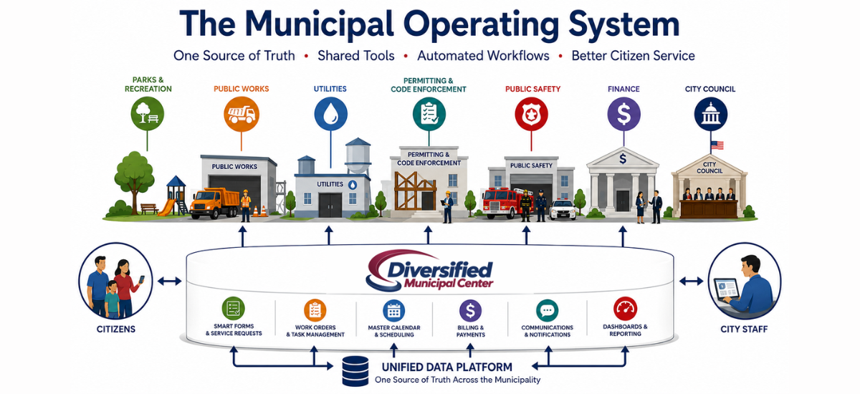
A municipal operating system is a unified platform that connects departments, data, workflows, and citizen services into a single digital environment. Rather than replacing every existing application, it creates a common foundation that integrates with departmental applications and allows information and processes to flow seamlessly across organizational boundaries.
The Diversified Municipal Center from Diversified Technology was designed specifically to serve as that municipal operating system.
Creating a Single Source of Truth
The first major benefit of a municipal operating system is operational efficiency through a unified data structure.
In most local governments, the same information is entered and maintained across multiple systems. A property address may exist in permitting software, utility billing software, GIS applications, code enforcement systems, and finance platforms. Citizen information may be duplicated across service requests, recreation programs, licensing systems, and communications platforms.
This fragmentation creates inefficiencies, inconsistencies, and blind spots.
When departments share a common data foundation, information becomes a strategic asset rather than a departmental resource. Staff can access the information they need without searching through multiple systems or requesting reports from other departments. Leaders gain a more complete view of operations across the organization, while data entered once can be used many times.
The benefits extend beyond efficiency. A unified data structure improves reporting, strengthens decision-making, enhances transparency, and creates a more accurate understanding of community needs.
Most importantly, it enables departments to collaborate around shared information rather than operate from competing versions of the truth.
Eliminating Friction Between Departments
The second major benefit is workflow efficiency through automation.
Government services rarely begin and end within a single department. A development project may involve planning, engineering, permitting, inspections, utilities, finance, and economic development. A citizen service request may require coordination among public works, code enforcement, parks, or administration.
Yet many governments still rely on manual handoffs to move work from one department to another.
A municipal operating system replaces these disconnected processes with automated workflows that guide work through the organization. Tasks can be routed automatically, approvals can move electronically, and information can follow the process rather than requiring staff to repeatedly re-enter or transfer data.
This automation reduces delays, minimizes errors, and increases accountability. Staff spend less time managing processes and more time solving problems.
As workforce challenges continue to affect local governments nationwide, workflow automation offers another critical advantage: scalability. By eliminating unnecessary manual work and automating routine processes, governments can increase capacity without increasing headcount at the same rate as demand.
Better Service for Citizens
Ultimately, neither data integration nor workflow automation is the end goal.
The goal is better service.
Citizens do not experience government as departments. They experience government as a single organization. They expect information to be accurate, services to be responsive, and interactions to be simple.
When departments share information and processes move efficiently across organizational boundaries, citizens benefit from faster response times, fewer delays, greater transparency, and more consistent service delivery.
A municipal operating system helps governments achieve what every community seeks: higher levels of service without a corresponding increase in administrative overhead.
That is the promise of the Diversified Municipal Center.
By combining a unified data foundation with automated workflows, the Diversified Municipal Center enables local governments to operate as a connected enterprise rather than a collection of disconnected systems.
The result is a more efficient organization, a more productive workforce, and a better experience for the people government serves.
Try it. Right here. Right now.
Visit diversifiedtechnology.com/try-it to explore a fully functional demonstration of the Diversified Municipal Center. Experience the platform from both the citizen’s perspective and the municipality’s perspective and see firsthand how a municipal operating system can transform service delivery in your community.
This content is made possible by our sponsor Diversified Technology Corp.; it is not written by and does not necessarily reflect the views of Route Fifty's editorial staff.
NEXT STORY: Start With the Problem, Not the AI