
Tech companies enlist colleges to help them train data center workers
Gerville via Getty Images




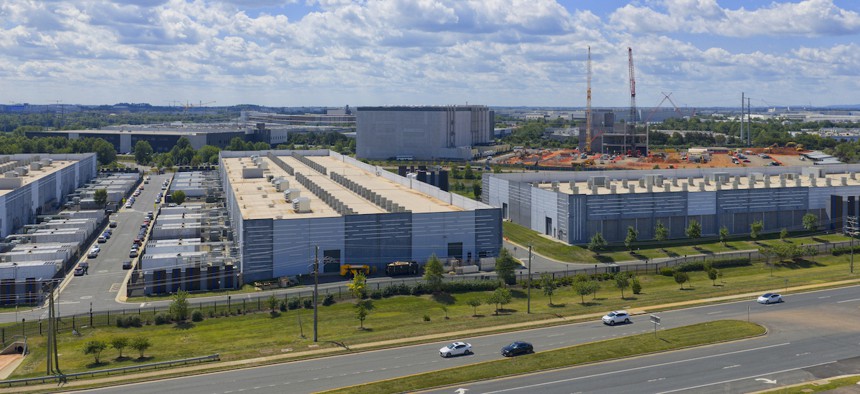
Data centers mostly create construction jobs, but staffing them does require some technicians to work there long-term.
This story was produced by The Hechinger Report, a nonprofit, independent news organization focused on inequality and innovation in education. Sign up for our higher education newsletter. It was republished from The Daily Yonder under a Creative Commons Attribution-NoDerivatives 4.0 International License.

The artificial intelligence race has been a boon for construction workers, employing many thousands nationwide as sprawling data centers rise from the dirt.
Eventually, the construction sounds will give way to a steady whir or whine emitted from giant, nondescript buildings filled with racks, servers, cables and cooling systems. Then what?
That’s the question vexing economists and county planners alike. The outlook for whether data centers will boost regional economies after construction subsides remains fuzzy. A site that generated thousands of construction jobs for several months or a few years may only employ several hundred or fewer employees long term.
But at least some workers will be needed to keep the buildings humming. Increasingly, the very corporations building data centers are playing a key role in training the operational workforce. Microsoft, Amazon, Google and Oracle are among the companies partnering with local higher education institutions to mint data center technicians and skilled trades workers, with the promise of in-demand jobs.
“It’s those mid-level jobs — the server technicians, the hardware technicians, those that have to maintain the infrastructure,” said Scott Adams, a professor of economics at the University of Wisconsin-Milwaukee. “There are hundreds of those jobs that are necessary, and those jobs need training because, in a sense, nobody has kind of done this explicit job before.”
The training programs exist in practically all corners of the United States. Just to name a few: Columbus State Community College in Ohio offers a data center technician program in partnership with Amazon Web Services. New Mexico State University and the University of New Mexico work with Oracle Academy. Gateway Technical College in Wisconsin houses a Microsoft Datacenter Academy.
Despite the potential benefits of these workforce training programs, they’re publicized only lightly through a few press releases or information posted online. Google, Oracle and Microsoft either didn’t respond to or declined interview requests from The Hechinger Report. These companies have encountered increasing resistance from local communities about the construction of data centers.
But 30-year-old Louis Maxcy is among a growing number of data center technicians whose career was jumpstarted by a scholarship-funded training program. He started courses for that program in September 2025 at Oregon’s Blue Mountain Community College, which partners with Amazon Web Services. The company hired him in the spring as he continued his training, giving him the cooperative work experience he needed to complete the program. In June, he graduated with a certificate and a job.
Now, he drives less than 10 minutes to an AWS data center in his hometown of Umatilla, in northeastern Oregon. The area’s economy is largely agricultural, and the largest employer is a state prison.
“There’s always been a stigma in this area that if you want to be successful, you need to leave,” Maxcy says.
He adds that his career path is proof that’s not the case anymore.
The data center building frenzy has dominated global headlines, thanks to massive capital investments and concerns ranging from power and water usage to noise pollution. Data Center Map, which has been compiling market research since 2007, shows more than 4,700 locations across the U.S., with large clusters in Virginia, Texas, Ohio, California, Georgia and Illinois.
The U.S. Census Bureau estimates that employment in data centers increased more than 60 percent from 2016 to 2023. But the number of sustained operational jobs within data centers varies.
Even so, training programs are attempting to address a skills gap as data centers rapidly multiply and companies need qualified workers to run them.
Amazon Web Services, a cloud computing pioneer dating back to 2006, needs technicians who take care of data centers’ computer hardware as well as building operations and machinery, says Nicholas Lee-Romagnolo, the company’s principal for workforce and economic development. Those positions require varying levels of technical skill in a constantly evolving environment.
“Those servers change all the time. The fiber changes all the time,” Lee-Romagnolo said. “Everything inside the data center is constantly being upgraded, especially in Amazon Web Services’ data centers. So we have to make sure that curriculum isn't 3 years old — that it's constantly being updated to serve the present need.”
That’s where partnerships with colleges come in.
Last fall, Gateway Technical College in Racine, Wisconsin, launched a Microsoft Datacenter Academy. It’s one of several dozen around the world. Microsoft declined an interview request, but the technology company’s website describes the academy as a “community skilling program that collaborates with local education partners to create pathways into the datacenter industry.”
The timing and location aren’t random. In June, Microsoft opened its first data center in the Village of Mount Pleasant, which sits between Milwaukee and Chicago in Racine County. Construction of a second, adjacent facility is underway.
During two semesters at Gateway, students can complete four courses — IT Tech Skills, Hardware/Software Support, Server Technologies and Data Center Technician — to receive a Microsoft Data Center Certificate.

If those courses sound more skills-based than conceptual, that’s the whole point. Step into a classroom and you’ll find students peering into the organs of a standalone computer or server, said Mark Kappes, dean of Gateway’s Business and Workforce Solutions, which oversees partnerships with employers, and its School of Manufacturing, Engineering and Information Technology.
He said the “hands-on” courses prepare students to step right into roles as data center technicians, IT support specialists, cloud infrastructure associates or facilities operation technicians. Large hyperscalers and smaller companies with data storage needs employ technicians to monitor and replace hardware, troubleshoot problems and ensure overall facility safety.
By the end of May, 14 students had earned the Microsoft Data Center Certificate, and another 206 were enrolled in the program, Kappes said. Recent high school graduates and adults seeking a career pivot have been especially interested thanks to scholarships Microsoft funds, for the program and for some IT students, which cover the $2,277 tuition and approximately $760 for books.
Another part of the allure? A fast track to a job in an emerging sector. Students who complete the certificate can directly enter the workforce or continue pursuing a degree. Some do both.
“It has Microsoft’s name on it, and Microsoft is sponsoring scholarships for it, but it’s not necessarily to drive people or students or graduates to Microsoft,” said Kappes. “It’s for the general community’s well-being.”
Indeed, pushback about data centers often revolves around the perceived drawbacks versus the potential community benefits of greenlighting such projects. A report from the Brookings Institution, a think tank, released earlier this year urged local governments to negotiate stronger regional benefits when they strike deals with tech companies, such as investments in job training for local residents that could foster an evolving tech employment ecosystem.
“We’ve seen [workforce training] just pop up organically in the wild,” said Mark Muro, who co-authored the report. “The next step is for this to become a kind of standard part of negotiations.”
Steven Zylstra, president and CEO of the Arizona Technology Council, a networking and trade association, sees some parallels with the semiconductor industry, which has teamed up with community colleges to bolster its workforce pipeline. Maricopa Community Colleges in Arizona, for instance, have partnerships with Intel for training manufacturing facility technicians and Microsoft for preparing data center technicians.
“The demand is growing, and obviously companies know exactly what they need,” he said. “When they develop these internal programs, they get what they’re expecting.”
Will students get what they are expecting?
Data center training programs provide an entry point to modern jobs with livable wages and benefits, especially for people who lack interest in a four-year degree or cannot afford it.
The average wage for data center technicians is about $32 an hour, based on 7,700 Indeed job postings over the last three years, which comes out to roughly $66,000 a year. Managers or specialized roles can command six-figure salaries, though more education may be necessary.
Still, experts say students should ask questions about the portability of the skills they’re learning and whether their knowledge could, ironically, become obsolete, thanks to the quick pace of AI innovation.
Chad Knights, chief academic officer and vice president of academic affairs at Northern Virginia Community College, thinks students at his institution will be well positioned to adapt to changes. He said NOVA, which partners with AWS and other companies to train aspiring data center workers, has a curriculum that is intentionally well-rounded.
“It’s a very AI-resilient role,” he said, pointing to the manual processing, troubleshooting and physical infrastructure management aspects of the job. “But even if it does become subject to some level of automation, those individuals have their hand in no less than four different trades: plumbing, HVAC, electrical and fiber.”
Adams, the economics professor at the University of Wisconsin-Milwaukee, agreed that the AI economy appears to be turning away from an occupation-based model, where workers solely identify by specific titles, and moving instead toward one that prizes a suite of skills. An employee may label himself as a welder who specializes in heating, ventilation and air conditioning systems.
“We’re kind of at the beginning of the railroad,” Adams said. “We’re just laying some tracks … and I think nobody could envision 150 years ago how that would change the economy and the new jobs that would be created.”
Maxcy, the data center technician in Oregon, says his new job provides constant learning opportunities. Every day brings new problems to solve or efficiencies to discover while keeping the sprawling data center’s servers operating. He monitors, troubleshoots and repairs servers — often debriefing with colleagues on other teams afterward.
“We can kind of compare notes and talk about how we can grow as technicians from what the other person is learning,” he said.
Maxcy originally wanted to study computer science. He earned two associate degrees before switching to the data center technician training program, which he thought offered a more viable career pathway.
He now considers his work akin to a modern-day trade.
“In a lot of ways, I feel like I’ve made it,” said Maxcy, who envisions a long career working for Amazon Web Services. “I feel like I’m comfortable, and I have a good, sustainable income to thrive in this area.”