How a research paper helped spark Utah’s data center water law
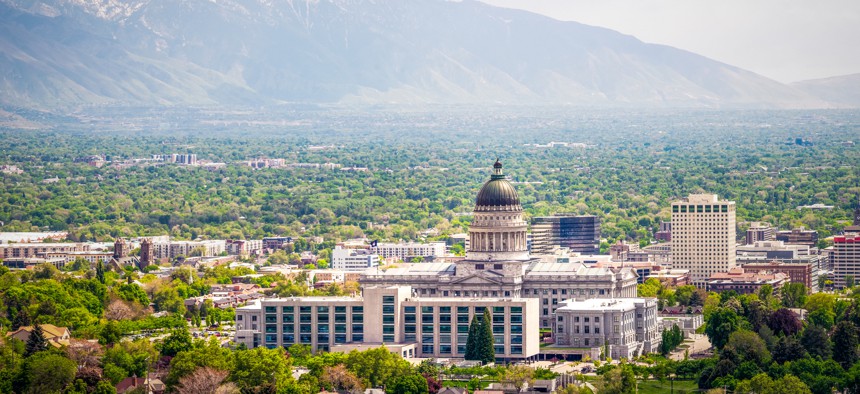
georgeclerk via Getty Images

What began as an effort by three fellows at the Aspen Institute resulted in a push to bring more transparency around how data centers consume water in the state.

Utah this year became the first state to mandate more transparency around how data centers use and consume water, in a joint effort between lawmakers, researchers and advocacy groups.

The result was a bill that Republican Gov. Spencer Cox signed in March requiring new data centers in the state that are over 10,000 square feet in size and use at least 75 acre-feet of water a year to report their water usage to Utah’s Division of Water Resources. Those reporting requirements include the sources of their water, what it will be used for, conservation efforts, water quality and more. While the data will be anonymized, total use will be aggregated and released to the public.

The law, which has since been replicated in Nebraska, comes as data center operators and developers come under increasing pressure about the strain they may place on electricity and water. That’s become especially apparent in Utah, where the Stratos Project in Box Elder County has sparked months of controversy and is the subject of a lawsuit. Cox signed an executive order in May to establish what he called a “higher bar” for data center development in the state.

State Rep. Jill Koford, who sponsored the bill in the Utah House, said during a committee hearing that this legislative effort is to provide “transparency and a reporting mechanism for data centers.”

“The goal is to give local water providers and the state an idea of how our most precious commodity, water, is being used,” Koford continued. The bill received strong support in both chambers.

The effort began as a project by three fellows at the Aspen Institute’s Aspen Policy Academy, who undertook research into the growth of data centers in Utah even as the Great Salt Lake saw a record low water level. It was completed as part of the 2024 Science and Technology Policy Fellowship, a program to teach science and technology experts how to impact policy.

The three research fellows began by pulling information about existing data centers in the state and their water consumption, which are less advanced than the ones being built and are much smaller. But very little public information was available, including on how much water was consumed by a data center as opposed to being diverted elsewhere in the water cycle after it is used.

Researchers sent requests under Utah’s open records law, the Government Records Access and Management Act, on the 21 data centers in the Salt Lake City area they could identify, and received responses for seven that varied in specificity and helpfulness. That became more significant as data centers have taken hold in headlines, especially as more jurisdictions fight against building them.

“Data centers are really complex, and they have flown under the radar of policy and the popular imagination for so long,” said Rebecca Kilberg, one of the three Aspen Institute fellows who produced the report. “Part of that is because they could be in your closet, and it wasn't going to show up very much on your bill. You had to keep the room cool, but now you have hyperscale data centers being the norm, and if you look at how they're built even, you'll see that they're much more concentrated than many other industries.”

In response to the lack of transparency and guidelines around data center water use, the fellows recommended that the state create a database of data centers’ water usage and use that information to draft water efficiency targets. They suggested that those targets be set using Water Usage Effectiveness, the ratio between a data center’s water usage and its energy consumption, to align with industry leaders.

Having to disclose water usage and meet various efficiency targets would then incentivize data center operators to use more efficient cooling technology, which already exists and uses far less water, the fellows argued.

Then after being featured on a podcast and heard by officials from environmental nonprofit Stewardship Utah, the policy brief was turned into legislation that was debated and passed during the state legislative session earlier this year, albeit watered down in its requirements from previous versions. Kilberg noted that having guardrails around data centers is a bipartisan issue that touches various areas of everyday life.

“It's health, it's economic prosperity, it's literally the water that you need to drink to stay alive, it's your recreation, it's your backyard,” she said. “We're not saying everything needs to go back in time, but this is something that's very happily at an intersection that people recognize is not political for whatever reason. I hope that people can seize this moment to unite over something that could so obviously be better and is being controlled by these very wealthy groups that are not invested in the area.”

Kilberg said the effort in Utah is “highly replicable,” and recent reports support that stance. Researchers at the Getches-Wilkinson Center for Natural Resources, Energy and the Environment at the University of Colorado Law School found that more states are using or considering using reporting and conservation requirements, as well as financial incentives and putting strings on appropriated money to respond to water demand.

The Information Technology and Innovation Foundation also said in a report that moratoriums like those issued in New York and Texas are less effective than transparency around water usage, especially as water is a local issue that varies widely between jurisdictions.

Koford said data center operators can also benefit from these requirements, as they can not only provide information to the state but also the public. A recent Gallup survey showed that 71% of Americans are opposed to building data centers in their area, partly as they are unsure about the effect on their electricity and water supplies. Koford said during the March committee meeting this law can help operators “tell their story about how they are being good stewards of our water.”

X
This website uses cookies to enhance user experience and to analyze performance and traffic on our website. We also share information about your use of our site with our social media, advertising and analytics partners. Learn More / Do Not Sell My Personal Information
Accept Cookies
X
Cookie Preferences Cookie List

Do Not Sell My Personal Information

When you visit our website, we store cookies on your browser to collect information. The information collected might relate to you, your preferences or your device, and is mostly used to make the site work as you expect it to and to provide a more personalized web experience. However, you can choose not to allow certain types of cookies, which may impact your experience of the site and the services we are able to offer. Click on the different category headings to find out more and change our default settings according to your preference. You cannot opt-out of our First Party Strictly Necessary Cookies as they are deployed in order to ensure the proper functioning of our website (such as prompting the cookie banner and remembering your settings, to log into your account, to redirect you when you log out, etc.). For more information about the First and Third Party Cookies used please follow this link.

Allow All Cookies

Manage Consent Preferences

Strictly Necessary Cookies - Always Active

We do not allow you to opt-out of our certain cookies, as they are necessary to ensure the proper functioning of our website (such as prompting our cookie banner and remembering your privacy choices) and/or to monitor site performance. These cookies are not used in a way that constitutes a “sale” of your data under the CCPA. You can set your browser to block or alert you about these cookies, but some parts of the site will not work as intended if you do so. You can usually find these settings in the Options or Preferences menu of your browser. Visit www.allaboutcookies.org to learn more.

Sale of Personal Data, Targeting & Social Media Cookies

Under the California Consumer Privacy Act, you have the right to opt-out of the sale of your personal information to third parties. These cookies collect information for analytics and to personalize your experience with targeted ads. You may exercise your right to opt out of the sale of personal information by using this toggle switch. If you opt out we will not be able to offer you personalised ads and will not hand over your personal information to any third parties. Additionally, you may contact our legal department for further clarification about your rights as a California consumer by using this Exercise My Rights link

If you have enabled privacy controls on your browser (such as a plugin), we have to take that as a valid request to opt-out. Therefore we would not be able to track your activity through the web. This may affect our ability to personalize ads according to your preferences.

Targeting cookies may be set through our site by our advertising partners. They may be used by those companies to build a profile of your interests and show you relevant adverts on other sites. They do not store directly personal information, but are based on uniquely identifying your browser and internet device. If you do not allow these cookies, you will experience less targeted advertising.

Social media cookies are set by a range of social media services that we have added to the site to enable you to share our content with your friends and networks. They are capable of tracking your browser across other sites and building up a profile of your interests. This may impact the content and messages you see on other websites you visit. If you do not allow these cookies you may not be able to use or see these sharing tools.

If you want to opt out of all of our lead reports and lists, please submit a privacy request at our Do Not Sell page.

Save Settings
Cookie Preferences Cookie List

Cookie List

A cookie is a small piece of data (text file) that a website – when visited by a user – asks your browser to store on your device in order to remember information about you, such as your language preference or login information. Those cookies are set by us and called first-party cookies. We also use third-party cookies – which are cookies from a domain different than the domain of the website you are visiting – for our advertising and marketing efforts. More specifically, we use cookies and other tracking technologies for the following purposes:

Strictly Necessary Cookies

We do not allow you to opt-out of our certain cookies, as they are necessary to ensure the proper functioning of our website (such as prompting our cookie banner and remembering your privacy choices) and/or to monitor site performance. These cookies are not used in a way that constitutes a “sale” of your data under the CCPA. You can set your browser to block or alert you about these cookies, but some parts of the site will not work as intended if you do so. You can usually find these settings in the Options or Preferences menu of your browser. Visit www.allaboutcookies.org to learn more.

Functional Cookies

We do not allow you to opt-out of our certain cookies, as they are necessary to ensure the proper functioning of our website (such as prompting our cookie banner and remembering your privacy choices) and/or to monitor site performance. These cookies are not used in a way that constitutes a “sale” of your data under the CCPA. You can set your browser to block or alert you about these cookies, but some parts of the site will not work as intended if you do so. You can usually find these settings in the Options or Preferences menu of your browser. Visit www.allaboutcookies.org to learn more.

Performance Cookies

We do not allow you to opt-out of our certain cookies, as they are necessary to ensure the proper functioning of our website (such as prompting our cookie banner and remembering your privacy choices) and/or to monitor site performance. These cookies are not used in a way that constitutes a “sale” of your data under the CCPA. You can set your browser to block or alert you about these cookies, but some parts of the site will not work as intended if you do so. You can usually find these settings in the Options or Preferences menu of your browser. Visit www.allaboutcookies.org to learn more.

Sale of Personal Data

We also use cookies to personalize your experience on our websites, including by determining the most relevant content and advertisements to show you, and to monitor site traffic and performance, so that we may improve our websites and your experience. You may opt out of our use of such cookies (and the associated “sale” of your Personal Information) by using this toggle switch. You will still see some advertising, regardless of your selection. Because we do not track you across different devices, browsers and GEMG properties, your selection will take effect only on this browser, this device and this website.

Social Media Cookies

We also use cookies to personalize your experience on our websites, including by determining the most relevant content and advertisements to show you, and to monitor site traffic and performance, so that we may improve our websites and your experience. You may opt out of our use of such cookies (and the associated “sale” of your Personal Information) by using this toggle switch. You will still see some advertising, regardless of your selection. Because we do not track you across different devices, browsers and GEMG properties, your selection will take effect only on this browser, this device and this website.

Targeting Cookies

We also use cookies to personalize your experience on our websites, including by determining the most relevant content and advertisements to show you, and to monitor site traffic and performance, so that we may improve our websites and your experience. You may opt out of our use of such cookies (and the associated “sale” of your Personal Information) by using this toggle switch. You will still see some advertising, regardless of your selection. Because we do not track you across different devices, browsers and GEMG properties, your selection will take effect only on this browser, this device and this website.