
As police increasingly embrace AI, some wait for regulations and proof it works
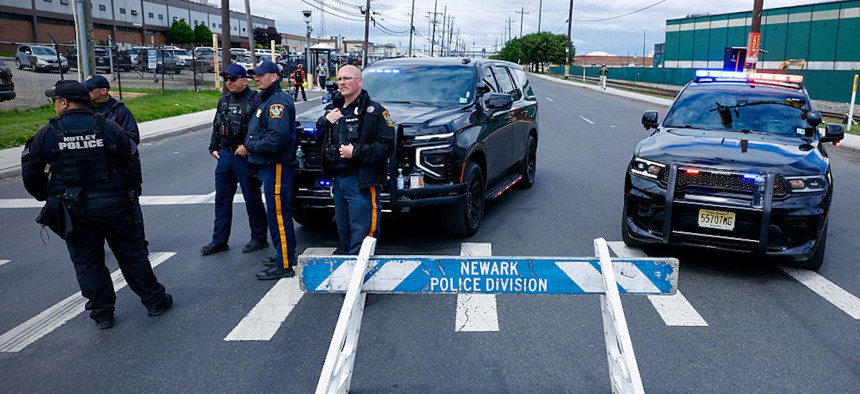
New Jersey State police officers stand guard outside Delaney Hall, which is being used as an Immigration and Customs Enforcement detention center, in Newark, New Jersey, on May 30, 2026. Kena Betancur / AFP via Getty Images





New Jersey has no statewide guardrails on police use of artificial intelligence, but that hasn't stopped cops from using it.
This story was originally published by the New Jersey Monitor.
In Cape May County, police stumped by the decades-old mystery of a missing 11-year-old boy turned to artificial intelligence to hunt for clues human detectives might have missed. In Trenton, an expanding web of AI-powered surveillance cameras tracks pedestrians and motorists as they navigate the capital city. And in towns from Mount Holly to Eastampton, officers now rely on AI to draft incident reports.
New Jersey has no statewide strategy or regulations on police use of AI, even as law enforcement officers across the state are increasingly deploying AI-equipped technological tools to do everything from routine paperwork to complex sleuthing.
The trend comes as unease grows nationally over recent whistleblower warnings of the potentially dire consequences of unrestrained AI, as well as the costs and environmental impacts of data centers, which power the technology.
Critics warn that the multi-billion-dollar industry evolves so fast that police departments have become expensive testing grounds for unproven technology, with taxpayers left holding the bill.
“These are not cheap tools,” said Dillon Reisman, a staff attorney with the American Civil Liberties Union of New Jersey who focuses on the intersection of technology and civil rights. “Law enforcement officers are dipping their toes into a really expensive pool and becoming reliant on AI when no one has actually proven that it reduces crime and solves more investigations.”
Supporters counter that AI can expand what law enforcement can do and save time and money through administrative efficiencies. They downplay concerns that AI tools can trample privacy and civil rights, with Trenton Mayor Reed Gusciora crediting his city’s surveillance system with cutting murders fivefold since 2020.
“I have a bigger fear of getting shot,” Gusciora said. “We’ve done a remarkable job of bringing down crime, and I’ll take my chances with the cameras.”
No statewide guardrails
New Jersey officials have tiptoed around regulating law enforcement use of AI.
The state Attorney General’s office solicited public comments on facial recognition technology in 2022 but then issued no guidance. Legislators have introduced a bill twice since May 2025 to study AI in policing, but it has not advanced. They introduced two more bills just this week to restrict government use (and prohibit private use) of automated license plate readers and limit their data retention.
Yet policymakers have not adopted any statewide directives or guardrails for police mulling new AI tech tools — although that could soon change.
Attorney General Jen Davenport’s office “is actively pursuing statewide governance to ensure ethical, constitutional, and fair evaluation and implementation of AI by New Jersey law enforcement,” Davenport spokesman Rob Rowan told the New Jersey Monitor. Rowan declined to offer a timeline or details on what such governance would look like.
The inaction from policymakers has discouraged some law enforcement officials from leaning into the AI trend.
“If you sign a two-year contract with a company, and then you’re six months in and the attorney general says you can’t use that? We’re still obligated to pay that contract,” said Middle Township Police Chief Tracey Super.
Super thinks AI will shape the future of law enforcement. But beyond budgetary concerns, he has been hesitant to adopt AI tools because of uncertainties about “how the public’s information is protected.” He also shares Reisman’s reservations about whether AI works the wonders its developers promise.
In 2023, his department partnered with the AI company Terawe to try to crack the cold case of Mark Himebaugh, who was 11 when he vanished in November 1991 after walking down his street to watch firefighters tackle a brush fire.
“It really didn’t do what we were hoping,” Super said. “It was more like a search engine with a database, which was helpful, but nothing that we were able to actually solve Mark’s disappearance.”
Under the partnership, the department got a free yearlong trial of the service. When that ended, investigators could have continued using it for $30,000 a month, a considerable cost for a 55-officer police force in a community of about 20,000 residents, Super said.
“We’re a medium-sized agency. Our budget isn’t big enough. We still want to find Mark, but we can’t devote one tenth of our budget to it,” he said.
Super said many of his fellow chiefs have been similarly cautious about AI adoption, especially those that head smaller departments with stretched budgets.
A researcher with the New Jersey State Policy Lab agreed such caution is common among public safety officials. Policymakers want proof AI tools work well given their costs and operational risks, and they fear AI could undermine community trust and replicate existing biases and injustices because they often rely on historical data, researcher Canyu Gao found in April.
Yet others have forged ahead.
Police in Camden County and Newark have deployed drones to bolster surveillance systems. Detectives around the state have used facial recognition technology, which compares facial images captured by security cameras against databases of known faces, to identify suspects.
Agencies from the Mount Holly Police Department to the Morris County Sheriff’s Office have employed AI software developed by Code Four that analyzes footage from police body cameras to draft incident reports.
In Paterson, the police department used an AI tool by Truleo to review body camera footage to determine if officers acted professionally. In Pennsauken, police used a robotic dog Wednesday to enter a home where two people were found dead in a suspected murder-suicide.
And the Mercer County Prosecutor’s Office rolled out a surveillance program in 2022 that now relies on more than 500 cameras (many of which include automated license plate readers) that primarily target crime hotspots, violence-prone locations, community events, and critical infrastructure, spokeswoman Casey DeBlasio said. The system, which uses technology from Lyndhurst-based Packetalk, will be expanded, she added.
Those efforts haven’t always gone smoothly.
The mass surveillance capabilities created by Packetalk, Flock, and companies peddling similar products have spawned protests and petitions demanding safeguards both in New Jersey and nationally. And in 2023, federal authorities indicted Packetalk’s owner on charges that he sold equipment from Chinese companies banned under the National Defense Authorization Act. The feds later dropped the charges without explanation, but the episode prompted Passaic County to scramble to recover $13 million it had paid Packetalk for its tech tools. Packetalk staff referred questions to owner Tamer Zakhary, who did not respond to a request for comment.
Facial recognition technology has resulted in enough wrongful arrests that the state Office of the Public Defender took one case to the state Supreme Court in a bid to expose the technology’s deficiencies and expand transparency. In that 2023 case and another that led to a decision issued in June, the state’s top court sided with defense attorneys in ruling that police and prosecutors must more fully disclose how the technology works and how authorities use it.
Such problems seem inevitable when solving crimes can be “a messy human endeavor,” Reisman said.
“It’s extremely concerning that public agencies, including ones as sensitive and important as law enforcement agencies, could adopt tools with no guardrails,” Reisman said. “What we really need now is radical transparency about what happens when a law enforcement agency anywhere in the state or the state itself adopts technology based on large language models.”
I think we’re going to be litigating a lot of conclusions that were drawn through AI.– Jennifer Sellitti, the state public defender
AI in the courts
As police and prosecutors increasingly use AI, defense attorneys and judges are more frequently facing the consequences in court.
Many AI tools pose thorny civil rights and privacy questions, said Tamar Lerer, who heads the state public defender’s forensic science unit. The surveillance systems that span the state can store people’s personal data for a long time and be searched at will for any reason, she said. In other states, police have used them to track women who sought abortions or stalk romantic interests.
“The automatic license plate readers don’t just see license plates. They also see bumper stickers, so we’re talking about expressive information now, not just license plate numbers. They can often capture who’s in a car, or at least part of them. They’re also capturing where someone is, whether you’re at home with your lawn signs or you’re at the strip club or at the abortion clinic,” Lerer said. “We have to be very clear about what this all means.”
She added: “For other kinds of privacy invasions, there are rules: You need a warrant to search someone’s house. You don’t need a warrant to track someone’s face down the streets for days, for weeks, for months.”
Jennifer Sellitti, the state public defender, echoed those concerns.
She pointed to unexpected ways AI has cropped up in court, including a fire marshal who revealed in January that he used ChatGPT to prepare his court testimony in a deadly arson in Monmouth County and a dead man who delivered his own victim impact statement via an AI avatar last year in an Arizona courtroom.
“I think we’re going to be litigating a lot of conclusions that were drawn through AI,” she said.
AI software that uses body camera footage to draft incident reports has been touted as a tool that frees up officers from writing their own reports, but Sellitti sees problems there too.
“When a witness testifies in court, they have to testify on personal knowledge, things that they actually observed,” Sellitti said.
Using AI to write incident reports flouts that legal doctrine, she added.
“With human beings, certain things are important in a moment because our brain can’t handle everything at once. So we decide that certain things are important, and that is critical to understanding an officer’s intent, the reason they stopped someone, the reason they found something suspicious,” Sellitti said. “The AI can look at everything all at once and analyze it, and then write a report that creates reasonable suspicion that that officer didn’t actually have in her mind at the time she pulled the car over, which is the relevant test under constitutional law.”
AI-drafted legal filings have proven so problematic in courts around the country that judicial officials in New Jersey issued guidance in March urging attorneys and jurists to “trust but verify” any AI tools, cautioning they could fabricate case citations and quotes, overstate legal principles, and misstate holdings. Lawyers remain responsible for what they file, the courts warned. The guidance came three years after New Jersey court officials established an AI committee that issued broader guidelines in 2024 that still stand today.
Chief Justice Stuart Rabner, during his annual address in May to the state bar association, lamented that AI has made judges’ jobs more complex.
“Years ago, for example, a self-represented litigant might have filed a 2-count complaint with the court,” Rabner said. “Today, with help from AI, the same complaint may well have 15 counts prepared in minutes with the press of a button. Multiply that by thousands to appreciate how much more time and attention judges must devote to resolve those cases each calendar year.”
Despite these concerns, Sellitti and Rabner both see a place for AI in and out of courtrooms.
In July, Sellitti’s office launched a new AI-powered database developed by Princeton University that allows public defenders to access years of briefs, motions, legal research, training materials, and institutional expertise through one unified, searchable system — materials that otherwise existed across various offices, servers, and databases.
“It used to take hours to do that. Now it literally takes seconds,” Sellitti said.
Judiciary officials developed a similar tool, called NJ Courts AI Access, that state court judges, court executives, and law clerks can use to summarize, search, analyze, and review legal documents, courts spokesman Peter McAleer said.
Court officials also have provided ongoing training since 2023 — required of all incoming law clerks — on AI literacy, ethics, confidentiality, accuracy, and human oversight, while a dedicated AI specialist provides individualized support to judges and staff, McAleer said.
Sellitti has tasked an AI-interested group of “super users” in her office with trying new AI tools to determine if wider use is warranted. Any staff who gets training also now must consider how AI might assist whatever they’re getting trained on, she added.
“The right strategy is to make sure that the AI is not doing the job that the witness or the lawyer should be doing and to make clear that AI is a tool that should be used by people to save time, to make us more efficient. But it doesn’t replace the work product of an attorney or the observations of a police officer or lay witness or forensic scientist,” Sellitti said.
Every technology is “a blessing and a curse” that will present new challenges for police, prosecutors, public defenders, and judges, especially given the speed with which some have raced to adopt it, she said.
“But I also think you’ve got to get ahead of it, so that we’re the ones using it to our advantage in courtrooms,” she added. “And we’ve been trying to do that.”
New Jersey Monitor is part of States Newsroom, a nonprofit news network supported by grants and a coalition of donors as a 501c(3) public charity. New Jersey Monitor maintains editorial independence. Contact Editor Terrence T. McDonald for questions: info@newjerseymonitor.com.