Supreme Court OKs use of federal citizenship tool to vet voters, but midterm impact will be limited
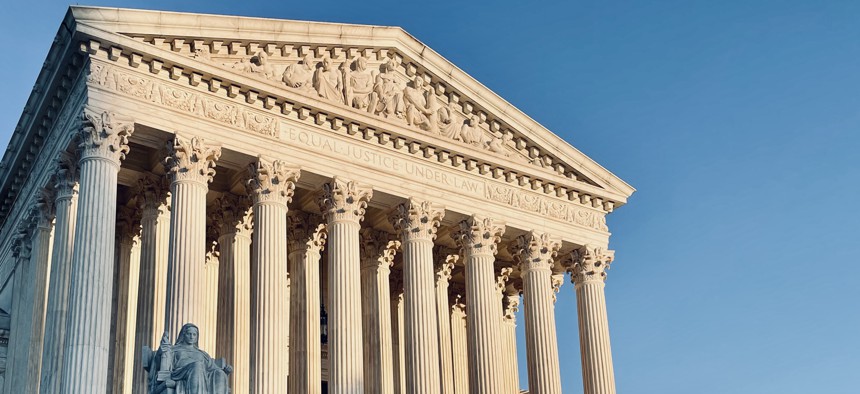
Douglas Rissing via Getty Images


The ruling is a victory for Trump’s efforts to give the federal government a larger role in election administration.

This article was originally published by Votebeat.

The Supreme Court cleared the way Friday for election officials to resume using a federal immigration status verification system to check voter rolls for potential noncitizens — a significant victory for President Donald Trump’s administration, but one that’s likely to have little impact on the November midterm elections.

The unsigned opinion hit pause on a lower court’s ruling from June while the case works its way through the appeals process. The lower court had found that the Department of Homeland Security had violated voter privacy by expanding the Systematic Alien Verification for Entitlements system, better known as SAVE, so that states could run their voter rolls through it to check for any noncitizens.

Friday’s ruling is not expected to lead to any widespread removal of voters before the November election because federal law prohibits election officials from systematically unregistering voters within 90 days of an election.

However, as a result of the ruling, the Trump administration will be able to restart use of the SAVE system to scrutinize state voter rolls after the election, and election officials will be able to use the SAVE system to check the citizenship of individual voters in the meantime as well.

The Department of Homeland Security has maintained the SAVE system for decades to check immigrants’ eligibility for public benefits. But in 2025, the Trump administration revamped the tool to allow election officials to check voter rolls in bulk against federal citizenship and immigration records and to search using Social Security numbers, making it far easier to screen registered voters for potential noncitizens.

The case against the expanded SAVE was brought by a coalition of groups, including the League of Women Voters and the Electronic Privacy Information Center, that argued that the Trump administration violated Americans’ privacy by expanding how the system is used.

“Today’s decision is profoundly disappointing, as it puts Americans at risk of being unlawfully targeted by the administration’s unreliable voter purge database weeks before the midterm elections,” Abigail Kunkler, an attorney for the Electronic Privacy Information Center, said in a statement on behalf of the plaintiffs.

She said the case “is not over” and noted the lower court had ruled that the expanded SAVE violates multiple laws. “We will be doing everything in our power to protect Americans’ voting and privacy rights by ensuring that the district court decision stands.”

Trump administration officials celebrated the court victory.

“Yes, you read that right. We had to file an emergency petition in the Supreme Court just so we could use government data to help states stop noncitizens from illegally voting,” James Percival, the Department of Homeland Security’s general counsel, said on X in reaction to the decision.

The Department of Homeland Security has said that election officials in 25 states, mostly Republicans, have run their voter rolls through the SAVE system. Some of those officials praised SAVE as a valuable tool for weeding out ineligible voters, but others have found it to be unreliable.

A ProPublica investigation from earlier this year found that the Trump administration’s rush to turn the system into a voter verification tool made it prone to false positives. In at least five different states, the system has flagged people as noncitizens who were actually citizens.

In Texas, Votebeat reported that the system flagged hundreds of people who had registered to vote through the state Department of Public Safety, which requires proof of citizenship from any prospective registrants. State and local election officials have confirmed that several of those people are indeed eligible to vote.

In a dissent to Friday’s opinion, Justice Ketanji Brown Jackson cited the problems in Texas as a main reason she opposed the Trump administration’s use of the SAVE system to check voter rolls. Jackson noted that one plaintiff in the case had her voter registration revoked without her knowledge and that two others had to provide proof of citizenship to remain on voter rolls.

“The harm caused by burdening or disenfranchising even a few lawful voters outweighs the nonexistent harm that the Government experiences when it is prevented from taking an action that it likely lacks the authority to take,” she wrote.

Jackson was joined in her dissent by the court’s two other liberal justices, Sonia Sotomayor and Elena Kagan.

The ruling was a rare victory for Trump in his effort to impose more federal control over the country’s electoral system. Federal courts have dismissed 25 Department of Justice lawsuits seeking states’ unredacted voter rolls, with the federal government yet to prevail in a single one.

The president has also failed to get the SAVE Act or SAVE America Act through Congress, two bills that would have required Americans to prove their citizenship before registering to vote. (Despite their names, they are not related to the Department of Homeland Security’s SAVE system.) And earlier this month, the Supreme Court ruled that proposed Trump administration rules that would have given the U.S. Postal Service the ability to restrict the delivery of mail ballots could not go into effect for the 2026 election.

X
This website uses cookies to enhance user experience and to analyze performance and traffic on our website. We also share information about your use of our site with our social media, advertising and analytics partners. Learn More / Do Not Sell My Personal Information
Accept Cookies
X
Cookie Preferences Cookie List

Do Not Sell My Personal Information

When you visit our website, we store cookies on your browser to collect information. The information collected might relate to you, your preferences or your device, and is mostly used to make the site work as you expect it to and to provide a more personalized web experience. However, you can choose not to allow certain types of cookies, which may impact your experience of the site and the services we are able to offer. Click on the different category headings to find out more and change our default settings according to your preference. You cannot opt-out of our First Party Strictly Necessary Cookies as they are deployed in order to ensure the proper functioning of our website (such as prompting the cookie banner and remembering your settings, to log into your account, to redirect you when you log out, etc.). For more information about the First and Third Party Cookies used please follow this link.

Allow All Cookies

Manage Consent Preferences

Strictly Necessary Cookies - Always Active

We do not allow you to opt-out of our certain cookies, as they are necessary to ensure the proper functioning of our website (such as prompting our cookie banner and remembering your privacy choices) and/or to monitor site performance. These cookies are not used in a way that constitutes a “sale” of your data under the CCPA. You can set your browser to block or alert you about these cookies, but some parts of the site will not work as intended if you do so. You can usually find these settings in the Options or Preferences menu of your browser. Visit www.allaboutcookies.org to learn more.

Sale of Personal Data, Targeting & Social Media Cookies

Under the California Consumer Privacy Act, you have the right to opt-out of the sale of your personal information to third parties. These cookies collect information for analytics and to personalize your experience with targeted ads. You may exercise your right to opt out of the sale of personal information by using this toggle switch. If you opt out we will not be able to offer you personalised ads and will not hand over your personal information to any third parties. Additionally, you may contact our legal department for further clarification about your rights as a California consumer by using this Exercise My Rights link

If you have enabled privacy controls on your browser (such as a plugin), we have to take that as a valid request to opt-out. Therefore we would not be able to track your activity through the web. This may affect our ability to personalize ads according to your preferences.

Targeting cookies may be set through our site by our advertising partners. They may be used by those companies to build a profile of your interests and show you relevant adverts on other sites. They do not store directly personal information, but are based on uniquely identifying your browser and internet device. If you do not allow these cookies, you will experience less targeted advertising.

Social media cookies are set by a range of social media services that we have added to the site to enable you to share our content with your friends and networks. They are capable of tracking your browser across other sites and building up a profile of your interests. This may impact the content and messages you see on other websites you visit. If you do not allow these cookies you may not be able to use or see these sharing tools.

If you want to opt out of all of our lead reports and lists, please submit a privacy request at our Do Not Sell page.

Save Settings
Cookie Preferences Cookie List

Cookie List

A cookie is a small piece of data (text file) that a website – when visited by a user – asks your browser to store on your device in order to remember information about you, such as your language preference or login information. Those cookies are set by us and called first-party cookies. We also use third-party cookies – which are cookies from a domain different than the domain of the website you are visiting – for our advertising and marketing efforts. More specifically, we use cookies and other tracking technologies for the following purposes:

Strictly Necessary Cookies

We do not allow you to opt-out of our certain cookies, as they are necessary to ensure the proper functioning of our website (such as prompting our cookie banner and remembering your privacy choices) and/or to monitor site performance. These cookies are not used in a way that constitutes a “sale” of your data under the CCPA. You can set your browser to block or alert you about these cookies, but some parts of the site will not work as intended if you do so. You can usually find these settings in the Options or Preferences menu of your browser. Visit www.allaboutcookies.org to learn more.

Functional Cookies

We do not allow you to opt-out of our certain cookies, as they are necessary to ensure the proper functioning of our website (such as prompting our cookie banner and remembering your privacy choices) and/or to monitor site performance. These cookies are not used in a way that constitutes a “sale” of your data under the CCPA. You can set your browser to block or alert you about these cookies, but some parts of the site will not work as intended if you do so. You can usually find these settings in the Options or Preferences menu of your browser. Visit www.allaboutcookies.org to learn more.

Performance Cookies

We do not allow you to opt-out of our certain cookies, as they are necessary to ensure the proper functioning of our website (such as prompting our cookie banner and remembering your privacy choices) and/or to monitor site performance. These cookies are not used in a way that constitutes a “sale” of your data under the CCPA. You can set your browser to block or alert you about these cookies, but some parts of the site will not work as intended if you do so. You can usually find these settings in the Options or Preferences menu of your browser. Visit www.allaboutcookies.org to learn more.

Sale of Personal Data

We also use cookies to personalize your experience on our websites, including by determining the most relevant content and advertisements to show you, and to monitor site traffic and performance, so that we may improve our websites and your experience. You may opt out of our use of such cookies (and the associated “sale” of your Personal Information) by using this toggle switch. You will still see some advertising, regardless of your selection. Because we do not track you across different devices, browsers and GEMG properties, your selection will take effect only on this browser, this device and this website.

Social Media Cookies

We also use cookies to personalize your experience on our websites, including by determining the most relevant content and advertisements to show you, and to monitor site traffic and performance, so that we may improve our websites and your experience. You may opt out of our use of such cookies (and the associated “sale” of your Personal Information) by using this toggle switch. You will still see some advertising, regardless of your selection. Because we do not track you across different devices, browsers and GEMG properties, your selection will take effect only on this browser, this device and this website.

Targeting Cookies

We also use cookies to personalize your experience on our websites, including by determining the most relevant content and advertisements to show you, and to monitor site traffic and performance, so that we may improve our websites and your experience. You may opt out of our use of such cookies (and the associated “sale” of your Personal Information) by using this toggle switch. You will still see some advertising, regardless of your selection. Because we do not track you across different devices, browsers and GEMG properties, your selection will take effect only on this browser, this device and this website.