
States, cities move to ban cryptocurrency kiosks as scams mount
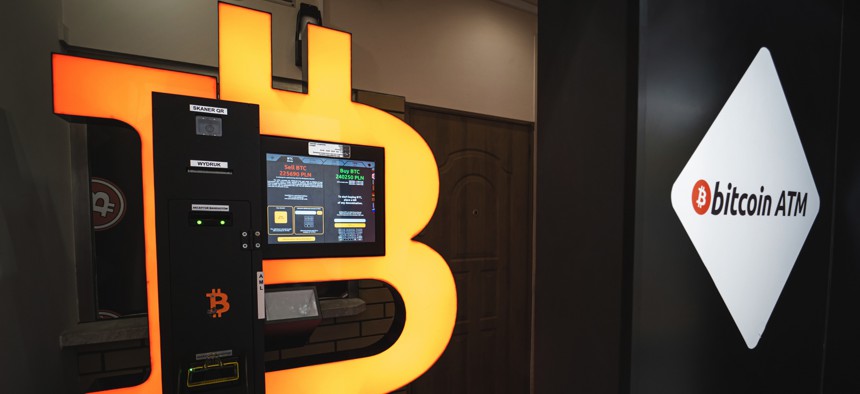
salarko via Getty Images





Teenage boys, older Americans increasingly fall prey to crimes tied to the ATM-like machines.
This article was originally published by Stateline.
States and cities across the country are cracking down on cryptocurrency kiosks as financial scams involving the ATM-like machines continue to mount, costing Americans nearly $389 million last year alone.
Four states — Indiana, Minnesota, Tennessee and Vermont — enacted statewide bans this year, while dozens of communities have moved to prohibit the machines or impose new restrictions on their use. A new law in Hawaii, which went into effect in October, bans consumers from depositing cash into kiosks to buy cryptocurrency.
The crackdown comes as scammers increasingly direct victims to cryptocurrency kiosks, often located in gas stations, convenience stores and grocery stores, to deposit cash that is converted into digital currency and transferred to accounts controlled by criminals.
The FBI received 13,460 complaints involving cryptocurrency kiosks in 2025, with reported losses totaling nearly $389 million. Complaints increased 23% from the previous year, while financial losses jumped 58%, according to the agency’s cybercrime report, which was released in April.
Older Americans have been particularly hard hit. More than half of the complaints involved people older than 50, who reported more than $302 million in losses last year.
The mounting losses have prompted policymakers across the country to pursue tighter restrictions and outright bans on cryptocurrency kiosks — efforts that consumer advocates say are urgently needed to prevent further financial harm.
“Every day that these laws aren’t passed are days where victims are having money stolen from them, and that money, because it’s through cryptocurrency and the nature of the kiosk, it’s just almost impossible to get any of that money back,” said Françoise Cleveland, AARP’s government affairs director, in an interview with Stateline.
Indiana became the first state to ban cryptocurrency kiosks in March, followed by Tennessee and Vermont in July and Minnesota in August. The measures mark a shift from earlier efforts to regulate the machines through transaction limits, fraud warnings and licensing requirements.
At least 35 states have enacted legislation addressing cryptocurrency kiosks since 2023, including 18 that passed laws this year, according to AARP, which has advocated for stronger consumer protections.
Local governments are stepping up, too. In Massachusetts, at least 20 communities have banned cryptocurrency kiosks as of August. In late October, a crypto kiosk ban took effect in Jackson, Michigan — the first of its kind in the state. Operators must remove machines by the end of January. The fast-growing city of Star, Idaho, passed a ban in September requiring kiosks to be removed by this month.
Other municipalities have opted to allow the machines but add stricter restrictions, including requiring fraud warnings, identification checks or transaction limits.
Attorneys general in several places, including the District of Columbia, Iowa and Massachusetts, have sued cryptocurrency kiosk operators, alleging they exploited residents and failed to implement adequate safeguards against fraud.
A three-year investigation by the Iowa attorney general’s office found that 98% of transactions at Bitcoin Depot kiosks in the state were linked to scams, compared with 94% at CoinFlip kiosks. The findings, released in February, prompted the state to sue both companies.
Bitcoin Depot has since filed for bankruptcy, citing increasingly restrictive state regulations and bans. The company took its kiosks offline in May.
In recent years, some kiosk operators have pushed back against outright bans and some proposed restrictions, arguing that the machines serve legitimate customers and that stronger fraud safeguards, rather than prohibitions, would better protect consumers.
Earlier this year, Larry Lipka, the general counsel for CoinFlip, which operates more than 5,000 kiosks in the U.S. and other countries, testified against the statewide ban in Minnesota, arguing that regulators should strengthen enforcement instead.
“It is inappropriate to ban a legal product because fraud is happening. Not our fault,” Lipka said.
Some operators, including CoinFlip, have also implemented holding periods during which transactions can be reversed, offer refunds to scam victims and provide 24/7 customer support.
How the Scams Work
Unlike traditional ATMs, which allow customers to withdraw or deposit money from bank accounts, cryptocurrency kiosks allow users to purchase digital currencies such as Bitcoin with cash. Some machines also allow customers to sell cryptocurrency in exchange for cash.
Scammers exploit the machines by calling victims and persuading them to withdraw money from their bank accounts and deposit it into a kiosk, often providing a QR code linked to a digital wallet controlled by the criminal.
Once the cash is deposited, the machine converts it into cryptocurrency and transfers the funds to the designated digital account, called a “wallet.” Those transactions generally cannot be reversed, making it difficult for victims to recover their money. Kiosk operators also charge transaction fees, regardless of whether the transaction was fraudulent, typically ranging from 20% to 30%, depending on the company.
The scams take several forms. Criminals may impersonate law enforcement officers, government officials, bank employees or technical support representatives, falsely claiming that victims owe money, face arrest or need to move their savings to protect them from fraud.
Other scammers establish romantic relationships online or promote fraudulent investment opportunities before directing victims to deposit money into the machines.
In many cases, scammers remain on the phone with victims throughout the transaction, providing step-by-step instructions on where to find a kiosk and how to send the money.
Beyond Financial Scams
Although older Americans account for a disproportionate share of reported losses involving cryptocurrency kiosks, some investigators say the machines can also play a role in crimes affecting younger people.
Matt Hogan, a detective with the Connecticut State Police who investigates financial crimes, said kiosks have been used in connection with financially motivated sextortion, in which perpetrators threaten to distribute intimate images or videos unless victims pay them money.
The schemes can target teenagers and young adults, who may be coerced into sending money to prevent explicit images from being shared with family members, friends or classmates.
The FBI has warned that financially motivated sextortion increasingly targets teenage boys, particularly those between 14 and 17. Criminals may demand payment through mobile payment applications, gift cards or cryptocurrency.
“That’s definitely an up and coming problem,” Hogan said.
Hogan also pointed to the use of cryptocurrency kiosks in other criminal activity, including money laundering, narcotics-related offenses and payments involving child sexual abuse material.
Federal authorities have raised similar concerns. In an August 2025 notice, the federal Treasury Department’s Financial Crimes Enforcement Network warned that cryptocurrency kiosks were being used to facilitate scams and launder suspected drug proceeds.
A 2022 report from the U.S. Government Accountability Office also found that drug and human traffickers have used cryptocurrency kiosks to convert cash into digital currency and obscure the source of illicit payments.
“Everybody is a potential target for fraud,” said Cleveland, of AARP.
Regulation or Outright Bans?
Despite those concerns, Hogan expressed reservations about banning cryptocurrency kiosks altogether.
He said he supports many of the consumer protections being adopted across the country, but worries that outright bans could push criminals toward alternative methods of transferring money that may be more difficult for investigators to trace.
Transactions involving Bitcoin and many other cryptocurrencies are recorded on public digital ledgers known as blockchains, allowing investigators to follow the movement of funds between digital wallets. Advances in investigative techniques have also given law enforcement more tools to trace cryptocurrency transactions, although identifying the people behind those transactions and recovering stolen funds is still sometimes difficult.
“If these machines do get shut off, bad guys are ingenuitive,” Hogan said of potential kiosk bans. “They are able to pivot. They have no care for authority or morals, so they will pivot to a place that we likely will have less visibility.”
Industry representatives have also pushed back against the growing wave of bans, warning of the economic consequences for businesses and the customers who rely on their services.
That debate played out in Indiana earlier this year, where lawmakers initially considered legislation requiring kiosk operators to obtain licenses, verify customers’ identities and comply with transaction and fee limits.
But after hearing testimony from law enforcement, scam victims and industry representatives, lawmakers abandoned the proposed regulations in favor of an outright ban.
“I can think of no legitimate reasons, no substantial legitimate reasons,” to warrant the kiosks, Republican state Sen. Scott Baldwin said during a February committee hearing.
CoinFlip, which had operated in Indiana for eight years, criticized the decision, saying it had worked with lawmakers in 17 other states to adopt consumer protections without prohibiting the machines.
“We are shocked to learn that the state of Indiana would eliminate an entire industry based on a lack of understanding of digital assets and the services we already provide to 17,000 Hoosiers around the state,” a company spokesperson told the Indiana Capital Chronicle.