
Big Tech wants to build a data center in your city. Is it worth it?
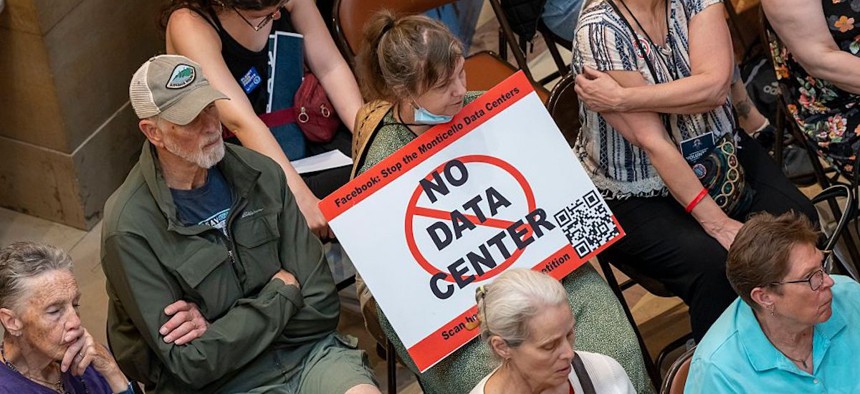
Community members want a two-year pause on new hyperscale data centers, increased regulation and a ban on non-disclosure agreements. Michael Siluk/UCG/Universal Images Group via Getty Images




A closer look at costs and benefits.
This story was originally published by the Minnesota Reformer.
Community opposition to data centers is rising fast, but big computing facilities still have at least one influential fan.
“If I were the mayor of a town or the governor of a state and I had a chance to get a big … AI plant or data center, I would absolutely want it because the jobs are enormous and the money paid, the taxes paid, are just enormous,” President Donald Trump told reporters last month.
He returned to the subject recently, in harsher form.
“The only reason that communities throughout the U.S.A. should not want Data Centers is if they want to end up being backwards and poor,” Trump said in a lengthy Truth Social post. “If we kill the Golden Goose, you will only have yourselves to blame.”
Recent public polling shows Trump’s stance on data centers is unpopular, even within his own party. A recent Economist/YouGov poll finds the general concept of data center construction underwater by more than 30 percentage points, and Americans opposed to data centers in their communities by a margin of more than 3 to 1.
Fifty-two percent of Republicans would say no to a new data center nearby, while just 28% would support one, the poll found. Respondents expressed particular concern about data centers’ impacts on electric bills and home values.
Those worries and others — about excessive water usage, air and noise pollution, strain on the power grid and secret deals between developers and local officials — are bubbling up across Minnesota as Meta brings the state’s first hyperscale data center online in Rosemount, and Google seeks permission to build two more near Rochester and Duluth. There’s unease about what happens inside these facilities, too.
“There is very real, increasing opposition to AI and the way it is being forcefully integrated into our lives against our will. People rightfully understand data centers to be inextricably linked to the spread of this unpopular technology,” said DFL state Sen. Erin Maye Quade, who represents parts of Rosemount.
Benefits can be significant
Evidence from data center host communities suggests the economic benefits are real. Property taxes paid by about 30 data centers in Quincy, Washington, underwrite an ongoing public building spree in a once-poor agricultural town. Loudoun County, Virginia, near Washington, D.C., has reduced residential property taxes every year of the past decade thanks to hundreds of millions in annual revenue from more than 70 data centers.
“You can … accommodate some of those needs, and not burden the average taxpayer with bills they cannot afford, by growing the property tax base,” Pete Sepp, president of the nonpartisan National Taxpayers Union, said in a May webinar extolling the local benefits of data centers.
Across the Potomac River from Loudoun in Sepp’s home base of Montgomery County, Maryland, “there is an outright hostility in the regulatory and tax climate … not coincidentally, well, my universal homeowners property tax credit of almost $700 is going away (and) the local income tax rate (is) going up,” he added.
Downtown Minneapolis has several smallish data centers in operation and at least one more under construction. A few dozen more dot the Twin Cities’ suburbs. Some of these have operated uneventfully for decades. But Minnesota does not yet have any computing clusters to rival Quincy’s or Loudoun County’s.
Meta’s Rosemount facility will be the state’s first experience with the newer generation of industrial-scale facilities that has soured public opinion on data centers generally. Rosemount says Meta could pay the city up to $20 million in property taxes over 20 years and support 148 permanent jobs once operational, likely later this year or in early 2027. The city reported total revenues of $68.8 million in 2024.
The Dakota County assessor expects the project to have a total tax bill of $2.6 million in 2028, Rosemount community development director Adam Kienberger told the Reformer.
The companies behind more than a dozen other proposed data centers around Minnesota — some bigger than Meta’s — tout similar economic benefits.
The bigger the data center, the bigger the promise. Meta says it will spend more than $300 million on local infrastructure improvements to support the $50 billion campus it’s building in northeastern Louisiana, while giving every teacher in the area a bonus of up to $50,000 this year and delivering $2.65 billion in bill savings over 20 years through its partnership with Entergy, Louisiana’s main electric utility.
Maye Quade is among a growing group of state and local officials who say tech companies’ apparent generosity amounts to an admission that large-scale data centers are burdensome.
“These tech billionaires could just pay the taxes they spend billions of dollars getting politicians to eliminate instead of bribing individual communities to try and blunt opposition,” she told the Reformer in an email.
“The use of ‘host community’ is so interesting here, as it evokes a host-parasite relationship, which I think is apt,” she added.
Backroom negotiations between Meta, utility executives and state officials in 2024 netted the tech giant up to $10 billion in tax breaks and a host of other benefits for its Louisiana campus, the New York Times reported in July.
Meta shrouded its Rosemount project in secrecy, too, using a codename (“Project Bigfoot”) and shell company (“Jimnist, LLC”) to conceal its identity early in the development process. Rosemount and two of its neighbors, Eagan and Inver Grove Heights, have since passed temporary moratoriums on data center development.
Reality check: water usage
Minneapolis also temporarily halted approvals in most of the city earlier this year as it updates its zoning rules for data centers. Planning staff say that while land constraints make Minneapolis a poor host for hyperscale facilities, the city has plenty of existing buildings that could be retrofitted for high-powered server rooms.
Several such projects are operating, under construction or proposed downtown: at the Sleep Number building, a former Wells Fargo operations center and, most recently, the Minnesota Star Tribune’s shuttered printing plant. All would occupy less real estate and draw significantly less power than Meta’s Rosemount campus.
Experts say these comparatively small urban facilities are less impactful than hyperscale campuses when housed in existing commercial buildings with nearby power, water and fiber lines. Hyperscale data centers typically rise on agricultural land and require substantial infrastructure upgrades before they can come online.
Urban data centers can in some cases be a net benefit for utility systems with spare capacity, said Meg McMahan, Minneapolis’ city planning director.
The Minneapolis water utility was built to treat 110 million gallons of water per day, at least 20 million gallons more than current peak daily demand, McMahan’s staff said in a presentation to the city council last month. The presentation said the Sleep Number data center uses about 100,000 gallons of water per day, or 0.5% of the excess daily capacity.
That is a lot of water, but it pales in comparison to the amount consumed for, say, summertime landscape irrigation. The suburbs of Golden Valley, Crystal and New Hope, all of which tap the Minneapolis water system, can see daily demand jump 10 million gallons or more in summer — more than double levels seen in the cooler months.
Data centers with closed-loop cooling systems, which are fast becoming the industry norm, consume even less water once the systems are charged. The developer of the proposed Star Tribune printing plant facility, for instance, has said it will consume “two to four residential homes’” worth of water each day. (These figures don’t account for the water consumed by the gas, coal and nuclear power plants that generate about two-thirds of Minnesota’s electricity and dwarf other sources of water demand, however.)
Likewise, every Xcel Energy customer in Minneapolis pays a percentage-based franchise fee on their monthly electric bill. That fee passes through to the city, which uses a portion of it to fund climate and energy efficiency initiatives. Because even small data centers consume more electricity per square foot than offices or homes, they pay proportionally more toward these initiatives, McMahan told the Reformer in an interview.
“That is a direct financial contribution,” she said.
Minnesota also requires data centers to pay the full cost of electrical service, including any new power plants or lines. Google has said it will pay to bring more than two large nuclear reactors’ worth of emissions-free energy resources online to support its two proposed data centers in Minnesota. By contrast, all Xcel ratepayers typically cover its costs to build new infrastructure, plus a profit margin approved by Minnesota utility regulators.
City analyst: Data center retrofits offer lower benefit, but still worthwhile
On the other hand, a data center added to an existing downtown building has a smaller net benefit for public budgets in Minneapolis and Hennepin County than a fresh hyperscale campus does in places like Rosemount and Dakota County.
The data center is likely to boost the building’s value, as the Sleep Number project did, but from a much higher base — and thus less in percentage terms — than hundreds of thousands of square feet of state-of-the-art industrial space on former cornfields.
The takeaway from a staff report shared with the Minneapolis City Council last month was that while data center retrofits could shift property tax burdens away Minneapolis residents who’ve seen steep tax increases of late, the net benefit for the city’s finances is more difficult to determine and likely to vary by project.
“We’re talking about really different contextual situations when you’re talking about Rosemount versus downtown Minneapolis,” McMahan said.
Minneapolis has roughly 8 million square feet of vacant commercial space and would like to convert as much as possible into housing, but with many buildings unsuitable for residential use, “Data centers are another tool in the toolbox,” she added.
It’s a reasonable position in a place where data centers already nudge up against shops, restaurants and offices. Representatives from the Virginia-based company behind the Sleep Number and Star Tribune projects made the connection explicit at a neighborhood meeting last month, saying a lucrative data center in the former printing plant — which itself is likely unsuitable for residential conversion — would subsidize new housing elsewhere on the 13-acre site.
If attendees’ hostile reaction to the pitch was any indication of local sentiment, they have a lot more convincing to do.
Minnesota Reformer is part of States Newsroom, a nonprofit news network supported by grants and a coalition of donors as a 501c(3) public charity. Minnesota Reformer maintains editorial independence. Contact Editor J. Patrick Coolican for questions: info@minnesotareformer.com.