
Election results mean a ‘new day’ for state government, civic tech leader says
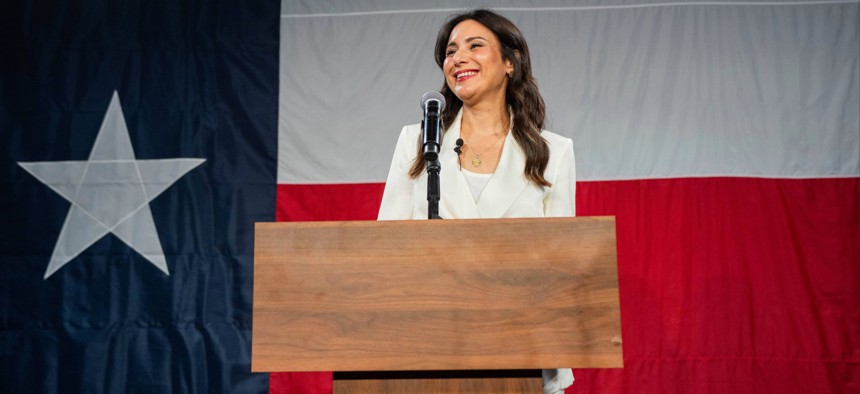
Texas Gov.-elect Gina Hinojosa speaks at an election night party after her victory in the state's governor's race. Austin American-Statesman/Hearst Newspapers via Getty Images


 By
Chris Teale
Amanda Renteria, CEO of Code for America, told Route Fifty the bevy of new governors can use technology to weather coming storms, and plan for a brighter future.
Even as some of the results of the 2026 midterm elections are still being finalized, dramatic changes look to be ahead in state leadership as a host of brand-new governors will be sworn in come January.
And they will have busy agendas, especially as many more mandates on social services, benefits and health care from the One Big Beautiful Bill Act, known also as H.R. 1, are set to go into effect. Experts have already warned that thousands may lose coverage, including under Medicaid, and states are scrambling to implement those changes.
But plenty of folks stand ready and willing to help, including civic technologists, who have turned to technology and artificial intelligence to try to streamline tax filing, benefits applications and various other initiatives.
Amanda Renteria, the CEO of Code for America, which is one such civic tech organization, said the opportunities are boundless in state government for this new generation of governors to come in, weather some of these initial storms and move into a brighter, tech-assisted future.
Route Fifty sat down with Renteria to hear her thoughts on what happened, and what’s to come.
This interview has been edited for brevity and clarity.
ROUTE FIFTY: First, your reaction to the results?
AMANDA RENTERIA: This is a new day for America and a new mandate to deliver for real people, for affordability and for helping people have economic opportunity again. That is exciting because a new generation spoke. Midterms are a moment where we hear from every state and every district what people want, and there's no doubt that this election cycle was particularly important because red, blue, north, south, you really did hear a message of affordability.
What I can tell you from the Code for America view is that we've been seeing this especially over the last six months, where people are nervous and scared about food assistance and food prices, they're worried about gas prices and they're worried about what’s going to happen with their healthcare too.
There's been a general uncertainty that we have seen at the state level, and we heard loud and clear in what votes were happening and what was top of mind for everybody was the work that we do. As I think about the role of the civic part of that and the tech part of that, I think we've got to be as a civic tech movement to make sure that we're listening to people on the ground and what they're saying about their everyday needs.
What's exciting to me is some of the stuff that we've put out about, it's time for a new national model. It's time to really think about how you use AI responsibly. It's time to not just close the gaps of government, but how do you really make sure that people have economic security? How do you make sure people have stability and the programs in this country that help people through these life moments of having a kid, of owning a house, all those things that have for the most part gone away for younger generations. What's exciting is to be at a new time where people are thinking that it is possible now to rethink these government systems in a way that really is for a future generation.
That, to me, is exciting because it's coming at a time where technology has matured and if done right, AI and emerging technologies can really help design an entirely new system for these governors who have been elected, for senators to think about the kind of policy we need at the federal level. I'm fired up.
ROUTE FIFTY: We have a lot of new governors taking office in January. What are the things that they are going to be concerned about and thinking about?
RENTERIA: All of these governors are stepping into a moment where they're coming in with the requirement to put in place policies that are going to mean fewer people have healthcare and fewer people have food assistance at a time when affordability is top of mind, clearly, and people are worried. Every single governor is going to face that reality.
I think for us, that means how do we help on day one with these new governors do what they can to have systems ready and in place to help, to make sure people don't fall off healthcare, to make sure there are resources for folks who are the hardest hit in any transition? I think there's a real push for us to help them with new ideas. I think back to when [Maryland Gov. Wes] Moore started and said, "I want to figure out a way to end childhood poverty," and everyone went all in on civic tech to try and figure this out. What you saw in Maryland is a great model of how you bring community-based organizations together to make sure that the community feels heard and is trusted.
Then on the other side, they redesigned their systems so it would be easier to access for people who are eligible. That combination of both making sure to bring people along the journey and making the modernization changes based on feedback, that's the magic. That's what civic tech was all about from the very beginning — how do you bridge people and technology? Now's our chance to do it with governors across the country who themselves have mandates for affordability right now.
ROUTE FIFTY: What could that look like from a technology point of view? Where do you even start?
RENTERIA: One of the most important things for every governor right now is to take a look at what kind of tech talent they have around them. The other thing is that every single governor coming in today has to really think about what does using AI responsibly mean for them? AI is here. What does that mean in terms of how they make sure their entire employee base, everyone they lead is well versed in and understands what AI is all about? That includes both the transition that will put more pressure on workforce issues, and how they utilize these powerful tools to be able to fulfill their priorities.
The incoming governor of Texas [Gina Hinojosa] said around day two or three that she's going to look at all the vendors and say, "Wait a second, who's really here for the people, and how much of this is an old guard vendor system that has held back modernization?"
I think you're going to see more of these young, new governors who maybe the country didn't expect them to win, they have an opportunity to look at everything differently. They get a chance to upskill, and help their workforce understand what's at stake. But like any government, they don't get to, as I like to say, pause while they rebuild. They actually have to address the crisis at hand and rebuild at the same time.
And, particularly because of H.R. 1, there is a looming crisis right in front of them. Many of them are coming in with a mandate to make life easier for the people that just elected them. Being able to understand both those things is going to be really important, and we're here to help. We want to help, both in how do you address HR 1 right now, what kinds of things can you do in your state in a practical way to improve renewals, make it easier for people to renew, and on the other side, how do we start thinking about a new model? What are their initiatives? Is it ending childhood hunger? Is it childcare? Is it getting education and upskilling back in? Whatever it is, technology is and should be at the table.
ROUTE FIFTY: I hear what you're saying about the technology side of things, but how do you do that while also not just introducing technology to a broken process?
RENTERIA: There's an opportunity for all of these governors to rethink their systems and rethink their contracts and look at who their vendors are. A lot of governors come in, or at least we've seen over the years, and they take the system that is. I think given what they need to do in order to comply with H.R. 1, they have to actually redesign, and many of them have already started. That's the good news. What we have seen over the last two years, really six months in earnest, is that states have been getting ready for this in order to have faster renewal processes, in order to be able to use the data they already have internally, in order to be able to interpret policy in real time. That's going to help in this transition.
For governors, I think you're seeing a vision that most of them are putting into place, which is they actually understand the task at hand. That part is really important, especially with some of these new, younger governors who are coming in. They've lived through a conversation aboutAI. Every single governor has had to answer the data center question, which also is even just talking about AI. What does that mean for real people? What does that mean internally for how you manage your own systems? At least from what I'm seeing of governors across the country, it doesn't feel like they are beholden to what is inside government. I think the clear message is people wanted something different.
ROUTE FIFTY: We've got some young people coming into state office. What does it mean having folks who maybe are a little bit younger and thinking a little bit differently?
RENTERIA: You're going to see people flip the table upside down and see what's there, and I think that's important, because for these new governors, they have a vision of doing it differently. And if you want to do it differently, it does mean you start to undo some of these systems and say, "Now, how do we get to the root of the problem?" That's exciting for us at Code for America because so much of the work that we do is trying to figure out the root of the problem and then having the courage to say, "Let's change it." Every single governor is going to be asking that question. We're excited about partnering with those who are really thinking about the future.
When I think about just looking around the country, the different people who were elected, what I have learned in my world of politics is when you have different kinds of leaders with different lived experience, they really bring that to the work. The idea that you have working-class folks who have risen up in their career to run for governor in California, the son of immigrant, working-class parents, they look at the systems differently and say, "The systems that help people with economic opportunity, why aren't those working? How do we make them better?" And they're not afraid to say, "Well, let's do it differently."
And I think when you think about whether it's [California Gov.-elect] Xavier Becerra, or you think about Gina Hinojosa, or you think about [Georgia Gov.-elect] Keisha Lance Bottoms, these are leaders who have done things differently their entire lives because of who they are, and now they get a chance to reshape their state. The way you reshape your state from what I've learned is you deliver on your promises, and many of these governors have promised that government's going to work. They've got to come in and make it work, not just how it's always worked, but they're facing a federal government that isn't quite working in the way it should, and they're facing a new technology that can both help and harm. And that part brings technology to the table in a way that it's never been there before.
ROUTE FIFTY: Just on the AI point, I'm curious what the next 12 months holds for AI and its intersection with civic tech. What are you going to be looking out for in that area?
RENTERIA: We're looking to help people understand how to use AI responsibly. Our view is that AI is here. Sure, you can slow it down, but we need governments to really understand it, because that's the only way you're going to be able to assess both the risk and the opportunity. Right now, the debate is pro- or anti-AI, and there's a third way here, which is: how do you use this most powerful tool to actually address some of the challenges that these governors are facing and that our country is facing right now? That lane can be filled, and I believe will be filled, by a lot of these folks who have just gotten elected, both at the state level from an implementation standpoint and at the federal level from a policy standpoint.
ROUTE FIFTY: In terms of the new model you’ve talked about, is it going to be a load of incremental changes? What does that path forward look like?
RENTERIA: There's been a lot of great work and models in states already. I mentioned Maryland, but Washington just released their Washington Cares [care fund]. That's impressive. [Illinois] Gov. J.B. Pritzker helped create a childcare hub. We worked with them on creating a childcare hub for the first time. We worked with New Jersey on making filing your taxes easy and simple for low-income folks. These ideas can be spread and shared where every state gets to benefit from it.
When we talk about a new national model, we're working around what a new safety net looks like. What are the characteristics of that? How do we make sure government is using the data they already have? How do we make sure that government can move effectively and at the speed of policy change? And how do you actually strengthen a broader ecosystem of community-based organizations so that people come with you along the way?
I think one of the clear messages that a lot of AI or tech leaders missed is that you can't just put in a data center in the quiet, by night. Those days are over. We, as civic tech, need to make sure that we are building a bridge to why modernization matters. For me, it's not just the implementation, but really sharing why you are doing something. Why Pritzker really thought childcare was important, why we have to end child hunger. That "why" actually matters.
For a long time, civic tech has talked about technology as the answer, not enough about the relationship between community-based organizations and the public itself, and why this is important. Now is our opportunity to actually do that and say what that means. As we move from here to the beginning of the year, I'm looking forward to actually being a lot more specific about what we mean when we ask what a safety net looks like for the future. We've done this on tax, where we think it should be free and easy, particularly for low-income people, and we actually did it in Direct File. Now's our opportunity to really have that kind of thinking all across the country, and people are fired up for it, because a new generation is here and they're thinking about problems and challenges that haven't been addressed for far too long, and that's exciting.
ROUTE FIFTY: Any final thoughts you wanted to leave me with?
RENTERIA: I can't think of a better time to be in civic tech.