
Virginia built the digital capital of the world. Can governance keep pace?
Gerville via Getty Images





COMMENTARY | How decades of rational decisions built a global data-center hub — and exposed the limits of public planning.
Virginia did not become the world’s leading data-center market by design. Its dominance took shape over decades through infrastructure investments, electricity-pricing structures, and tax policies — choices that often made sense in isolation at both the local and state level, even as their combined impact remained unclear.
What began as a modest technical edge has since expanded into a transformation large enough to test the limits of land-use regulation, energy planning, and local governance across the Commonwealth — at a time when it was impossible to foresee the infrastructure demands of large-scale computing and artificial intelligence.
Well before server campuses came to dominate Northern Virginia’s landscape, the region was already positioned at the center of emerging digital networks. In the late 1960s, the Advanced Research Projects Agency launched ARPANET, the first operational packet-switching network and the precursor to today’s internet. As networking moved from research into commercial use, the region’s proximity to federal agencies, defense contractors, and national-security institutions helped concentrate technical expertise and early infrastructure in one place.
By the early 1990s, Northern Virginia had emerged as a pivotal junction in the early internet. In 1993, MAE-East — among the first major internet exchange points in the world — began routing a remarkable volume of global traffic from a modest office on Boone Boulevard in Tysons Corner. That location, however, proved unable to scale. As internet adoption surged, the region’s physical infrastructure migrated westward, drawn by available land and more permissive zoning.
The westward movement intensified after 1995. AOL’s expansion into Loudoun County helped solidify a growing digital ecosystem, and in 1998 MAE-East shifted operations to Ashburn alongside some of the region’s earliest carrier-neutral interconnection facilities. Companies such as Equinix developed neutral environments where competing networks could interconnect efficiently, drawing ever larger volumes of global traffic. Northern Virginia endured the dot-com collapse and entered the 2010s well positioned to benefit disproportionately from the expansion of cloud computing.
State policy further strengthened that momentum. Dominion Energy’s relatively low electricity rates offered a significant competitive advantage, and in 2008 the General Assembly approved a sales-and-use tax exemption for data-center equipment that attracted sustained investment from companies including Amazon, Microsoft, Meta, and Google. By the early 2010s, Virginia’s advantage had grown so pronounced that few markets worldwide could realistically close the gap.
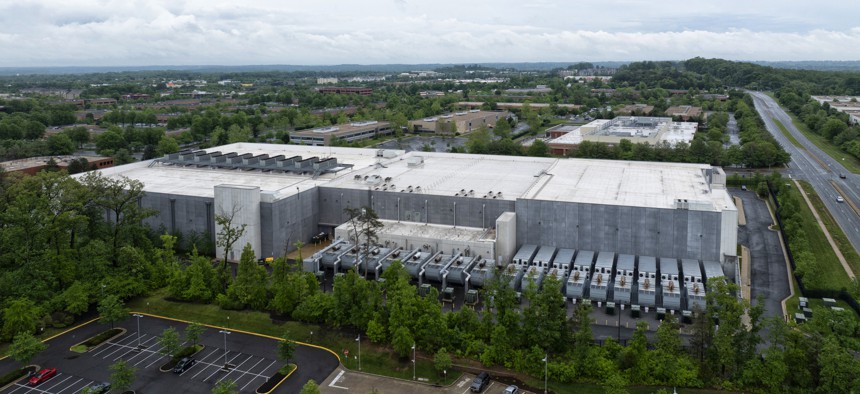
By the mid-2020s, the magnitude of development was difficult to overstate. Northern Virginia had emerged as the world’s largest cluster of data-center infrastructure, with Ashburn — widely known as Data Center Alley — functioning as a core global interconnection hub. Thousands of megawatts were already in operation, thousands more were under construction, and tens of thousands remained in various stages of the planning process.
Even the world’s digital capital has its constraints. In multiple recent instances, residents became aware of large data-center proposals only after land had been consolidated and rezoning efforts were already moving forward, often shielded by nondisclosure agreements that limited public discussion by officials and landowners alike. After years of rapid growth, Loudoun and Prince William counties began encountering constraints no incentive package could resolve. Transmission capacity tightened. Project timelines lengthened. Noise, water use, and land consumption emerged as political flashpoints.
Loudoun County stepped back from automatic by-right approvals, a notable change for a jurisdiction that had long functioned as a de facto fast-track for data-center projects. Prince William County, meanwhile, became a national flashpoint over the proposed Digital Gateway, setting billion-dollar developers against preservationists, homeowners, and tribal leaders. An industry that had operated largely out of public view suddenly moved to the center of public hearings, campaign mailers, and local elections.
As Northern Virginia began to encounter the constraints of its own success, development pressure shifted south. Henrico County landed Meta’s East Coast campus. Culpeper moved to establish a technology zone aimed at attracting hyperscale operators. Chesterfield County provided one of the clearest signals of this transition when Google announced plans for a multibillion-dollar campus at Bermuda Hundred, the product of years of confidential negotiations and the quiet consolidation of more than a thousand acres. By then, Virginia was no longer dealing with activity isolated to Northern Virginia; it was grappling with the statewide implications of infrastructure operating at global scale.
Industry analyses indicate that Northern Virginia represents a substantial share of global hyperscale data-center capacity, on par with entire national markets. In many countries — China, for instance — comparable infrastructure primarily serves domestic users and national platforms. In the United States and, by extension, Virginia, much of that capacity supports global cloud services, meaning decisions made at the local and state level now carry consequences for cloud reliability, artificial intelligence deployment, and U.S. technological competitiveness.
The same dynamics that fueled Virginia’s rise are now placing increasing strain on it. Dominion Energy’s long-term load projections have climbed sharply, driven in large part by data-center demand—a trend the company’s CEO, Robert Blue, has acknowledged publicly. Across multiple localities, projects have been delayed, scaled back, or rejected amid zoning conflicts, transmission limitations, and mounting community opposition. At the same time, other states, including Texas, are positioning themselves as serious competitors by combining expansive land availability with aggressive energy-infrastructure investments aimed at next-generation computing and large-scale artificial intelligence workloads associated with firms such as OpenAI.
The benefits are still significant. Chesterfield officials have characterized Google’s data-center project — the largest capital investment in the county’s history — as a long-term fiscal anchor expected to produce millions of dollars in annual tax revenue. Local leaders have also stressed that data centers vary widely in scale and impact, and that partnerships with top-tier operators can deliver distinct economic returns.
At the same time, the costs are becoming harder to ignore. Farmland loss, escalating energy and water demand, community fatigue, and pressure on electricity rates driven by large-scale grid expansion have moved from theoretical concerns to practical ones. State legislative analysts caution that without constraints, continued growth could sharply increase Virginia’s electricity demand in the decades ahead.
Even so, Virginia still lacks a cohesive statewide framework for managing an industry whose impacts now extend well beyond any single county. Local governments continue to negotiate independently with multinational firms, residents often encounter projects only after pivotal decisions are already in motion, and grid upgrades proceed on timelines measured in decades rather than election cycles.
Northern Virginia built the digital capital of the world. That scale is now reshaping the rest of the Commonwealth, whether communities are prepared for it or not.
Growth itself is not the problem. Nor is technology. The risk lies in allowing a transformation of this magnitude to unfold without mechanisms that align land use, energy planning, and economic development across jurisdictions.
If Virginia intends to remain a central node in the global digital economy without sacrificing landscapes, local authority, or long-term planning capacity, it will need to supplement local decision-making with broader coordination and forward-looking infrastructure policy. Without that shift, growth will continue to accumulate incrementally — one rezoning, one interconnection, one variance at a time — until the consequences become visible only after the window to plan has already passed.