
How Virginia became the world’s data center capital and how it’s going
Gerville via Getty Images





From AOL’s arrival in Ashburn to today’s AI-driven boom, Virginia became the backbone of the internet economy. Now lawmakers are debating how to manage the industry’s soaring energy demands and economic influence.
This article was originally published by Virginia Mercury.
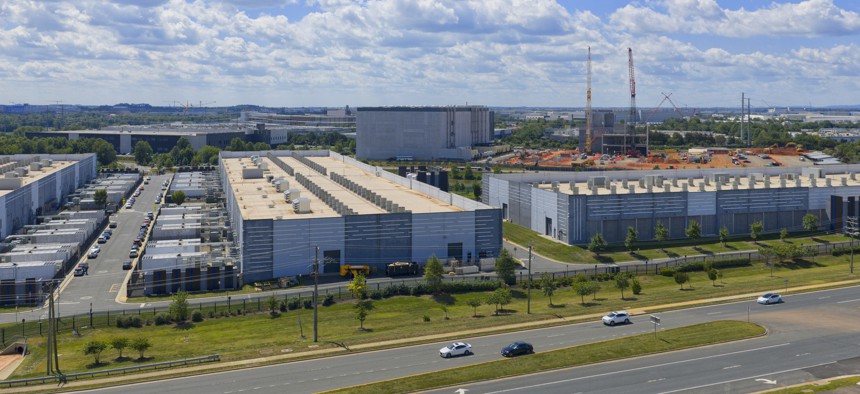
Demand for internet access and electronic storage has grown alongside digital technology itself. At the center of that growth are the energy infrastructure and data centers that governments and companies began developing in Northern Virginia in the late 20th century. Today, the region houses the world’s largest concentration of data centers, making Virginia the nation’s digital capital.
That growth has brought major economic benefits for local governments, but it has also divided communities increasingly weary of the facilities’ heavy demands on water and energy, among other impacts.
The commonwealth’s rise as a global digital leader did not happen overnight, said House Technology Committee Chair Cliff Hayes, D-Chesapeake. It was a result of years of persistence, long-term planning and problem-solving.
”This designation for the commonwealth to be the digital capital not only of this country but of the world has taken a lot of stamina, resilience and vision,” Hayes said.
Hayes said leadership also means adapting to new challenges. This year alone, lawmakers passed an entire package of bills aimed at further regulating the industry, while the fight over tax incentives remains largely unsolved.
AOL’s Move
Ashburn’s rise as one of the largest digital infrastructure hubs began in 1997 with the arrival of America Online, or AOL, then the primary internet gateway for many users. Soon after, UUNet/WorldCom and the relocation of the Metropolitan Area Ethernet East, a major internet exchange and traffic hub, helped create unmatched fiber connectivity, turning Loudoun County into a key internet crossroads and destination for other businesses.
Buddy Rizer, executive director for Loudoun County Economic Development, said AOL’s decision to locate in Loudoun helped make the internet mainstream for Americans and anchored the infrastructure that turned Loudoun and Virginia into the world’s leading internet hub.
“You can’t overstate the importance of AOL, right? AOL didn’t invent the internet, but they made it accessible to ordinary Americans at the moment that the commercial internet was starting to take off… by the late 1990s AOL had 20 million subscribers, and roughly half of U.S. homes that had internet were using AOL by 1997.”
Rizer said once Loudoun established core infrastructure and attracted a few anchor companies, growth became compounding: infrastructure drew companies, companies brought more infrastructure and the cycle continued for roughly 20 years.
Data Storage and Computing Explodes
While data centers have existed in Virginia for decades, the recent rise of artificial intelligence has accelerated demand for the warehouse-like facilities that store and process data around the world.
Ali Mehrizi-Sani, a professor at Virginia Tech, said Northern Virginia had many of the right ingredients to attract the industry even before the state sales and use tax exemption passed in 2008.
“The fact is that we have a lot of customers of data, and that’s really the federal government and their contractors,” Mehrizi-Sani said. “They use a lot of data, so really just proximity to Washington, D.C. has been a main driver of honestly everything in Virginia, including data centers.”
The early development of the internet exchange points in Virginia, combined with large stretches of undeveloped land in Northern Virginia, also helped fuel the industry’s growth. Loudoun County, for example, was far more rural than it is today.
Loudoun recorded 71 operating data centers, the most of any locality in the commonwealth, according to a 2024 study by the Joint Legislative Audit and Review Commission. Statewide, 131 data centers were operating at the time.
“That’s why you see data centers are coming further south, even to areas like where I live in Roanoke and Botetourt County, essentially in search of land,” Mehrizi-Sani said.
He said data centers have also remained in Virginia because electricity rates are comparatively lower than in other parts of the country. Another major factor is the state’s sales and use tax exemption.
Tax Breaks and Tax Gains
In Loudoun, data center revenue has generated substantial tax income year after year, providing the county with more than $100 million annually to support schools and government services.
The revenue stream — estimated at about $890 million in 2018 — has grown enough that the county has reduced real estate tax rates for homeowners every year for the past decade, according to county officials.
Revenue from data centers has also allowed county leaders to propose reducing the personal property tax rate on vehicles beginning in tax year 2026 and eliminating the $25 vehicle license fee.
In 2008, the General Assembly approved a statewide incentive allowing data centers to avoid the state’s 5.3% sales and use tax, which at the time was estimated to save the industry about $1.5 million annually. Data centers routinely refresh computer equipment and software, the exemption can significantly reduce costs every few years.
Now, however, the cost of the tax break has ballooned to about $1.9 billion annually in foregone state revenue.
While the tax break had previously been extended, and former Gov. Glenn Youngkin sought to continue it through 2050 in his final budget proposal, debate over potentially ending the incentive led to months of negotiations and brought Virginia to the brink of a government shutdown after lawmakers failed to pass a budget until the final days of June.
Some lawmakers argued the industry had benefitted enough from the tax exemption. At the same time, concerns over rising energy costs and environmental impacts prompted legislators to look for ways to reclaim some revenue from the trillion dollar industry.
But Gov. Abigail Spanberger led the push to preserve the tax break, arguing Virginia had “made an agreement” and should not reverse course. The exemption is currently set to expire in 2035 unless lawmakers change it before then.
“We know technology is not bad,” Senate Finance Committee Chair Louise Lucas, D-Portsmouth, said last month. “We all can benefit from technology, but we, as a government, have not done a good job in managing the regulations and the impact on our communities, and that’s what we’ve got to rein in. But we’ve also got to reign in the fact that data centers – they’re some of the largest corporations on the face of the Earth, trillion dollar organizations – are getting tax exemptions right now.”
While the exemption ultimately remained in the budget, lawmakers approved a new energy consumption tax on data centers expected to bring in a total of $600 million annually, or $1.2 billion over the biennium. The industry will pay 1.1 cents per kilowatt-hour of electricity consumed up to the cap, with any excess refunded at the end of the fiscal year.
Dominion Energy and Mecklenburg, Northern Virginia, and Rappahannock electric cooperatives reported in 2023 that data centers used about 5,050 megawatts of power that year, based on peak-load forecasts, according to the Joint Legislative Audit and Review Commission.
“What I have found is that some of the businesses coming to our commonwealth, they want to make investments in our communities and in our workforce. The consumption tax, as we’ve conceived of it here in the commonwealth, is one that’s based on fairness,” Spanberger told The Mercury last month.
Lawmakers also approved new water use regulations for data centers in areas designated as water scarce and within the water management area east of Interstate 95.
The changes aim to push facilities away from evaporative cooling systems that consume millions of gallons of water annually and toward more efficient technologies. Also, for the first time, the state will regulate data center noise levels.
The General Assembly also passed bills requiring cleaner backup generators that emit fewer carbon emissions and measures intended to help localities better assess the residential and environmental impacts of proposed facilities.
Public Policy
In 2010, Virginia created a retail and sales tax exemption for data centers, a factor companies have consistently identified as important in site selection.
Loudoun designated large areas for industrial and employment uses where data centers could be built, helping reduce development timelines and support continued growth.
Through successive comprehensive plans, Loudoun also reserved large tracts of land in eastern Loudoun — near Washington Dulles International Airport and the W&OD Trail — for industrial and employment uses close to existing fiber networks and electrical infrastructure. The move ensured a long-term supply of development-ready sites for large-scale data center campuses.
Opposition from residents has grown in recent years, with hundreds of community members attending local government meetings to oppose projects near homes, drinking water supplies and high-voltage transmission lines. Residents have urged lawmakers to impose stronger regulations and seek greater financial contributions from the industry for supporting infrastructure.
What’s next
Last week, lawmakers ordered a work group to study how the data center tax exemption could be phased out or modified to generate additional state revenue. A report is due in November.
While Spanberger has described the new consumption tax as “fair,” the data center industry disagrees. After lawmakers approved the budget amendments last week, Data Center Coalition CEO Josh Levi said the new tax will “drive away investment and job creation, and tarnish Virginia’s reputation.”
“The message to businesses in all industries is clear — Virginia is no longer a reliable partner,” Levi said in a June statement.
Rizer argued that Loudoun’s and Virginia’s future depends on treating data centers as a foundation for broader technology growth while maintaining a stable and predictable business climate.
“You can’t take success for granted … the principle that made us successful is a predictable, welcoming environment with predictable tax and policy issues,” Rizer said. “The only way that that success can go into the future is by staying grounded in those principles that brought us this far.”
As for federal involvement in an issue that has become a national flashpoint, Democratic U.S. Sen. Tim Kaine of Virginia, who was governor when the tax exemption passed, said states should decide individually how to manage data center growth rather than adopt a one-size-fits-all approach.
“(Data centers are a) global phenomenon, and being a leader in this important area is good for America’s national security and for Virginia’s economy,” Kaine said. “But there are real challenges when it comes to water, power and land use, so local communities must get a say when it comes to how to handle them.”
Virginia has become the state that many others are watching as they weigh to and regulate the growing data center industry. Lawmakers now face balancing the promise of economic investment with mounting concerns from residents pushing back against continued expansion.