
What Rhode Island lawmakers did — and didn’t do — on AI, crypto and data centers
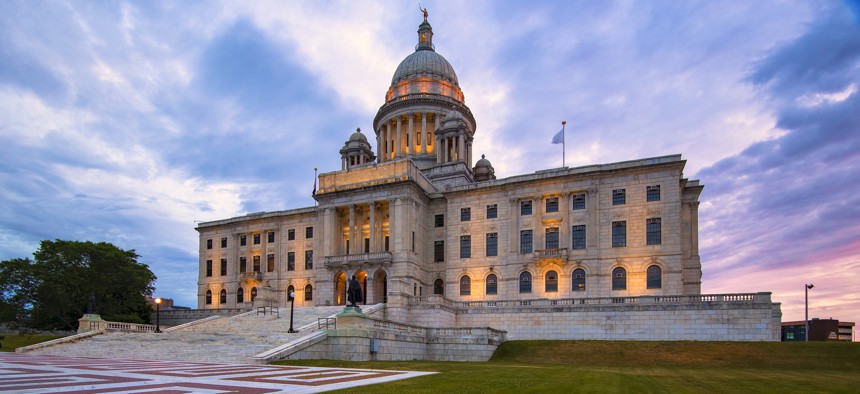
Shobeir Ansari via Getty Images





Lawmakers passed limited AI rules for companion models and healthcare. Broader tech regulations, including data centers, largely stalled, although a cryptocurrency study commission is finally coming.
This article was originally published by Rhode Island Current.
Technology moves fast. The Rhode Island State House moves a little slower.
Nevertheless, the Rhode Island General Assembly made several spirited attempts this year to legislate and regulate an increasingly speedy digital realm — with much of that speed derived, of course, from generative AI’s profound effect on all manner of digital life, work and productivity.
Among the laws Gov. Dan McKee signed shortly after the 2026 legislative session ended were three proposals which regulate specific uses of AI.
One of these efforts was spearheaded in the Senate by Sen. Lori Urso, a Pawtucket Democrat, whose S2195 and its House companion will now require platforms for AI “companion” models — which are designed to mimic interaction with humans via sustained conversations — to set up protocols for users who express suicidal thoughts or self-harm, as well as routinely remind users that they are “not communicating with a human,” per the bill text.
But legislators hesitated to approve more systematic efforts at regulating AI, and a larger policy fight over how to regulate data centers ultimately went nowhere.
Sen. Lou DiPalma, a Middletown Democrat and Raytheon engineer who sits on the Senate Artificial Intelligence and Emerging Technologies Committee, submitted and cosponsored both successful and unsuccessful tech-related proposals this year. DiPalma’s bill to set up operational guardrails for data centers — plus another which would have given data centers tax breaks — failed to clear the chamber. On the other hand, the senator’s bill to set up a blockchain and cryptocurrency study commission finally passed after several years of attempts.
DiPalma said Tuesday that, two minutes before speaking to Rhode Island Current, he was “on the phone with people working to solidify the rest of the members of the commission.” The 10-member panel’s interim report is due Jan. 5, 2027, and a final report due Jan. 5, 2028, per the resolution’s amended text.
Dan Hersey, founder of the Rhode Island Bitcoin Policy Initiative, said in an interview Tuesday that the commission’s creation should be viewed as a “foundation” toward “sound digital asset policy.” Hersey added that, given recent headlines on Rhode Island’s business-unfriendly environment, Rhode Island taking crypto more seriously “might be one of the cheapest competitiveness plays that are on the table.”
Other crypto bills, including measures involving private keys and decentralized autonomous organizations, failed this year, but Hersey thought those failures didn’t represent outright rejection. He said lawmakers first need a clearer understanding of blockchain technology and its financial implications before they can legislate it effectively. Hersey pointed to Wyoming, which created a blockchain study commission in 2018 and later enacted dozens of related laws.
“I think we should study everything before we legislate on behalf of it,” Hersey said.
Still, a multiyear push to merely set up a study group for a particular technology might be one example of the legislature’s turtle-like pace. Asked if state government can really keep up with technological advancement, DiPalma said he wasn’t sure.
“The way I answer that question is, if we think we’re going to keep pace, we’re going to fail,” DiPalma said.
“It’s too fast-paced to stay in front of it,” he added, “We have to make certain we’re putting the right kind of safeguards in place to ensure people are not harmed.”
Shriram Krishnamurthi, a professor of computer science at Brown University, offered over email Tuesday what he called a perhaps “overly cynical” take on Rhode Island’s tech-regulating efforts. The crypto study commission, he thought, was a good example, as “the whole phenomenon has gone through most stages of the Gartner hype cycle” — a model used to describe how new technologies move from exaggerated and inflated expectations into a period of disillusionment before reaching a plateau of productivity in which the technology becomes mainstream and widely used.
Rhode Island, however, “always seems to be late to the game,” Krishnamurthi said, and he doesn’t find that tech-related bills have exerted much impact.
DiPalma said, however, that the “easiest way to think about it” is that legislation should help technology increase “things that are being done good for humanity, as opposed to being done bad for humanity.”
All About AI
Apropos of its now ubiquitous public profile, much legislative concern focused on AI this year. Compared to 2025, when legislators submitted approximately four distinctive AI proposals, 2026 saw at least nine distinctive proposals emerge across chambers, with their goals slightly more targeted this time around.
Urso’s AI companion bill — sponsored by Rep. Tina Spears, a Charlestown Democrat, in the House — had meaningful support relatively early in the session and appeared in the annual package of bills prioritized by Senate leadership.
Urso’s bill was also attached to a House package led by Spears which focused on protecting children from digital harm via social media age verification, child-safe design and other topics. Most of these bills did not succeed, but House lawmakers did approve a resolution for a study commission to examine digital technology in public education and its effects on mental health. (Resolutions can take effect without the governor’s signature.)
Another tag-team effort by Urso and Spears that McKee signed, bills S2197 and H7349, regulate the use of AI in mental health treatment. The legislation essentially bars AI from practicing therapy or being used by clinicians to interpret emotions or create treatment plans. Mental health professionals could still use AI for administrative or supplementary tasks, but clinicians cannot outsource any therapeutic decisionmaking to AI.
“It is time to put safeguards in place to protect Rhode Islanders of all ages from this rapidly expanding technology, both at home and in a clinical setting,” Urso said in a statement issued shortly after the bills passed.
The bills H7538 and S2570 were also signed into law last month and took effect upon passage. They will require healthcare providers to notify patients when AI is used to document an in-person or telehealth visit.
DiPalma, who voted for the bill in the Senate, noted that doctors are already using AI “pervasively.” The disclaimer legislation is comparable, he said, to the boilerplate list of side effects that play at the end of pharmaceutical commercials.
“If a doctor can spend more time with patients than writing paper, guess what? I want them on the patients,” DiPalma said, noting that humans still review the transcribed output.
Failures to Launch
The transcription bills passed unanimously in the Senate, as did another AI-in-healthcare effort, S2010, sponsored by Sen. Linda Ujifusa, a Portsmouth Democrat. The four-page bill offered a much more comprehensive treatment of AI use in healthcare by seeking to regulate how health insurers can or cannot use AI to manage coverage and claims.
But Ujifusa’s bill did not clear the House, and its companion bill in that chamber, H7190, never left committee. Ujifusa said via text message Tuesday that she plans to reintroduce the bill next year.
Five other AI bills failed along the way. One was an 11-pager that sought to institute sweeping regulations on workplace surveillance, automated employment decisions and AI-driven decision making in the workplace. It also passed the Senate but did not clear the House.
Other AI bills which failed include:
- Legislation to inventory AI systems used by state agencies.
- A House bill requiring watermarks on AI-generated photos and videos “posted on a public platform.”
- A separate House-exclusive bill which would have created a civil cause of action for “individuals injured by artificial intelligence.”
- A Senate-only bill which would have broadened state laws against child sexual abuse material to include “computer-generated” depictions of minors, regardless of whether the minor depicted “actually exists.”
Data center legislation also had a moment during the middle of the legislative session, with two of the six relevant bills sponsored by DiPalma. The senator’s bills, as well as those submitted by his legislative colleagues in both chambers, never cleared committees or made it to floor votes. But the legislation would have instituted safety rails and ratepayer protections for any data centers built in the Ocean State. Another DiPalma bill would have given a tax break to data center operators.
Still, DiPalma said Tuesday, the issue is far from settled. He said states which invited data centers early on, like Virginia, “have seen the detrimental side of things without having guardrails that we were looking to put in.”
“So we need to figure out what makes sense for Rhode Island,” he said, adding, “Data centers aren’t going away.”