
Governors take major actions on AI
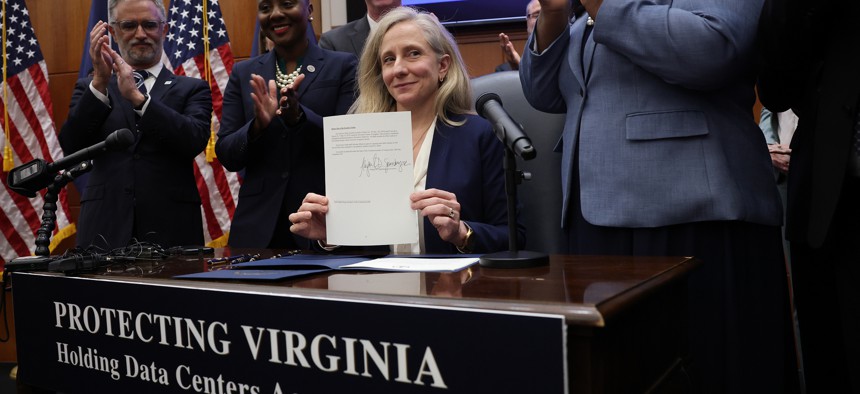
Virginia Gov. Abigail Spanberger at a signing ceremony for her Data Center Accountability Framework, a set of standards for the centers' development. Win McNamee via Getty Images





 By
Chris Teale
By
Chris Teale
An executive order by California Gov. Gavin Newsom looks to boost oversight of the tech, while Virginia Gov. Abigail Spanberger’s order tightens data center standards.
Two Democratic governors on opposite sides of the country signed directives last week to place new limits on artificial intelligence and the infrastructure that supports it.
California Gov. Gavin Newsom signed an executive order that he said would “dramatically” accelerate the implementation of new third-party oversight of AI systems’ safety and security risks, and require independent audits.
Newsom’s order brings together a task force of technology experts, and mandates that within two months they provide a guide on how the state can strengthen its AI laws. Proposals include a requirement that independent third parties write safety plans for AI companies, and that those companies develop an emergency shut-off function known as a “kill switch” for their frontier models.
“The federal government’s abject failure to create any form of meaningful AI oversight or accountability should alarm every American, especially when AI CEOs themselves are begging for regulation,” Newsom said in a statement. “We’re not waiting to act — we’re going to speed up our work on substantial and responsible AI oversight before it’s too late. We’re going to do this thoughtfully but with urgent velocity; the stakes are too high to wait or delay action.”
Newsom said this latest order is a natural extension of the work California has already done to regulate AI and provide safeguards. In September, he signed legislation to establish a framework for independent organizations to operate under and assess AI models’ safety and security, as well as another bill to create a state registry for AI auditors to assess AI systems and models for compliance with state law and establish standards for their independence, transparency and integrity.
And the potential building of kill switches, which would mandate that developers establish the technical capability to immediately shut down a given AI model’s ability to operate as a means to prevent similar automated hacking incidents, has garnered much attention in recent months. In July, Reps. Ted Lieu, a California Democrat, and Nathaniel Moran, a Texas Republican, introduced the AI Kill Switch Act in Congress, days after OpenAI confirmed that its models attacked fellow AI company Hugging Face’s data pipelines while being internally tested.
That bill, like every other suggested AI proposal in Congress, has yet to make progress, something Newsom said shows the need for state action.
“While Washington abdicates its responsibility to protect Americans, California is building on the strongest AI regulatory framework in the nation,” he said. “California has already built a national model, and our policy should be the national baseline.”
Across the country, meanwhile, Virginia Gov. Abigail Spanberger unveiled a massive effort designed to enhance standards around data centers, an aspect of AI that has proven immensely controversial in local communities across the U.S., and also create a state AI task force.
Spanberger’s “Data Center Accountability Framework,” which is to be at least partially mandated via executive order as well as proposed legislation for Virginia’s 2027 session, would look to increase transparency, enforce strong environmental protections, lower energy costs, protect the grid and give workers a better deal.
Among its many tenets, any entity under the governor’s supervision would be banned from entering into a nondisclosure agreement for a data center project, and the state will create an initial Data Center Planning and Community Engagement Toolkit for local governments and communities to help them get a better deal. Spanberger’s order also would expedite the development of data center noise regulations, review backup power generation options, work to direct investments into local energy projects and develop best practices on prioritizing creating good jobs.
That this effort comes in Virginia, where localities have relied heavily on data centers for tax revenue and development, is significant as those same localities reckon with the centers’ impact on their residents. Spanberger said in a statement that her framework is “about delivering a better deal for Virginians and holding data center companies, developers, and operators accountable.”
“In the years before I took office, data centers came to Virginia and the Commonwealth did not have a clear or coordinated plan to address their impacts on Virginians — on their electric bills, their water, their land, their air, or their quality of life,” Spanberger continued. “That changes today. I have said many times that Virginia should be leading the nation in setting the highest standards for this industry. And now, I believe we are doing just that.”