
‘Not enough data or expertise’: Oklahoma lawmakers consider future of data centers
EJ_Rodriquez via Getty Images





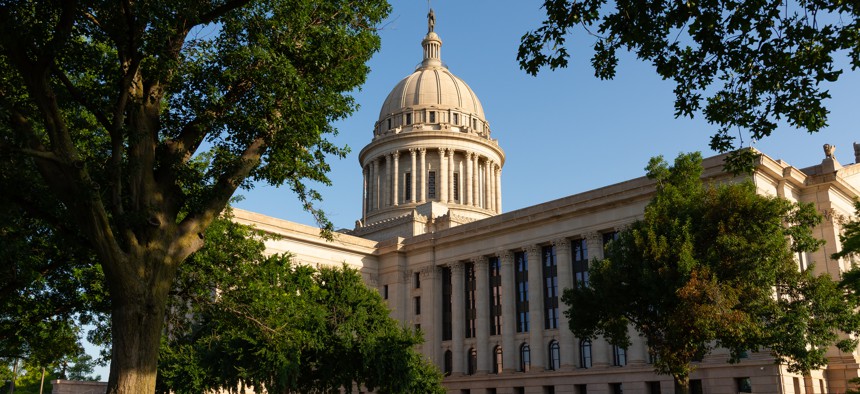
House lawmakers listened to presentations at the state Capitol on the impacts data centers have on Oklahoma.
This article was originally published by Oklahoma Voice.
OKLAHOMA CITY — Nearly a dozen state lawmakers heard from operators, developers, environmental agencies, local elected officials and concerned Oklahomans Tuesday as they weigh the best way to regulate the rapidly changing data center industry.
Oklahoma lawmakers held the study in hopes of finding a legislative solution that balances the needs of data centers operators with the growing concerns of residents. Residents in Oklahoma and across the country are concerned about the impact the massive facilities, which house and maintain the physical equipment needed to process digital information, will have on their utility bills and how much water they consume.
Some Oklahoma governments, like in Oklahoma City and the Seminole Nation, have enacted moratoriums on new construction as the demand for data centers increases with growing use of artificial intelligence.
Rep. Mark Chapman, R-Broken Arrow, who hosted the study, said state lawmakers need to look at the issue from multiple perspectives and figure out how to be as fair as possible to both data centers and Oklahomans when regulating the industry.
“Some people may be completely on one side or the other of this issue,” he said. “But I would like to think that, as with most things, the truth may fall somewhere in the middle.”
Chapman said data centers are coming to Oklahoma either way and the state needs to decide how it wants to participate.
“I’m not saying any of this to be a cheerleader for the data center industry,” he said. “I’m simply pointing out that regardless of where you stand on future data center development, we already use them all the time.”
He said he and other lawmakers should be wary of “one-size fits all” solutions.
Kaily Ball, a resident of Kingfisher County, said she began researching data centers when one began being developed five miles from her family’s farm, which they’ve been operating for five generations.
For Ball, the more than a thousand hours of research she’s done was necessary for her survival and her family’s long-term planning. She said she’d previously dealt with kidney failure as a result of heavy metal poisoning that left her more susceptible to water quality and environmental concerns.
She said she’s spoken over a thousand concerned Oklahomans as well as elected officials, data center developers and operators, and there’s frustration with the lack of transparency and information available on all sides.
“What I’ve seen from all sides of the issue is not that there’s not enough data or expertise,” Ball said. “It’s that we’re missing the connective tissue that brings them all together in a way that reduces the administrative burden on everyone.”
Among the concerns on the top of Oklahomans’ minds is water use, Ball said, as well as noise, construction traffic, contaminated natural resources, rising energy bills, and more.
Water and Energy Use
Chris Neel, the division chief of Water Rights Administration Division with the Oklahoma Water Resources Board, said the demand for water from data centers is immense, but the board doesn’t always have oversight of its use.
Google’s data center in Pryor uses an estimated 2.8 million to 3.76 million gallons of water per day, he said. In comparison, Norman, a city serving about 108,000 people, used an average of nearly 24 million gallons of water per day in August.
Google’s data center in Stillwater is estimated to use 5 million to 6 million gallons per day, Neel said.
Pryor Mayor Zac Doyle said Google’s data center, located at the MidAmerica Industrial Park, has been there for nearly 20 years and his community has benefitted through reduced utility bills, jobs, partnerships with local businesses and increased funding and grants.
He said his constituents in Pryor don’t seem to have an issue with data centers, but there’s some hesitation from private landowners just outside city limits who don’t want a data center built near their homes.
“In town, we’re used to it and we appreciate it,” Doyle said.
In addition to the Pryor data center, Google is planning new campuses in Stillwater, Owasso, and the Muskogee County towns of Summit and Council Hill. Data centers with other companies are planned, proposed or being built in other places across Oklahoma, like the recently announced Lambda data center in Chouteau.
Kimber Shoop, the director of regulatory affairs for OG&E, said the utility company has worked to make sure that large load consumers, like data centers, don’t pass costs onto regular ratepayers through a series of checks and balances.
Those include long-term commitments, contract termination fees, extra charges if ratepayers are negatively impacted and upfront grid connection costs.
“If you think about our costs as a big pie, all of our costs, our infrastructure, our capital, our expenses all go into a pie,” Shoop said. “And then when we set rates, we divide that pie up into slices. Residential customers get a slice, industrial customers get a slice, small commercial customers get a slice. But when we add a very large customer like a data center, Google, they take a huge piece of that and everybody else’s slices get smaller. That is the benefit.”
When data centers are responsibly connected to the grid, it can lower energy costs for consumers, said Matthew Horeled, vice president of commercial and regulatory operations with PSO.
He said the state should emulate Indiana Michigan Power, which is set up similarly to Oklahoma’s utility companies. They are about two years ahead of Oklahoma in data center growth and development, Horeled said, and have recently filed a rate decrease for their ratepayers because of increased revenue from data centers.
Lawmakers have previously made attempts to regulate data centers.
House Bill 2992 was signed into law this year to require new data centers to pay for their own infrastructure and the energy they consume, among other stipulations.
Senate Bill 259 was also signed, requiring data centers that want to use groundwater to implement a closed-loop cooling system, which loses less water than the common alternative of open-air evaporative cooling.
Passed last year, Senate Bill 480 allows data centers to build their own power plants, bypassing utilities.
NEXT STORY: Why New York City has become an AI Mecca