Federal judge blocks Trump administration’s overhaul of SAVE database
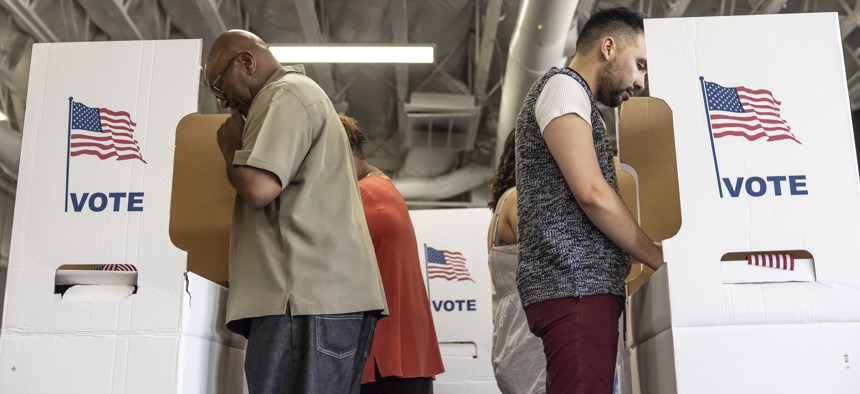
LPETTET via Getty Images

Several states have used the revamped database to verify voters’ citizenship, but the judge said this threatened their privacy and voting rights.

This article was originally published by Votebeat.

A federal judge on Monday blocked the Trump administration’s overhaul of an immigration verification system to check voter eligibility across the nation, striking down a central pillar of the government’s efforts to exercise more federal control over elections.

The judge cited Texas’ use of the Systematic Alien Verification for Entitlements, or SAVE, database, which flagged several voters who were actually citizens as noncitizens, as evidence that it threatened both privacy and voting rights less than five months before the November midterm election.

“The federal government has knowingly trampled on the privacy rights of American citizens in a manner that threatens the sacred right to vote,” Judge Sparkle Sooknanan said in her 75-page ruling. “This Court cannot stand idly by while that happens.”

Sooknanan’s decision does not eliminate SAVE, a decades-old immigration-status verification program. But it blocks the Trump administration’s 2025 overhaul of the system, which made it easier for states to check their voter rolls against the federal database, which includes individuals’ citizenship status and Social Security numbers.

Election officials have found that the modified database, however, is prone to error, something Sooknanan referenced in her decision. Federal officials, she wrote, “haphazardly combined and repurposed the private information of millions of Americans, including citizenship data that they knew to be unreliable.”

The ruling could strengthen challenges by voters who were removed, flagged, or placed under review by the system.

“States have partnered with the federal government to access the database and are actively removing United States citizens from voter rolls based on inaccurate information,” the judge wrote.

Voting Rights Groups, Trump Administration React to Ruling

The case was filed by the League of Women Voters and other groups who argued that the SAVE system was inaccurate and that using it to check voter rolls violated citizen privacy rights.

“Today’s decision is a resounding victory for voters,” said Marcia Johnson, chief of activation and justice for the League of Women Voters. “Efforts to create a federal voter database to facilitate voter purges threaten the fundamental right at the heart of our democracy.”

Justin Levitt, a professor at Loyola Law School who worked in the White House on democracy and voting rights issues under President Joe Biden, agreed that voters would benefit from the ruling.

“This provides incremental reassurance that they won’t be inaccurately singled out and have to jump through even more hoops to vote,” he said. “It stops the use of a deeply flawed process to cause trouble for real eligible citizens.”

However, James Percival, the general counsel at the Department of Homeland Security, which maintains the SAVE database, criticized the ruling as a misguided effort to block the Trump administration from trying to address voter fraud.

“It’s amazing how hard the Left will fight to stop us from solving problems they insist do not exist,” Percival said in a statement.

The Justice Department did not immediately respond to requests for comment.

Michael Morley, a professor at the Florida State University College of Law and faculty director of the FSU Election Law Center, said the ruling prevents the federal government from using all the information at its disposal to ensure that only eligible voters take part in elections.

“It seems to leave the government in a somewhat tenuous position of being able to provide citizenship data to states for voting purposes that is less accurate than it otherwise would be,” he said. “It restricts the government’s ability to take advantage of all of the most accurate sources of information it has in order, in most cases, to confirm people’s citizenship status.”

Judge Cites Texas’ Use of SAVE Database in Ruling

Texas intervened as a defendant in the case since it had been actively using SAVE to verify the citizenship status of its more than 18 million registered voters. The state gained access to the database in March 2025 after signing a memorandum of agreement with the Department of Homeland Security.

In October, the Texas Secretary of State’s Office announced SAVE had flagged 2,724 people as “potential noncitizens” and sent the list to county election officials to investigate. That process involved mailing letters to each person flagged, requesting additional information to verify their citizenship. If county officials received no response after 30 days, the person’s registration was canceled.

Some voters who responded to the notices turned out to be U.S. citizens after all; others had their registrations canceled, although a specific number hasn’t been released. Hundreds of other registrants who were flagged had registered at the Texas Department of Public Safety, the agency that issues driver’s licenses and state IDs. In Texas, proof of citizenship is required to obtain those documents.

In the ruling, Sooknanan said the state’s use of the database burdened and risked disenfranchising voters by incorrectly flagging naturalized citizens as noncitizens. The judge pointed to examples of voters in Texas who were U.S. citizens and had to provide proof of citizenship to keep their registration active and at least one U.S. citizen whose registration was revoked without their knowledge.

Sooknanan also pointed to an amicus brief filed by Travis County voter registration officials as evidence that the use of the overhauled SAVE database was inaccurate. The state flagged 97 potential noncitizens in Travis County. Voter registration officials found that about a quarter of those voters had registered at DPS and therefore had likely provided proof of citizenship.

Travis County officials were later able to confirm that at least 11 people who were flagged as potential noncitizens were in fact citizens.

“Texas threatened to revoke their voter registrations because of information obtained through the modified SAVE system; and they were required to confirm their citizenship to maintain their voter registrations,” Sooknanan said.

The secretary of state’s office did not immediately respond to a request for comment.

Celia Israel, the Travis County tax assessor-collector and voter registrar, said the ruling is “validating.”

“We have asked a lot of questions in the past several months about the SAVE database and about its accuracy,” Israel said. “The lawsuit confirms that there are inaccuracies and that it is worthwhile for us officials at the county level to ask the state questions.”

Other civil rights groups and voters have also challenged Texas’ use of the database in a federal court in Austin. The lawsuit is still pending.

X
This website uses cookies to enhance user experience and to analyze performance and traffic on our website. We also share information about your use of our site with our social media, advertising and analytics partners. Learn More / Do Not Sell My Personal Information
Accept Cookies
X
Cookie Preferences Cookie List

Do Not Sell My Personal Information

When you visit our website, we store cookies on your browser to collect information. The information collected might relate to you, your preferences or your device, and is mostly used to make the site work as you expect it to and to provide a more personalized web experience. However, you can choose not to allow certain types of cookies, which may impact your experience of the site and the services we are able to offer. Click on the different category headings to find out more and change our default settings according to your preference. You cannot opt-out of our First Party Strictly Necessary Cookies as they are deployed in order to ensure the proper functioning of our website (such as prompting the cookie banner and remembering your settings, to log into your account, to redirect you when you log out, etc.). For more information about the First and Third Party Cookies used please follow this link.

Allow All Cookies

Manage Consent Preferences

Strictly Necessary Cookies - Always Active

We do not allow you to opt-out of our certain cookies, as they are necessary to ensure the proper functioning of our website (such as prompting our cookie banner and remembering your privacy choices) and/or to monitor site performance. These cookies are not used in a way that constitutes a “sale” of your data under the CCPA. You can set your browser to block or alert you about these cookies, but some parts of the site will not work as intended if you do so. You can usually find these settings in the Options or Preferences menu of your browser. Visit www.allaboutcookies.org to learn more.

Sale of Personal Data, Targeting & Social Media Cookies

Under the California Consumer Privacy Act, you have the right to opt-out of the sale of your personal information to third parties. These cookies collect information for analytics and to personalize your experience with targeted ads. You may exercise your right to opt out of the sale of personal information by using this toggle switch. If you opt out we will not be able to offer you personalised ads and will not hand over your personal information to any third parties. Additionally, you may contact our legal department for further clarification about your rights as a California consumer by using this Exercise My Rights link

If you have enabled privacy controls on your browser (such as a plugin), we have to take that as a valid request to opt-out. Therefore we would not be able to track your activity through the web. This may affect our ability to personalize ads according to your preferences.

Targeting cookies may be set through our site by our advertising partners. They may be used by those companies to build a profile of your interests and show you relevant adverts on other sites. They do not store directly personal information, but are based on uniquely identifying your browser and internet device. If you do not allow these cookies, you will experience less targeted advertising.

Social media cookies are set by a range of social media services that we have added to the site to enable you to share our content with your friends and networks. They are capable of tracking your browser across other sites and building up a profile of your interests. This may impact the content and messages you see on other websites you visit. If you do not allow these cookies you may not be able to use or see these sharing tools.

If you want to opt out of all of our lead reports and lists, please submit a privacy request at our Do Not Sell page.

Save Settings
Cookie Preferences Cookie List

Cookie List

A cookie is a small piece of data (text file) that a website – when visited by a user – asks your browser to store on your device in order to remember information about you, such as your language preference or login information. Those cookies are set by us and called first-party cookies. We also use third-party cookies – which are cookies from a domain different than the domain of the website you are visiting – for our advertising and marketing efforts. More specifically, we use cookies and other tracking technologies for the following purposes:

Strictly Necessary Cookies

We do not allow you to opt-out of our certain cookies, as they are necessary to ensure the proper functioning of our website (such as prompting our cookie banner and remembering your privacy choices) and/or to monitor site performance. These cookies are not used in a way that constitutes a “sale” of your data under the CCPA. You can set your browser to block or alert you about these cookies, but some parts of the site will not work as intended if you do so. You can usually find these settings in the Options or Preferences menu of your browser. Visit www.allaboutcookies.org to learn more.

Functional Cookies

We do not allow you to opt-out of our certain cookies, as they are necessary to ensure the proper functioning of our website (such as prompting our cookie banner and remembering your privacy choices) and/or to monitor site performance. These cookies are not used in a way that constitutes a “sale” of your data under the CCPA. You can set your browser to block or alert you about these cookies, but some parts of the site will not work as intended if you do so. You can usually find these settings in the Options or Preferences menu of your browser. Visit www.allaboutcookies.org to learn more.

Performance Cookies

We do not allow you to opt-out of our certain cookies, as they are necessary to ensure the proper functioning of our website (such as prompting our cookie banner and remembering your privacy choices) and/or to monitor site performance. These cookies are not used in a way that constitutes a “sale” of your data under the CCPA. You can set your browser to block or alert you about these cookies, but some parts of the site will not work as intended if you do so. You can usually find these settings in the Options or Preferences menu of your browser. Visit www.allaboutcookies.org to learn more.

Sale of Personal Data

We also use cookies to personalize your experience on our websites, including by determining the most relevant content and advertisements to show you, and to monitor site traffic and performance, so that we may improve our websites and your experience. You may opt out of our use of such cookies (and the associated “sale” of your Personal Information) by using this toggle switch. You will still see some advertising, regardless of your selection. Because we do not track you across different devices, browsers and GEMG properties, your selection will take effect only on this browser, this device and this website.

Social Media Cookies

We also use cookies to personalize your experience on our websites, including by determining the most relevant content and advertisements to show you, and to monitor site traffic and performance, so that we may improve our websites and your experience. You may opt out of our use of such cookies (and the associated “sale” of your Personal Information) by using this toggle switch. You will still see some advertising, regardless of your selection. Because we do not track you across different devices, browsers and GEMG properties, your selection will take effect only on this browser, this device and this website.

Targeting Cookies

We also use cookies to personalize your experience on our websites, including by determining the most relevant content and advertisements to show you, and to monitor site traffic and performance, so that we may improve our websites and your experience. You may opt out of our use of such cookies (and the associated “sale” of your Personal Information) by using this toggle switch. You will still see some advertising, regardless of your selection. Because we do not track you across different devices, browsers and GEMG properties, your selection will take effect only on this browser, this device and this website.