
Maryland to expand chip EBT card program statewide
PS Photography via Getty Images






It joins a growing number of states turning to chip technology as a tool against benefit fraud.
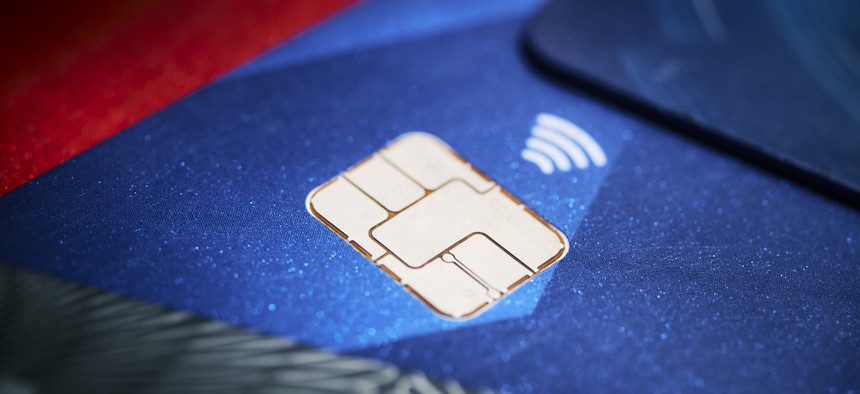
Maryland is rolling out chip-enabled electronic benefit transfer cards statewide following promising initial results from a recent pilot program. The move makes Maryland the fourth state in the nation to adopt the modernized cards.
The Maryland Department of Human Services is currently sending approximately 500,000 of the chip-enabled EBT cards to residents and local aid facilities, said JD Robinson, acting director of the Office of Benefits Access at DHS. The new cards aim to reduce the risk of fraud or theft within the state’s administration of the Supplemental Nutrition Assistance Program and other cash assistance services.
“The front and center point of this whole rollout is security,” Robinson told Route Fifty, particularly as, he said, states are still reeling from “the crisis that we faced in 2022 and 2023, when we saw this meteoric rise in benefit theft that hasn't really slowed down much at all nationwide.”
Indeed, traditional magnetic-stripe cards are susceptible to skimming devices, which can be used to steal card data, and ultimately, the cardholder’s benefits. Since March 2023, DHS has replaced $52 million in stolen benefits, including SNAP and pandemic-era EBT benefits. Nationwide, government benefit fraud has increased 182% since fiscal year 2021, according to the U.S. Sentencing Commission.
During a pilot program last month, DHS sent roughly 1,500 chip cards to residents across Anne Arundel and Dorchester counties, as well as Baltimore City. Of that total, 1,049 cards were activated and about half of the transactions they were used for included tap-to-pay and chip insertions, DHS officials said in a July statement.
The main data DHS leaders were monitoring was chip card activation rates and how quickly customers were able to do so before they started making purchases, Robinson said, adding that “we were looking for a 70% [activation rate], and we cleared that.”
Program data also indicated that beneficiaries used the chip cards for ATM and online transactions. Throughout the pilot, 92% of transactions were securely approved and generated more than $191,000 in retailer activity, according to DHS officials. The overwhelming majority of participants — 98% — live within 10 miles of a retailer offering chip-transaction services.
DHS will continue to track card activation and use rates and retailers in the state who are able to participate in chip card technology, Robinson said.
Maryland joins three other states — Alabama, California and Oklahoma — who have already adopted and began rolling out chip EBT cards.
The California Department of Social Services reported in January that EBT theft declined 83% by Nov. 2025 after implementing anti-fraud initiatives, including the deployment of chip cards earlier the same year. Alabama and Oklahoma officials started mailing out chip EBT cards to residents this year, following their respective pilot programs conducted in late 2025 and this past spring.
Other state leaders have indicated that they will begin transitioning to chip cards, particularly as states face heightened scrutiny toward the accuracy of their public assistance programs.
The New Jersey Department of Human Services announced last month that it is launching a pilot program for chip cards this summer in three counties over the course of four weeks.
New York Gov. Kathy Hochul recently announced that the New York State Office of Temporary and Disability Assistance has contracted with a vendor to begin issuing new EBT cards beginning next year. And Pennsylvania Gov. Josh Shapiro has also approved the state’s budget for next year with $7 million allocated for replacing magnetic-stripe EBT cards with chip technology.
For Maryland and other states, chip cards can offer officials and benefit recipients relief, Robinson said, because too often benefits are stolen, and “people come to the checkout line, pull out their old EBT card … and they swipe it, and they see they have nothing on there.”
“The ability for us to have this basic level of security,” he said, “cannot be overstated.”