
How tech can help localities solve weather gaps
Robbie Russell via Getty Images




 By
Chris Teale
By
Chris Teale
National Weather Service radars may miss storms or other incidents, but now local governments are investing in their own equipment to supplement those federal tools.
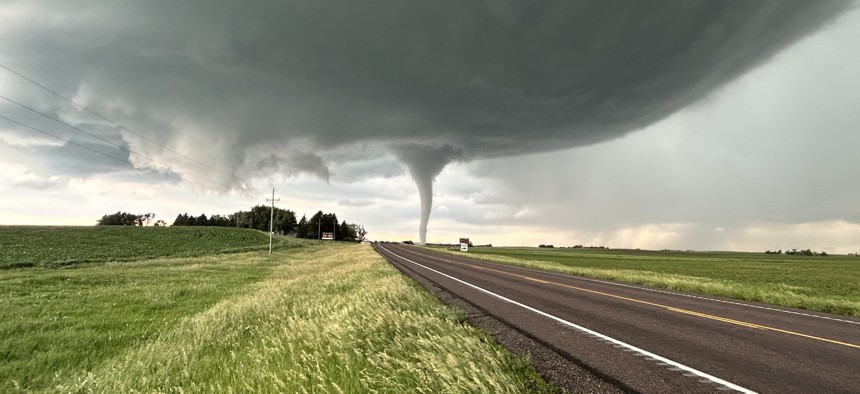
When a tornado touched down in Lee County, Florida several years ago and moved through a populated area, local officials thought the National Weather Service would have warned them beforehand.
But neither the assigned NWS forecast office in Tampa Bay nor the other closest in Miami issued a tornado warning to Lee County. Ben Abes, the county’s director of public safety, explained that, upon contacting the NWS, officials there said they had not seen the tornado approaching on their radar.
When it hit around 6:30 a.m., the county received multiple 911 calls and had first responders in the middle of a shift change, but formal warnings needed to come from weather forecasters, so Lee County was caught flat-footed in its response.
“There was this really significant disconnect that unfortunately we understood in great detail,” Abes said. “Thankfully, no fatalities, but we had some injuries and we had a tremendous amount of damage we had to clean up from.”
The incident stemmed from a phenomenon known as radar gaps, where weather or other climate activity is too low to be seen by the radars controlled by the NWS and National Oceanic and Atmospheric Administration weather stations, but it still has real-world impacts. Partly, that is due to aging technology that lawmakers have sought to upgrade and replace, and it is estimated to impact millions of people and leave them vulnerable to tornadoes, floods and more.
Job cuts and other turmoil at NOAA and NWS wrought by the Department of Government Efficiency have worsened the predicament, and led many state and local governments to turn to technology to try and stay ahead of the problem themselves and supplement federal forecasting tools.
Lee County, for example, has been hit by Hurricanes Irma and Ian in recent years, and since then has invested in its own tools to provide localized weather forecasting and data. Abes said that has included tidal gauges from Hohonu and the weather intelligence platform Weatherstem, as a lack of localized data before had left the county “fairly blind,” he said.
The county also just installed an enhanced radar system from Climavision, which not only tracks major weather events like thunderstorms and hurricanes, but also air quality and other metrics. Having a localized radar can pick up on events that NWS may miss, and it can then be used to supplement their existing infrastructure and radars to build a fuller picture of what is happening.
“There's a lot of things that happen at the lower levels of the atmosphere that are not visible, and so they don't get a special weather statement, they don't get a severe thunderstorm warning because, from their vantage point, they don't have the same visibility as they would storms that are directly adjacent to the Tampa Bay region,” Abes said. “We're a solid hour-and-a-half drive from the Weather Service office. If you're 15 or 30 minutes away from the Weather Service office, they could tell you the moment it starts raining, but they can't necessarily see that until some of the storms really explode here in Southwest Florida.”
Cities, counties and state governments are on the forefront of dealing with more extreme weather, especially as the nation and the world reckon with the effects of climate change and a rapidly warming planet creating more instability in the atmosphere. And perhaps the biggest issue for governments at all levels is finding the money to make themselves more resilient and better prepared for extreme weather.
“There will never be enough public dollars,” Melissa Hoffer, Massachusetts’ climate chief, said during a webinar last month hosted by Clark University. “What we had previously in the [Inflation Reduction Act] was a good accelerator, which we don't have anymore. But now without that, we have to figure it out. People at the local government level are the ones that are dealing with this issue, no matter if the federal government is there or not.”
The constraints on public dollars have led to greater calls for public-private partnerships, like the kind underway in Lee County, where private industry helps governments better track local weather using high-end tools. Providers, then, need to show that they are not trying to privatize weather but are supplementing what already exists and doing so to help the public good.
“The technology that we bring to the table is not here to replace the National Weather Service,” said Tara Goode, Climavision’s vice president of strategic partnerships and radar operations. “The number one thing we need to do is prove that we work with the National Weather Service, which is an easy thing to do. Our data is operationalized in their environment. That provides a lot of confidence and credibility. Any technological provider or potential P3 partner needs to ensure they are being respectful and responsible when they enter that conversation, because it's a non-starter if you try to replace the really great work that's already being done at the federal level.”
For local leaders, such partnerships need a “great deal of scrutiny” to ensure they’re a good fit, Abes said. Lee County has engaged with P3s since 2013, he said, and given how the relationship with NWS has evolved, governments can try something new.
“These are complex problems, and sometimes we get stuck in this rut of trying to solve them the same way,” Abes said. “We’ve tried to take down every possible barrier and find ways to fix those gaps.”