
Missouri AI regulations stall as lawmakers fear loss of rural broadband funds
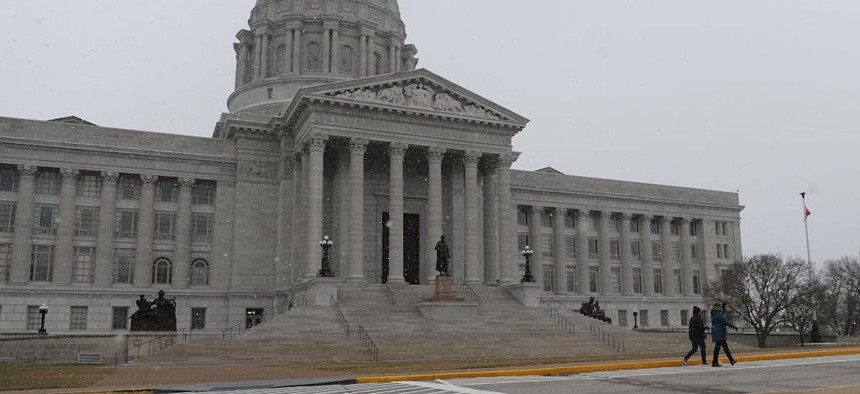
Michael B. Thomas/Getty Images





A Senate bill establishing liability guidelines for artificial intelligence harm has hit resistance from lawmakers who are worried it could provoke retaliation from the Trump administration.
This story was originally published by the Missouri Indepenent.
The promise and peril of artificial intelligence have been a recurring theme for Missouri lawmakers this year, as they debate safeguards on campaign advertisements, companion chatbots and mental health therapy that use the technology.
But efforts to enact regulations in Missouri stalled last week in the state Senate amid fears the legislation could jeopardize nearly $900 million in remaining federal broadband funds for rural internet expansion.
The underlying bill, sponsored by GOP state Sen. Joe Nicola of Grain Valley, would specify that liability for harm caused by an AI system always resides with a person or organization — whether it’s the company that designed and created the system or an individual who used it. Courts would decide where liability lies in specific cases.
The bill would also prohibit AI from being granted legal personhood. People would be prohibited from marrying an AI partner, and AI could not own property or be an officer of a corporation.
“We don’t want anybody, any company or any person, to be able to blame the machine or blame the AI,” Nicola said.
An amendment sponsored by Republican state Sen. Brad Hudson of Cape Fair would require age verification to restrict minors’ use of AI chatbots and make it unlawful to develop or publish chatbots likely to encourage minors to engage in self-harm or sexual conduct.
Another amendment, sponsored by Senate Minority Leader Doug Beck, a Democrat from Affton, would prohibit the use of AI to prescribe medication or controlled substances, while Republican state Sen. David Gregory of Chesterfield attached an amendment banning nondisclosure agreements in lawsuits stemming from the bill.
But the debate turned quickly to broadband funding, with lawmakers warning the bill could run afoul of President Donald Trump and jeopardize federal money for rural high-speed internet access.
Trump issued an executive order last December establishing an AI Litigation Task Force within the U.S. Office of the Attorney General to challenge “onerous” state laws that conflict with a national policy of “a minimally burdensome national policy framework for AI.”
Trump also indicated that states deemed to have overly burdensome AI laws would be ineligible to receive remaining “non-deployment” funds set aside for the $42.5 billion federal Broadband Equity Access and Deployment Program.
Missouri was awarded $1.7 billion through that program in August. But last June, two months ahead of the state’s deadline to report the companies it had chosen to install fiber in rural areas, the National Telecommunications and Information Administration gave states 90 days to redo their selection processes implementing new priorities. While the Biden administration’s earlier guidance had prioritized fiber, the new directive told states to choose the lowest bid, including from satellite internet providers.
The new directives contributed to $21 billion in savings in states’ final proposals. Gov. Mike Kehoe announced in January that the agency approved Missouri’s $814 million final spending plan, which aims to connect more than 200,000 “unserved” or “underserved” locations to high-speed internet statewide. About 12% of those locations will use satellite connections.
That leaves $900 million in “non-deployment funds” from Missouri’s original allocation. And Missouri lawmakers representing rural areas are worried about losing those funds.
The federal government earlier this month postponed guidance to states on how they can spend the funds, and in November U.S. Sen. Joni Ernst, an Iowa Republican, filed a bill that would claw back the $21 billion to the U.S. Treasury.
Republican state Rep. Louis Riggs of Hannibal is sponsoring a House resolution urging the federal government to allow nondeployment funds to stay in Missouri.
“They call it savings,” he told a committee last week. “I call it theft.”
During debate on Nicola’s bill in the Missouri Senate, Republican state Sen. Jamie Burger of Benton read the entirety of Trump’s executive order aloud and asked Nicola for comment.
Nicola responded that “an executive order is not law.”
“I would prefer the federal government to have some guardrails on AI, but they have failed us,” Nicola said.
Congress has yet to pass AI legislation, though the Trump administration on March 20 issued a more detailed national AI policy framework to guide federal lawmakers.
Republican state Sen. Jason Bean of Holcomb told Burger that the bill wouldn’t be worth jeopardizing the state’s rural broadband funding.
“Deployment of rural broadband, it’s not an easy task,” Bean said. “It’s extremely important. There’s underserved, but there’s also [areas that are] not served at all. And I think this would be very, very concerning if we put at risk our federal funding.”
Bean said that while he’s also concerned about the bill stifling AI innovation, the threat to rural broadband funding is “a big deal.”
“It’s a huge deal,” Burger said.
Nicola told The Independent that the uncertain fate of the broadband funds is the primary source of opposition to his legislation.
“Especially with some of the senators in rural districts that need the money to get fiber out to the people, that’s the sticking issue that we just need to clear up,” Nicola said.
Nicola said he would seek feedback from the White House about the bill.
“I take great offense at any president that is telling the state what they can and can’t do,” he said.
Burger told The Independent that he shares many of his colleagues’ concerns about the dangers of AI.
“People always say, ‘People are being violated by AI,’ and I know that, and I hate that,” Burger said. “But I don’t know that we can stop that anyway with our legislation.”
He said that since AI crosses state borders, there’s a need for federal legislation that crosses state borders too.
“I live 20 miles from Illinois, 80 miles from Arkansas,” Burger said. “They’ll just go across state lines. How can we regulate those things?”
Measures seeking to shield children from AI risks have garnered bipartisan support, even among lawmakers who are otherwise wary of AI legislation.
Republican state Sen. Mary Elizabeth Coleman of Arnold said that while she had “real, deep concerns” about Nicola’s bill, Hudson’s amendment requiring age verification for AI chatbots would help “protect [minors] from people who wish to see and do harm.”
“I’m old enough to remember when we thought that less government, not more, is preferential, and that regulation for the sake of regulation was bad,” Coleman said.
Another bill, sponsored by Democratic state Sen. Patty Lewis of Kansas City, would make it unlawful for people who develop or publish AI to advertise that it can provide professional mental health services. Republican state Rep. Tara Peters of Rolla is sponsoring a similar House bill.
During committee hearings on that legislation last month, witnesses described the danger of AI’s tendency to reinforce the ideas people feed into it. This danger, they said, can especially affect children and teens.
Dr. Heidi Sallee, a primary care pediatrician and president of the Missouri chapter of the American Academy of Pediatrics, told The Independent that while AI legislation “will never be able to protect 100% of the people,” it’s important to require AI companies to take safety precautions.
And she said that the emphasis in Lewis and Peters’ bills on advertising means that they won’t stifle innovation in the AI industry.
“It doesn’t prohibit development,” Sallee said.
But that may not be enough to win enough lawmakers’ support.
Riggs said Missouri lawmakers “don’t have any business” passing bills that restrict AI.
“It will literally cost us $900 million in non-deployment funds,” he said. “…It’s just one more little wrinkle in the broadband picture.”
Missouri Independent is part of States Newsroom, a nonprofit news network supported by grants and a coalition of donors as a 501c(3) public charity. Missouri Independent maintains editorial independence. Contact Editor Jason Hancock for questions: info@missouriindependent.com.