
Data center backlash set to sway midterm elections
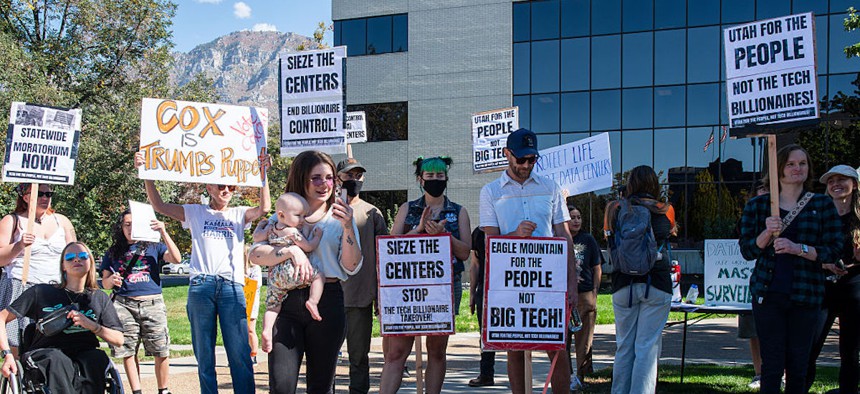
Demonstrators hold signs reading ''Utah For The People Not The Tech Billionaires!'' and ''Sieze The Centers'' during a community protest opposing a proposed data center zoning ordinance outside the Utah County Administration Building in Provo, Utah, on Oct. 7, 2026. Charles-McClintock Wilson/NurPhoto via Getty Images


Data centers figure in state and federal races and are the subject of dozens of ballot measures.
This story was originally published by Stateline.
In the course of a single election cycle, the backlash against data centers has grown from an issue at local planning commission and city council meetings to become a flashpoint in state and federal races across the country.
Candidates who once touted data centers as an economic boon have backtracked, and voters in at least three dozen cities, counties and townships will consider ballot measures in November that could ban data centers in their communities. Analysts say the opposition to data centers has come from Republican and Democratic voters alike.
“The people are speaking, and they’re speaking in one voice in opposition to this infrastructure,” said Tatishe Nteta, provost professor of political science at UMass Amherst. “It is not something that people desire in any shape, form or fashion. This potentially could be the issue that gives you the status of a former member of a city council or a former member of Congress.”
Last month, UMass Amherst published a poll, directed by Nteta, showing that only 11% of Americans would support the construction of an artificial intelligence data center in their local community. The poll found that 65% of respondents oppose the construction of such facilities.
Local and national activists have a long list of grievances against data centers, which tech companies are aggressively building to provide the computing power for artificial intelligence platforms. The rapid buildout of data centers is expected to strain the electrical grid and drive up energy costs, some forecasts show.
Opponents are also concerned about the facilities’ pollution, water use, noise and conversion of farmland and other open spaces. Many developers are also building private, “behind-the-meter” natural gas plants to power their data centers, increasing concerns about emissions and public health.
Some activists also object to the artificial intelligence technologies the sites will power, which threaten to disrupt the economy, replace workers, erode critical thinking skills and mental health and even — according to some tech executives — potentially kill all humans.
“For so many years, Ohio rolled out the red carpet to become a tech hub,” said Nick Owens, an attorney with Conserve Ohio, a campaign seeking to block data center development. “Unfortunately, what we’ve become is a tech dump.”
Anger at both parties
Activists across the country have lashed out at elected officials from both parties who have offered state and local tax breaks in order to entice data center developers. They’ve also called out local officials for negotiating deals behind closed doors and signing non-disclosure agreements with large tech companies.
“The politicians are chasing the grassroots, they aren’t leading on the issue,” said Anthony Elmo, public education defender with Good Jobs First, a policy group that tracks government subsidies related to economic development. “(Politicians) who were very pro-data center a year ago are now coming out against them due to political factors.”
Tech companies have launched their own political efforts to respond to the backlash. Industry leaders argue that artificial intelligence is key to the nation’s economic competitiveness. They note that the data center boom has created many construction jobs and increased property tax revenue in communities desperate for more money.
Leading the Future, a tech-backed Super PAC, has invested in federal and state campaigns in support of both Republican and Democratic candidates who support artificial intelligence. Josh Vlasto, the group’s co-leader, argued that the narrative around data centers has conflated the industry at large with its worst offenders — speculative projects that disregarded local opposition and failed to meet environmental standards.
“(Voters) want the jobs in their communities, they want the revenue, but they want the risks and downsides mitigated and addressed,” he said. “There is backlash in communities that don’t want them, but if you look to the states that are building and doing it right, these data centers are being welcomed and generating a massive amount of revenue. If this is done correctly, I could see this issue turning drastically in a different direction.”
An investigation earlier this year linked Leading the Future with a news website that used AI bots posing as journalists to solicit quotes for stories that promoted industry talking points. Another investigation found that a dark-money group tied to Leading the Future paid lifestyle influencers to promote artificial intelligence by highlighting the threat of competition from Chinese AI.
The Data Center Coalition, a membership association for tech companies, did not respond to a Stateline interview request. Amazon, Google and OpenAI — industry leaders that have pushed for data center construction — did not respond to Stateline inquiries. Think Big, an associated PAC of Leading the Future that supports Democratic candidates, did not respond to an interview request.
‘People coming together’
Across the United States, data centers currently use about 49 gigawatts of electricity, according to the website US Data Center Map. New projects planned or under construction total nearly 350 gigawatts — roughly a quarter of the country’s current electrical generation capacity.
While data centers have long powered our online infrastructure, many of the “hyperscale” facilities being built to support artificial intelligence are much larger and use vastly more power.
Ohio has become the political epicenter of the data center backlash. Like many states, Ohio agreed to sales tax exemptions for data centers in the 2010s in order to secure investment from tech companies. In recent years, the state has seen a boom in construction, with 154 operational facilities and 84 more data centers in the works — more than all but three other states.
“Our attraction in Ohio was a very minimal regulatory framework, plentiful farmland and plentiful water,” said Nick Owens, the Conserve Ohio attorney.
Owens, like many data center activists, became engaged on the issue when he learned that a large project was planned in his rural community in Brown County. Owens is a lifelong Republican and was a 2024 delegate for President Donald Trump, who has called data center opponents “backwards and poor.” He said politicians from city councils to the White House have failed to hear residents’ concerns.
“The dysfunction and unresponsiveness of government at all levels is truly sickening and frightening,” he said. “Conversely, it’s one of the most beautiful things I’ve ever seen, people coming together across communities, putting partisan differences aside and uniting (to oppose data centers).”
Conserve Ohio has worked with community activists across the state to draft ballot initiatives to ban data centers, change zoning regulations or require voter approval for large facilities. In total, Ohio municipalities will vote on 21 ballot measures related to data centers. Nationwide, 39 measures in eight states will be on the ballot this year, according to Ballotpedia.
In elections earlier this year, four local ballot measures across the country were decided with overwhelming opposition to data centers.
Jen Belt is the leader of Protect Grove City, an Ohio nonprofit backing a ballot measure to block development in that community.
“This is the first issue that I’ve seen Grove City united in such a way,” she said. “It is red, it is blue, it is every age, it is every socioeconomic status. It kind of gives you hope.”
Three communities in Kansas will vote on data center bans in November, including Ottawa, a city in the eastern portion of the state where residents have fought back against a proposed data center. Michael Lewis, with the nonprofit group Ottawa United, which has led the campaign, said locals were outraged when city commissioners announced the planned development.
“Everything was negotiated without public input, it was all done behind closed doors until they brought it out and approved it,” he said.
Lewis serves as vice chair of the Franklin County Democratic Party and is running for state representative. But the data center backlash has been so strong that his allies on the issue include the secretary of the Franklin County Republican Party and GOP state Rep. Rebecca Schmoe, his opponent in the general election.
Issue in statewide races
The issue has been a focal point of statewide races as well. U.S. Sen. Jon Husted of Ohio, a Republican, has come under attack for championing tax breaks for data centers during his time as lieutenant governor. His Democratic opponent, former U.S. Sen. Sherrod Brown, has run ads calling him “the face of data centers.”
Last month, the National Republican Senatorial Committee warned in a memo that data centers are “the anchor hanging around Husted’s neck,” The Washington Post reported. Husted has drafted a bill that would require state utility regulators to consider making data centers pay to cover the costs of their own electrical infrastructure needs. Senate Democrats blocked the bill last month, calling it “toothless” political messaging.
In Pennsylvania, both gubernatorial candidates have distanced themselves from their previous support for data centers. Texas Republican Gov. Greg Abbott, until recently a staunch data center advocate, issued a moratorium on new data center permits last month, amid attacks from his Democratic opponent.
“Republican candidates know this is a losing issue and one that can do damage to their already questionable electoral positions,” said Nteta, the political science professor. “It’s a unique issue that brings together Americans in ways we don’t usually see.”
Vlasto, with the pro-data center Super PAC, said candidates calling for statewide bans on data centers are overcorrecting.
“Each community is going to make their choice,” he said. “Some communities are just not going to welcome data centers. From a political position, it doesn’t seem like preventing communities that want to build data centers is a palatable position either.”
Elmo, with Good Jobs First, said even longtime data center opponents are surprised at how quickly they have become a top political issue. He said tech companies and politicians who once promoted data centers have now joined calls for “responsible” development.
“This issue puts (politicians) between a rock and a hard place between the grassroots and their wealthy tech donors,” he said. “If the industry you’re trying to regulate immediately agrees with everything you’re suggesting to regulate them, I’d suggest that those regulations are not extremely effective.”
Stateline reporter Alex Brown can be reached at abrown@stateline.org.
Stateline is part of States Newsroom, a nonprofit news network supported by grants and a coalition of donors as a 501c(3) public charity. Stateline maintains editorial independence. Contact Editor Scott S. Greenberger for questions: info@stateline.org.