Government must find ‘sweet spot’ for data center and AI regulation, expert says
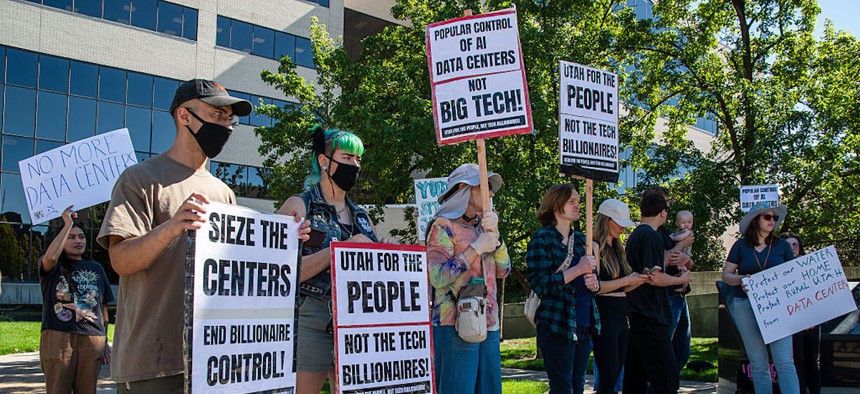
Demonstrators hold signs reading ''Utah For The People Not The Tech Billionaires!'' and ''Sieze The Centers'' during a community protest opposing a proposed data center zoning ordinance outside the Utah County Administration Building in Provo, Utah, on Oct. 7, 2026.

Demonstrators hold signs reading ''Utah For The People Not The Tech Billionaires!'' and ''Sieze The Centers'' during a community protest opposing a proposed data center zoning ordinance outside the Utah County Administration Building in Provo, Utah, on Oct. 7, 2026. Charles-McClintock Wilson/NurPhoto via Getty Images


The Nov. 3 midterms will further reveal how Americans feel about data center regulations, which could set the tone for future regulatory efforts, speakers said during a recent event.

Data centers are a hot topic on voters’ mind across the U.S. as the Nov. 3 midterm elections approach. Dozens of data center-related ballot propositions will be put to voters across the country, and government leaders must exercise caution and responsibility as they shape the future of data centers in their communities, experts say. 

Voters in 10 states next month will decide on 41 local ballot measures aimed at advancing data center development, restricting that development or requiring certain conditions to be met before a data center project can commence. 

The centers play a key role in building the computing infrastructure needed to support artificial intelligence systems, a technology that the private and public sectors increasingly rely on to enhance operational efficiency and service delivery. While developers posture the facilities as opportunities for economic and workforce development in communities, many Americans remain fearful of their impact on the environment and residents’ health and utility bills. 

“We also need safeguards for local communities [that] mitigate impact on energy, water and noise,” said Sanjay Patnaik, director of the Center on Regulation and Markets at the Brookings Institution, during an event hosted this week by the policy research nonprofit. “I think the polling that we have seen reflects that, and, especially when we look at the midterms, it’s really important we get this right.” 

Indeed, recent survey findings indicate that data centers are considered Americans’ least favorite development project, with 46% of residents saying they would oppose the construction of such facilities in their communities. 

In Harwood, North Dakota, a proposed measure would require increased review for certain data center and other industrial developments, such as independent evaluation of the project’s technical information, a public hearing and access to public records related to the development, if approved by voters. 

Constituents in Ottawa, Kansas, will vote whether to ban the construction of data centers that use more than 25 megawatts of power. A similar measure is on the ballot in Sunbury, Ohio, regarding data centers that reach a monthly demand or peak electrical load of more than 25 megawatts. 

Also in Ohio, constituents in Grove City will decide if data center developments, expansions or property transfers for facilities using more than 50 contiguous acres, more than 20 megawatts during peak demand or more than 500,000 gallons of water daily will require additional voter approval. 

Three major factors are driving residents’ sentiments toward data centers, which has become a significant national debate over the last year, said Anthony Pipa, a senior fellow at Brookings Institution’s Center for Sustainable Development. 

As an example, he pointed to West Virginia, where a proposed data center campus in Tucker County has put residents at odds with developers and government leaders in support of the project since early 2025. 

A major issue in the Tucker County case, which is becoming “emblematic” of localities across the U.S., is “a lack of transparency, where [developers are] dealing with one or two officials in negotiating a potential deal, and then bringing the community in at the very end,” Pipa said, adding that this approach “has created a very difficult dynamic for the community to feel like they're shaping the future of their community rather than the shaping of their community being done to them.” 

Americans are also considering the potential risks data centers pose on their residential utility rates and broader land usage impacts, he said. The proposed data center in Tucker County, for example, would include a backup diesel generator located about a mile from a local elementary school. Residents in communities like Tucker County are increasingly considering whether the benefits of such facilities outweigh the risks. 

A lack of trust is a third point of contention influencing how people feel toward data centers, particularly regarding community benefit agreements in data center proposals, Pipa said. 

“Everybody's talking about community benefits agreements. There's maybe one or two that have actually been executed, and none have been tested,” he said. 

Additionally, there still remains broad public distrust toward AI that could be further fueling Americans’ backlash toward data centers, said Mark Muro, a senior fellow at Brookings Institution. 

“I think it is fair to say Americans have been feeling frustrated this summer and fall at the peremptory way the new technology has been imposed without guardrails, as fast as possible and often through questionable data center deals shrouded in [nondisclosure agreements],” he said. 

With the upcoming midterm elections, “states really have a tremendous role here, and, I think … control a lot of levers here whether it’s [deciding on] electricity hookups, environmental aspects and others,” Muro said. 

Pennsylvania Gov. Josh Shapiro, for instance, signed an executive order, to “set some standards” for data center development in the state, Pipa said. The order removes such projects from the state’s fast track permitting program, establishes energy affordability standards and prohibits the use of nondisclosure agreements for data center developments. 

Several states — led by New York’s announcement in July — and localities have increasingly turned to establishing moratoriums on the development and expansions of data centers. 

Pipa pointed again to West Virginia, which “has taken a completely opposite view” on data center regulation. 

West Virginia “has one of the more extreme laws … where [the] state government actually does a lot on the siting decisions for the microgrids and the power plants that would power” the proposed development in Tucker County, Muro explained, which “effectively preempts local control. The county commissioners and the local municipalities don't have the decision-making authority.” 

Ultimately, balancing AI and data center advancement with communities’ skepticism will be “a tricky balance to find,” Patnaik said, but government leaders must “try to find that sweet spot for regulation.”

X
This website uses cookies to enhance user experience and to analyze performance and traffic on our website. We also share information about your use of our site with our social media, advertising and analytics partners. Learn More / Do Not Sell My Personal Information
Accept Cookies
X
Cookie Preferences Cookie List

Do Not Sell My Personal Information

When you visit our website, we store cookies on your browser to collect information. The information collected might relate to you, your preferences or your device, and is mostly used to make the site work as you expect it to and to provide a more personalized web experience. However, you can choose not to allow certain types of cookies, which may impact your experience of the site and the services we are able to offer. Click on the different category headings to find out more and change our default settings according to your preference. You cannot opt-out of our First Party Strictly Necessary Cookies as they are deployed in order to ensure the proper functioning of our website (such as prompting the cookie banner and remembering your settings, to log into your account, to redirect you when you log out, etc.). For more information about the First and Third Party Cookies used please follow this link.

Allow All Cookies

Manage Consent Preferences

Strictly Necessary Cookies - Always Active

We do not allow you to opt-out of our certain cookies, as they are necessary to ensure the proper functioning of our website (such as prompting our cookie banner and remembering your privacy choices) and/or to monitor site performance. These cookies are not used in a way that constitutes a “sale” of your data under the CCPA. You can set your browser to block or alert you about these cookies, but some parts of the site will not work as intended if you do so. You can usually find these settings in the Options or Preferences menu of your browser. Visit www.allaboutcookies.org to learn more.

Sale of Personal Data, Targeting & Social Media Cookies

Under the California Consumer Privacy Act, you have the right to opt-out of the sale of your personal information to third parties. These cookies collect information for analytics and to personalize your experience with targeted ads. You may exercise your right to opt out of the sale of personal information by using this toggle switch. If you opt out we will not be able to offer you personalised ads and will not hand over your personal information to any third parties. Additionally, you may contact our legal department for further clarification about your rights as a California consumer by using this Exercise My Rights link

If you have enabled privacy controls on your browser (such as a plugin), we have to take that as a valid request to opt-out. Therefore we would not be able to track your activity through the web. This may affect our ability to personalize ads according to your preferences.

Targeting cookies may be set through our site by our advertising partners. They may be used by those companies to build a profile of your interests and show you relevant adverts on other sites. They do not store directly personal information, but are based on uniquely identifying your browser and internet device. If you do not allow these cookies, you will experience less targeted advertising.

Social media cookies are set by a range of social media services that we have added to the site to enable you to share our content with your friends and networks. They are capable of tracking your browser across other sites and building up a profile of your interests. This may impact the content and messages you see on other websites you visit. If you do not allow these cookies you may not be able to use or see these sharing tools.

If you want to opt out of all of our lead reports and lists, please submit a privacy request at our Do Not Sell page.

Save Settings
Cookie Preferences Cookie List

Cookie List

A cookie is a small piece of data (text file) that a website – when visited by a user – asks your browser to store on your device in order to remember information about you, such as your language preference or login information. Those cookies are set by us and called first-party cookies. We also use third-party cookies – which are cookies from a domain different than the domain of the website you are visiting – for our advertising and marketing efforts. More specifically, we use cookies and other tracking technologies for the following purposes:

Strictly Necessary Cookies

We do not allow you to opt-out of our certain cookies, as they are necessary to ensure the proper functioning of our website (such as prompting our cookie banner and remembering your privacy choices) and/or to monitor site performance. These cookies are not used in a way that constitutes a “sale” of your data under the CCPA. You can set your browser to block or alert you about these cookies, but some parts of the site will not work as intended if you do so. You can usually find these settings in the Options or Preferences menu of your browser. Visit www.allaboutcookies.org to learn more.

Functional Cookies

We do not allow you to opt-out of our certain cookies, as they are necessary to ensure the proper functioning of our website (such as prompting our cookie banner and remembering your privacy choices) and/or to monitor site performance. These cookies are not used in a way that constitutes a “sale” of your data under the CCPA. You can set your browser to block or alert you about these cookies, but some parts of the site will not work as intended if you do so. You can usually find these settings in the Options or Preferences menu of your browser. Visit www.allaboutcookies.org to learn more.

Performance Cookies

We do not allow you to opt-out of our certain cookies, as they are necessary to ensure the proper functioning of our website (such as prompting our cookie banner and remembering your privacy choices) and/or to monitor site performance. These cookies are not used in a way that constitutes a “sale” of your data under the CCPA. You can set your browser to block or alert you about these cookies, but some parts of the site will not work as intended if you do so. You can usually find these settings in the Options or Preferences menu of your browser. Visit www.allaboutcookies.org to learn more.

Sale of Personal Data

We also use cookies to personalize your experience on our websites, including by determining the most relevant content and advertisements to show you, and to monitor site traffic and performance, so that we may improve our websites and your experience. You may opt out of our use of such cookies (and the associated “sale” of your Personal Information) by using this toggle switch. You will still see some advertising, regardless of your selection. Because we do not track you across different devices, browsers and GEMG properties, your selection will take effect only on this browser, this device and this website.

Social Media Cookies

We also use cookies to personalize your experience on our websites, including by determining the most relevant content and advertisements to show you, and to monitor site traffic and performance, so that we may improve our websites and your experience. You may opt out of our use of such cookies (and the associated “sale” of your Personal Information) by using this toggle switch. You will still see some advertising, regardless of your selection. Because we do not track you across different devices, browsers and GEMG properties, your selection will take effect only on this browser, this device and this website.

Targeting Cookies

We also use cookies to personalize your experience on our websites, including by determining the most relevant content and advertisements to show you, and to monitor site traffic and performance, so that we may improve our websites and your experience. You may opt out of our use of such cookies (and the associated “sale” of your Personal Information) by using this toggle switch. You will still see some advertising, regardless of your selection. Because we do not track you across different devices, browsers and GEMG properties, your selection will take effect only on this browser, this device and this website.