
A last-minute change to Georgia’s ballot QR code bill could steer voting in a new direction
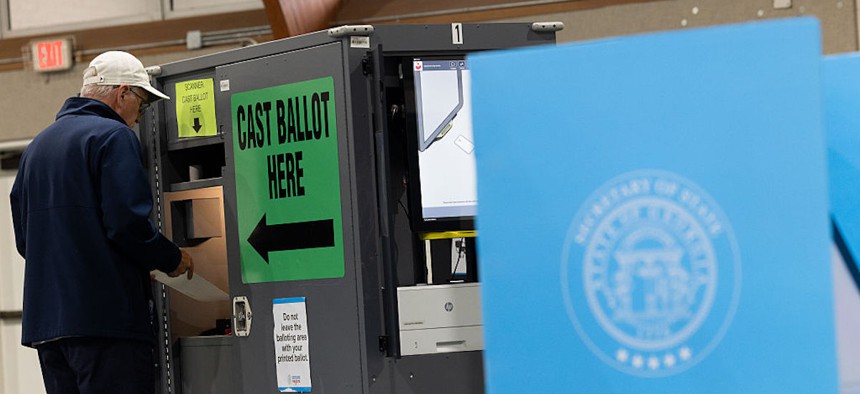
A voter scans his completed ballot at the Mt. Zion United Methodist Church polling station for the primary runoff election on June 16, 2026, in Marietta, Georgia. Jessica McGowan via Getty Images





A small change to a bill passed during June’s special session adds a new twist to the question of how future elections in Georgia will be run.
This story was originally published by the Georgia Recorder.
Georgia’s ballot QR code crisis is resolved for now, but a late change to an elections bill passed during last month’s special session adds a new twist to the question of how future elections across the state will be run.
Under a state law passed in 2024, Georgia could no longer use QR codes to count ballots after July 1, but state lawmakers repeatedly failed to appropriate the funds needed to make the switch ahead of the self-imposed deadline. The question of how to count votes had threatened to destabilize the state’s midterm elections.
The updated bill, which allows the state to continue using QR codes to tally votes until 2028, mandates additional post-election audits on certain statewide contests and establishes a special committee to help select the state’s next voting system, has been signed into law by Georgia Gov. Brian Kemp.
A last-minute amendment from Covington Rep. Tim Fleming, the Republican nominee for secretary of state, also instructs the special committee to narrow their focus to hand-marked paper ballot systems, which would represent a shift away from Georgia’s current system that uses voting machines to mark ballots.
The amendment also specifically designates ballot on-demand printing — where voters receive an individualized ballot printed after they check in to the polling place — as the preferred method, rather than relying upon pre-printed paper ballots.
The Legislature could still choose to enact a different type of voting system, but many Republican lawmakers and conservative advocates have signaled a preference for hand-marked paper ballots.
“This is just setting the parameters around what this committee will look at as far as the next statewide voting system,” Fleming told a legislative committee recently. Fleming did not respond to multiple requests for comment.
Penny Brown Reynolds, the Democratic nominee for secretary of state, also did not respond to a request for comment.
Rep. Saira Draper, an Atlanta Democrat and election lawyer, said that while she wasn’t necessarily opposed to a system like the one Fleming proposed, she would have preferred for the committee to be free to explore all the options available, including alternate voting systems.
“By putting in that amendment during a committee meeting that was not receiving public comment, where there was very little time before the bill hit the floor, it’s really a disservice because it narrows the scope of the committee’s work unnecessarily,” she said. “As long as we’re going to go through the process of selecting new equipment, we should be doing so with transparency and integrity.”
Georgia’s current voting machines were purchased for $107 million in 2019 and manufactured by Dominion Voting Systems, which is now known as Liberty Vote. They were used statewide in Georgia for the first time during the 2020 election.
But the company became a target of conservative media outlets like Fox News, Newsmax and One America News Network, who circulated false claims about the validity of the 2020 election results and accused Liberty Vote of rigging the election in favor of former President Joe Biden. Trump-aligned attorneys Rudy Giuliani and Sidney Powell also claimed that the company had conspired to switch votes in Biden’s favor.
Liberty Vote has since received millions of dollars in settlements after filing a series of lawsuits against those who claimed the company conspired to rig the 2020 election.
At least five different U.S.-based companies, including Liberty Vote, offer on-demand ballot printing, according to Verified Voting, a nonprofit organization that tracks election equipment across the country.
The state does currently rely on paper ballots to tally the official results, though only absentee and provisional ballots are marked by hand. Georgia is also one of the few states that uses one type of election equipment statewide, meaning that a shift in the vendor who supplies the results would impact all of the state’s 159 counties.
Mark Lindeman, Verified Voting’s policy and strategy director, said Fleming’s amendment largely aligns with the organization’s recommendation that most voters use ballots marked by hand and counted by machines, which they see as having the fewest risks and ensures that election officials can verify the outcome of an election. Precincts will still be required to have a certain number of ballot-marking devices to fulfill federal accessibility requirements though.
“I think it’s a good path for Georgia to adopt for 2028,” Lindeman said, noting that the extended deadline was crucial to give state and local officials time to switch over to the new system. “There have been proposals to try to roll this out somehow this year, and I just didn’t see how any of those could work. There just wasn’t enough time to put it together.”
However, Fleming’s amendment did not include many specifics around the use of printers that provide individualized ballots at polling places, and notably did not restrict legislators from considering a different system.
Among states that use the on-demand printed ballot system, Lindeman said, many still rely on pre-printed ballots on election day itself in case any technical difficulties arise.
“Because Election Day is the last opportunity to vote, I would not want to make Election Day any more dependent upon printing ballots at the last possible moment than it absolutely has to be,” he said.
“If [Georgia] required ballot on-demand for all in-person voting, I think that would be pretty distinctive.”
Joseph Kirk, the Bartow County elections director and president of the Georgia Association of Voter Registration and Election Officials, said his organization supported the bill, but noted that switching to a hand-marked paper ballot system could create some changes for the election workers who are tallying results, particularly when it comes to hand recounts.
“One of the features of our current voting system is there’s not a lot of question about the voter’s intent,” Kirk said.
Digital selections mean that there aren’t a lot of extraneous marks on the page that could confuse a machine, or instances where voters crossed a name out and selected a different one as sometimes happens with hand-marked ballots.
“With the hand-marked system, there will be more questions about the voter’s intent,” he said.
As a result, he added, the margins of victory could change more drastically during a hand recount under a hand-marked system than it would under a system that relies on machine-marked votes.
“And that’s OK, there’s ways to work through that. We’re just not used to it,” Kirk said.
Georgia Recorder is part of States Newsroom, a nonprofit news network supported by grants and a coalition of donors as a 501c(3) public charity. Georgia Recorder maintains editorial independence. Contact Editor Jill Nolin for questions: info@georgiarecorder.com.