
The meaning of modernization continues to expand for CIOs
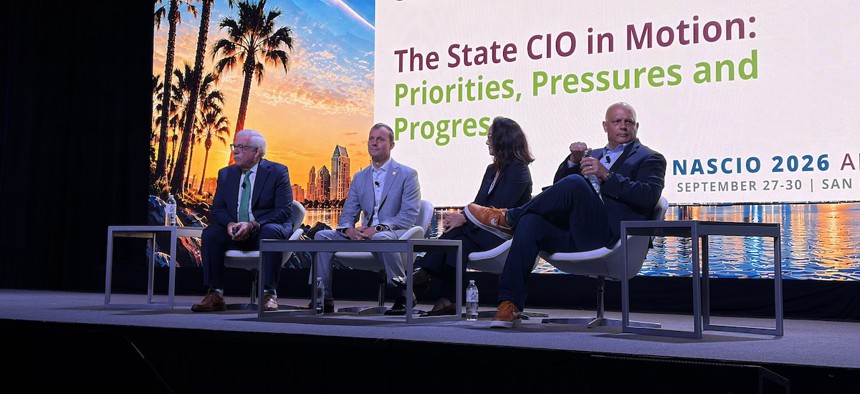
NASCIO Executive Director Doug Robinson (left) discusses findings from the the organization's annual survey with state CIOs Warren Sponholtz, Christine Sakuda and Tony Sauerhoff. The survey identifies trends and challenges shaping state government technology. Kaitlyn Levinson/Route Fifty




Beyond technology, state chief information officers are increasingly managing the modernization of their workforce, business models and service delivery.
SAN DIEGO — The role of state chief information officer has evolved in scope and responsibility in government, and a new report suggests that their definition of modernization is expanding as well.
State CIOs have increasingly felt “turbulence and disruption” with budget uncertainty and resource constraints in recent years, and the upcoming 39 gubernatorial elections on Nov. 3 are guaranteed to bring further change to political leadership, funding priorities and the people serving as CIOs, Doug Robinson, executive director of the National Association of State Chief Information Officers, said during a mainstage program at the organization’s annual conference in San Diego this week.
In fact, 90% of CIOs agreed that they anticipate or might face more turbulence and disruption in their role and organization over the next five years, according to NASCIO’s 2026 annual survey of CIOs released this week. The survey includes responses from 51 state and territorial CIOs that were collected this summer.
Despite the murky future ahead, state CIOs continue to strive for modernization across technology, state workforces and business models, said Tony Sauerhoff, chief information officer and executive director of the Texas Department of Information Resources.
The definition of modernization widens
For Florida’s CIO Warren Sponholtz, that sentiment begs the question, “How do I position myself in the organization to be able to adapt to reality and do it thoughtfully and well, so we don’t look back at this time and realize we made a mistake?”
Such considerations among CIOs indicate that the role “has evolved into an enterprise business leader, not only a technology operator,” according to NASCIO’s survey, adding that “operational excellence remains the foundation for transformation.”
In that sense, modernization “no longer means upgrading technology [or] upgrading hardware and software. It means changing how we run our business … It’s more digital transformation than modernization,” Sauerhoff said.
For instance, Florida is grappling with “the tug and push of centralization versus federation” of its state agencies, which have traditionally maintained their own IT departments, Sponholtz said.
Florida lawmakers considered a bill in 2025 that, if passed, could have created a centralized IT agency for the state called the Agency for State Systems and Enterprise Technology. The bill passed the Florida Senate but died on the Florida House floor last June.
A new effort to create an enterprise IT structure is already underway in the state. A similar bill introduced earlier this year looks to establish a division within the governor’s office to serve “as the state enterprise organization for information technology governance and as the lead entity responsible for understanding needs and environments, creating standards and strategy, supporting state agency technology efforts, and reporting on the state of information technology in this state.”
Meeting digital service demands with new business models
States CIOs’ approaches to developing and improving digital services for constituents are also evolving.
“I do think it’s our duty, our responsibility to … deliver government services as efficiently as we can,” Sauerhoff said.
However, 66% of respondents said they lack adequate funding and budget to “balance immediate public needs with future critical investment,” and 32% reported that a lack of trust stood in the way of developing and implementing digital solutions.
For Texas, building trust among state agencies is a critical piece to the modernization of citizen services, Sauerhoff said. One of DIR’s priorities moving forward is creating a “single front door for Texans that have to do business with their state,” he explained, “but it’s a job to sort of sell to agencies [and] bring them on board, and we’re working on that. I want to be able to make the case.”
“The CIO must bridge fragmented government silos and build cross-boundary relationships,” the survey reads.
Indeed, 86% of respondents said they were focused on customer relationship management, and 80% said open communication and transparency were a priority for their approach to business relationship management to assist their digital service delivery modernization efforts, according to the survey.
Revamping current state workforces
Also top of mind for state CIO modernization is the approach to workforce development and cultivation, according to the survey. In rank order, the three leading strategies include upskilling current employees, investing in training and establishing talent pipelines.
An expected wave of public sector retirements will take with it institutional knowledge and impose “changing skill requirements” that “are expected to challenge CIO organizations as they try to modernize and maintain critical services,” the survey reads.
In fact, workforce skills and capability constraints impact 28% of CIOs’ ability to deliver digital services, according to the survey.
“We're not just going to need more technologists, right? We're going to see our workforce changing, and not just a larger version of the workforce we have today, but it's going to look different,” Sauerhoff said.
In Hawaii, officials are turning to vendors for training and resources to upskill state staff and hold workshops within the state’s Office of Enterprise Technology Services and executive branch, said the state’s CIO Christine Sakuda.
Hawaii is particularly prioritizing the support of employees who have been working on the state’s mainframe or its application, she said. The mainframe’s major applications are in the process of being modernized, which is very disruptive to the many state employees who are unionized.
State leaders “are creating pathways for them to upskill and [transition] to applications, such as our interface engine that we’re developing, new AI teams [and] DevOps teams,” Sakuda said.
Emerging tech shapes CIO role and organization
Technology, particularly artificial intelligence, remains a main driver of government modernization in recent years.
Agentic AI, for instance, will be “the most impactful technology in the next two to three years, 64% of CIOs said, with 29% reporting that their state is already leveraging the technology in any state operation, according to the survey.
State tech leaders are also looking to reign in the use of AI tools with governance and guardrails for its responsible implementation. According to NASCIO, 98% of CIOs this year said they have adopted AI policies and procedures for development of the technology — up from 76% in 2025.
Sixty-one percent reported having “put in place procurement terms and contract provisions around generative AI” specifically — up from 41% last year, the survey reads. In this year’s survey, 96% of CIOs said their organizations are using generative AI tools in their daily work.
In Texas, an AI code of ethics that became statute last year stipulates that vendors must be contractually required “to implement risk management frameworks when deploying heightened scrutiny [AI] systems on behalf of state agencies or local governments.”
The statute also requires state and local entities to develop AI guidance that addresses human oversight, fairness and accuracy, data privacy and security, Sauerhoff said.
For AI to help innovate state government, “awareness and understanding is foundational,” Sponholtz said, explaining that, “there’s a great deal of potential that’s been passed through the technology, but governance is important so we can go fast and go safe.”