
Former state official reflects on tech’s role in uplifting residents
Courtesy photo via Aspen Institute





 By
Chris Teale
By
Chris Teale
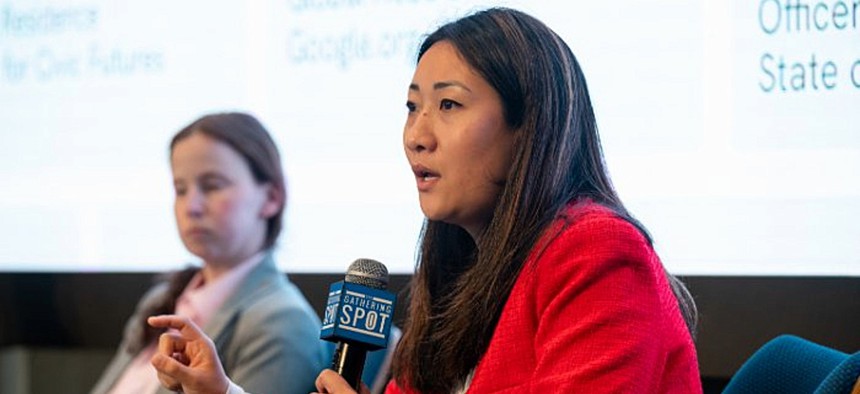
Ivy Teng Lei, California’s first chief digital strategy officer, implemented personal data controls and easier vital records requests during her time in the role. She said her background helped prepare her for what lay ahead.
As California’s first chief digital strategy officer, Ivy Teng Lei helped lead the state’s efforts to use technology to make government more effective and accessible.
Those efforts included giving state residents more control over their personal data, making it easier to request vital records online after a natural disaster, and expanding paid family leave for state employees.
And now Lei, who came to the role after participating in the Aspen Policy Academy’s Tech Executive Leadership Initiative, is considering her next move after leaving state employment in May following about two years in the post.
Route Fifty caught up with Lei to discuss her career, her background and her thoughts on the evolving role of technology in government.
This interview has been edited for brevity and clarity.
ROUTE FIFTY: I'd love to talk about what brought you to this chief digital strategy officer position in the first place. What led you up to that spot?
IVY TENG LEI: I emigrated to the United States when I was seven years old, and my family and I arrived at a six-floor walk-up in New York City. At the time when we got on the plane, my mother had mentioned, "We're going to Disneyland," and that was not the case. We actually ended up in New York City’s Chinatown. As I've gotten older, I realized we were actually living in the United States undocumented.
What that really looks like was this bubble of fellow immigrants, it's very easy to normalize that lifestyle of growing up undocumented, getting under the radar, and then getting by with what is given to us.
At the same time, we were 10 minutes away from the Twin Towers when they fell [on September 11, 2001], and both my mom and I lost our jobs. It was this immense realization that we were left to fend for ourselves. As I've gotten older and realizing what support the federal government and local and state government were offering for survivors of the 9/11 attacks, especially the subsequent air quality and economic downturn after, it was that resources were available to us regardless of our immigration status, but we didn't know how to reach out or even trust the entities to help us.
I was very lucky to be in the first wave of the Deferred Action for Childhood Arrivals program, upon graduation. And I experienced being a part of community organizing through nonprofits, and I desperately understood the lack of resources that they had. I committed to a career where I was going to start off in the private sector where the resources would allow me to learn as fast as I can, and balance this dual life to give back.
I was starting in college, I was very involved in nonprofits, community-based organizations, while starting in Fortune 500 companies. I started in companies that ran Super Bowl ads and spend millions of dollars to name one pharmaceutical drug. Then I worked at The Gap, and then I worked at startups.
Fast forward, I eventually was able to gain a path to a green card and citizenship because I met the luckiest man on Earth, I became a U.S. citizen, and I immediately wanted to finally have a seat at the table. That's when I transitioned from the private sector to the State of California.
What appealed to me about the chief digital strategy role [was] a couple of things. One was the fact that it was the first, and I had the opportunity to be the first in many of my previous careers. It was a very comfortable spot for me. And two, it had an immense focus on marginalized communities and vulnerable communities that have historically been harder to integrate in government services. I really felt that it was more important than ever that we have someone who has that lived experience at the table. The third is the optimism that was in the job description that we could create technology that not only modernizes — that's the baseline — but can move us in an innovative, inclusive and outcome-driven service delivery model.
While I was there, I was in charge of two branches of programming. There's the statewide digital identity framework, which at the central IT department, we have an open-source identity verification and eligibility verification mechanism. Are you who you say you are, and can we verify that online? Then the other part is, are you eligible for the things that you're applying for?
The digital identity framework is the actual product execution. What does it look like to actually use it in a program? When the fires hit Los Angeles, one of the use cases was, how do we reduce the barriers for survivors by allowing them to apply for vital record replacement completely digitally? If you can imagine, you have to visit an office and then get a notary, and then from there, you have to get a mailing address to then get the record replaced.
So we created a digital disaster recovery hub, where, because of the governor's executive order, we were able to digitize identity verification and request replacement completely online and for free because there's a disaster. Usually, it's a couple of hundred dollars to replace a lot of families' vital records.
The thing that I ended my time in California with is the DELETE Act under CalPrivacy. I was the lead on the technology side to get them from zero to one. Within my team is the product, engineering and infrastructure team, and we worked very closely with the user design, copy and legal team, and we were working hand-in-hand with the California Privacy Protection Agency to be their technical arm while they're building out their technical team. One of my team members actually ended up working there, and they became their first IT hire on the other side.
We started the project around February or March, and things really got going around April, and we were able to execute it on time, Jan. 1, 2026. No one had Christmas or holidays, but we launched this first-of-its-kind personal data privacy protection application that is now being modeled and introduced in other states as well that allows all Californians to request the deletion of their personal data once, and all 600 data brokers that register in California have to do it every 45 days.
That feels so gratifying for me as someone who has come from a place where who I am and what I do came at a bigger risk than getting better shopping ads. It was a difference between how safe my family felt going through government services or even my parents coming to school to participate in my activities. More than that, as a woman of color, the DELETE Act and data privacy policies have mostly been championed by survivors of domestic violence. And that feels doubly gratifying knowing that we now have a way to do it with teeth.
ROUTE FIFTY: You said the job description was optimistic. You're walking in the door on the first day. Where do you start? How did you go about putting your stamp on it?
LEI: I will even rewind a couple more steps before that, and the reason why we're here. While I was applying for the job, I was part of the Aspen Policy Academy’s Tech Executive Leadership Initiative. Government was so far behind just basic understanding of daily communication that the comparison is that they work in chisels and we work in Slack. At the time, I was like, "It can't be that bad." It was really that bad.
To this day, I'm so glad that I had that expectation because now at least in my head, I was like, "I told you so," and I have a community to go back to.
Before starting any job, and especially stepping into a room where, quite frankly, I did not belong in that room if you looked at the shape and size and colors of the folks who had a seat at the table, and there have been many moments where I go to an event where they would talk to my bosses and not me. When they see I'm the person who's going on stage, that's when they come to me.
When I think about putting my stamp, the fact of my existence in those rooms, the word mission doesn't necessarily do it justice. It's just my life's energy to be a loud, vocal advocate for the stories I wish were told so that my family didn't and my community didn't have to go through what we had to go through for no reason aside from just poor service design.
I go into those rooms, and I'm really happy that I now have my own key card, and I'm more energized by the idea that I can bring more people in, and people whose voices who would not have been thought of. Not even that they were not loud, because I don't think that's actually what liberated me a lot. It's not that people purposely don't let folks in; it's that they're just not remembered to be brought into those rooms.
One of the things that I did completely unrelated to my job, but it's something I'm incredibly proud of, was that I became a mom. I was pregnant on the job. I became a mom, and I realized that I didn't have disability insurance. I was someone who is a handful of levels away from the governor and doesn't have disability insurance to go on maternity leave.
More than that, I feel like I now have the seat where I can do something about other mothers, and it's not even just mothers. It's people who have an accident. It's short-term disability, and it was a law that changed around the [Jerry] Brown administration where they were introducing more talent into government. In the past, they could only promote from within to executive levels. And so they were like, "We need to change this to remove an exam requirement to allow CEAs," which is where I was at, Career Executive Assignments, to serve in California, but they didn't reflect that in the disability government code.
Since the Brown administration, women and folks who need short-term disability and came in as an executive didn't have coverage. What that meant wasn't just that we didn't have coverage, but when we leave the job, we also lose health insurance. If I was not on my husband's health insurance to begin with, I could have been slapped with a $60,000 bill to give life and create civilization, and on top of that, did not have any job protection or financial stability while I am bonding and recovering from this.
I really tapped into what I learned in Aspen around finding the stakeholders, creating a story that is relevant, and making it really super clear that the bottom line up front is to fix this.
I gave birth in October. I think I realized I was not covered around November and December, and spent my entire leave calling everybody I knew, linking the exact part where the government code was written. By July, the law was changed, and I have moms calling me that they were scheduled for a C-section a few days before the law was going to be changed, and if it wasn't for that, they would have been going through what I went through in real time.
It was not in the job description, but definitely something I couldn't have done without having the job.
ROUTE FIFTY: I'm thinking about the DELETE Act, and also getting vital records after a disaster. Two massive initiatives that I would imagine took a lot of work and a lot of effort. Was it difficult to make government think differently about some of these things?
LEI: It was extremely difficult in two ways. One was, the concept had already existed, but it never gained traction. And when the concept existed and never gained traction, it's usually a result of resistance that had already built up. And California's uniquely federated; it's extremely federated.
What we started seeing was departments and agencies were not necessarily opposed to a digital identity framework, but they wanted one that they could control on their own, and as a result, every department and agency started creating their own systems. That's why we see a very different experience on the Employment Development Department versus the Department of Motor Vehicles versus the Health and Human Services portal, for good reasons.
When they think about changing something, for them to then go through a central ID to then fix it on their own just takes too much maneuvering. When I took on a statewide digital identity framework, it was more of a translation exercise than a technical problem. It was, "You can have what you have, and we can have collective gains by having it centralized as well."
It was this balance between not taking away what you currently have, but asking you to join us so that more people can take advantage of what you've already built, because the way that we built it was uniquely open source.
The other difficulty was there was a chief identity officer that reported in to me, and they came from Google and were very aspirational about what is possible in the technology space. There was a little bit of like, we need to take two steps back so that we can take one step forward, so there was also an internal team trust-building period that needed to happen under my leadership so that we can then as a unit move forward and start pitching to other entities.
When a disaster hit, such as the LA fires, or when there's a legislative mandate and it pushes us to explore more options that are quick and easy to get to, it is an opportunity for us to test out those promises.
One of the things that was also difficult is, even if everyone at the table says let’s do something, the mechanism that is project planning requirements and procurement requirements and contracting processes and authorities and all of those things hasn't caught up. It took a lot of grace and forgiveness across different partnerships because, at some point, you're like, "I don't care why; I just need it to get done."
There have been moments where it was micro-wins by having everyone on the same team and building that trust, and then also using it to push the boundaries of procurement rules and asking how we make this more valuable for other entities as well.
The idea is, once we procure these entities, then other departments can also skip the procurement process because it's already on the statewide contract. That's a win-win for everybody. But then that will allow the service model to need to shift, because now we're not servicing just one agency, we're servicing a second and a third.
As a result of that, our financial and budgeting and procurement process needed to shift. It is a success story that pushes people to think a little differently. Sometimes they need to see the thing in order to imagine what could be possible. And statutory requirements are statutory requirements unless it changes, so their hands are tied as well. That's the hard part of working in government. You can have everybody want it to look better, but we still need to follow the law.
ROUTE FIFTY: I'm curious how the relationship between government and its technology has evolved in your time, especially as more things get digitized and more things go online?
LEI: Over the last year, the emergence of AI has really changed the tone of the conversation. We've went from migrating from on-premise data centers to let's push to modernization, which is just getting to the baseline. And with AI, we're like, "Forget modernization. We can just leapfrog completely in getting us to where consumers can experience government services the same way they experience Uber or DoorDash."
There is no longer an option to stand back. The availability of emergent technologies has changed the conversation from "Let's keep this the way. Things were working just fine. Let's just keep it the way it was," all the way to, "Absolutely not.” We have now introduced more executives who understand the benefit of integrating technology responsibly than we have ever before."
If you look at California's leadership today, it is full of the balance between new executives who are coming in with ideas and execution and more preparation than ever. If I didn't come in with the Aspen program, then I would have been much more optimistic than I was allowing myself to realistically survive.
We also now really recognize and respect the problems that the lifelong public servants have been trying to solve. To say it plainly, I think the evolution of government and technology started with saying we just need to introduce more technology. That was like phase one. But now phase two is that we know the technology exists. Now we need people who understand government to integrate it correctly. You can't just inject it in there; it's just going to fail. With AI, there's more and more interest in doing that much more sustainably.
ROUTE FIFTY: Just on the procurement point, is it a worry that you procure an AI technology, and then by the time it's implemented, the technology's evolved far, far away? How do we get around that?
LEI: There are two major types of procurement. There's emergency procurement and then there's regular procurement, which is what we are sick of. The first one is where if there is a moment of interest, including when there's a national disaster or crisis, including the security threats that we have today That is a moment to safely and responsibly prove out these tests while bypassing the procurement rules. Being ready for when a crisis requires fast-track thinking and implementation and testing.
Then there's regular procurement. Contrary to what most people think, procurement people are actually really trying to help. They are trying so hard to help, but they also have to be fiscally responsible stewards of public dollars.
Building relationships with procurement people and speaking their language is going to be so valuable for people who are trying to get things through. What we find is you get on a call, and it's a conversation of like, "No, we can't do this. We can't do this, and we can't do this," every time you come with an idea. The conversation needs to be, "This is what I need to get. What are the pathways for me to get there? Do I need an executive sign-off? Do I need a special project?" I can find those partners and recipes to fit the mold that you are rightfully trying to hold and be steward of, but you need to tell me what those are, and we can begin to brainstorm together.
Seeing them as the other side that I have to negotiate with never really worked. Some of the people that I've been able to build relationships with have done so much alphabet soup translating for me. To this day, one of the most fruitful weekly syncs I've had was actually with budget and procurement analysts, folks who are not necessarily at the table and making big decisions, but they know their craft so well that they see what you're trying to say. It's really like speaking across department lines and through the levels to building relationships across the different parts of the working process so that you're not just talking about it at a big idea standpoint, but you're really working with the people who are dotting the i's and the t's to work with you.
ROUTE FIFTY: How did you measure success, especially when you were with the state? What did success look like?
LEI: Success looks like I am able to hand off projects that last beyond me. Success looks like I open doors for people who have traditionally not been allowed or been in the room. And success looks like a comeback tour soon for Ivy, and that I will come back stronger with better tools and backing to do some of the work together.
ROUTE FIFTY: Well, I guess that does lead me to my final question. Your comeback tour — I can't wait. Any insight on what that might look like?
LEI: I don't know specifically yet, but I do know that I thrive in high-stakes situations, and the last time around was the opportunity to reimagine what digital identity at a government service level looks like.
I'd be really interested to see how the 36-plus governors elections are going to shake out at the state level, and what's going to happen at the federal level. I feel very strongly that the understanding of AI is just beginning to sink in for government entities, and yet the folks who talk about the benefit of all humanity have yet to welcome all humans to the table when making those decisions.
There are many gaps to be filled when I think about introducing technology into government, including AI. And I think at some point, those gaps need to be funded either at a government level or more sustainably in a budget line or that need to become by force, like the same way that maternity leave happened.
ROUTE FIFTY: Any final thoughts you’d like to share?
LEI: My final thought is, if people can think about their day-to-day job, not just in their job description, but who they are and what they can bring, that will exponentially amplify the work that we get done.
Someone's title maybe requires them to do a certain amount of duties, but governments, especially if we all fit within one lane, the path that we're heading towards is going to be the same. I really encourage folks to reimagine how they can interpret their job description to be a little bit more creative to meet the moment that we're at, and that will allow the creativity to inject into policy making.