
New Jersey announces research center to study social media impacts
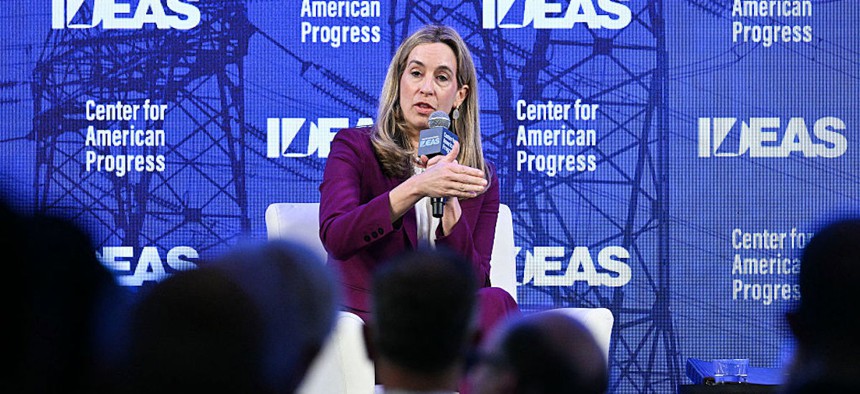
New Jersey Gov. Mikie Sherrill speaks during the The Center for American Progress IDEAS Conference in Washington, DC, on May 19, 2026. Jim WATSON / AFP via Getty Images






The announcement comes in the wake of states’ legal settlement with Meta, after they accused the tech company of knowingly designing social media apps with addictive and harmful features.
New Jersey is developing a research center aimed at studying social media’s impacts, addictive features and potential risks to youths’ health and well-being, state officials announced Monday.
The state is partnering with Rutgers University to conduct independent research on such issues, and the findings will help inform policymakers’ efforts to address social media harms on teens and children.
“Research has linked social media to depression and anxiety, fatigue and trouble sleeping, poor body image and disordered eating,” Gov. Mikie Sherrill said in a statement. “This new center will be an invaluable tool to help us better understand how technology is affecting our children, and more importantly, turn research into real solutions to protect our kids, support our families and address the ongoing youth mental health crisis.”
The state’s social media research center will target three priorities: the assessment of social media’s impacts, the intervention of its harmful use and the prevention of irresponsible and unhealthy use of social media.
Such efforts will be supported by a $500,000 state investment allocated in fiscal 2027, according to state officials.
“The extent to which [states] can get really good evidence and really good data to really understand what the impact of social media is on kids of all ages will be very helpful in policymaking,” Dr. Georges Benjamin, CEO of the American Public Health Association, told Route Fifty.
“Our states are a laboratory of policy, and they experiment all the time,” he said, but “decision-making has been crude.”
As an example, Benjamin pointed to cellphone bans during school hours, which have gained traction among states in recent years.
“Those are good policies, probably, but they don’t really get to the cause and effect as exact as a study will do,” he explained. Further research could help clarify major concerns surrounding youths’ social media use, such as how different age groups and genders are uniquely impacted, whether apps are associated with an increase in mental health risks and other factors.
Indeed, problems like sleep disruption, cyberbullying, online gambling and pornography addiction, among others, have become more prevalent among youths, while policy has not kept up, Renee Hobbs, professor of communication studies at the University of Rhode Island, told Route Fifty.
However, “it’s important to recognize” that “it’s not all bad,” she said, adding that social media can also be “a form of expression for writing and speaking and a form of communication” for adolescents.
But “we’ve had a historic deficit of federal-level investment in the domain of children and media, and that has meant that foundations, philanthropies and, now, state governments have stepped forward to fill the gap,” she said.
New Jersey’s social media research center, for instance, was established in one of three bills recently signed by Sherrill that look to strengthen security and privacy protections for children using social media platforms.
One of the bills, in part, restricts the data companies may collect on minor users, and the other requires the social media research center to issue a final report and policy recommendations to the New Jersey Department of Health within 18 months.
New Jersey was also one of 33 states to file a landmark lawsuit against Meta, the company that owns Facebook and Instagram, in October 2023.
The bipartisan coalition of states claimed that the media company violated the federal Children’s Online Privacy Protection Act by building addictive features into social media apps like Facebook and Instagram that “have harmed and continue to harm the physical and mental health of children and teens,” state officials said in a statement at the time.
The lawsuit reached a settlement in August, under which Meta must pay up to $17.1 billion to 47 states, Washington, D.C., and U.S. territories. New Jersey is slated to receive at least $525 million as part of the settlement, New Jersey Attorney General Jennifer Davenport announced at the time.
The settlement money could be used for supporting youth mental health programs, crisis intervention services, online safety investigations and digital literacy efforts, among others, New Jersey officials said.