
Governments need community trust to get drone programs off the ground, experts say
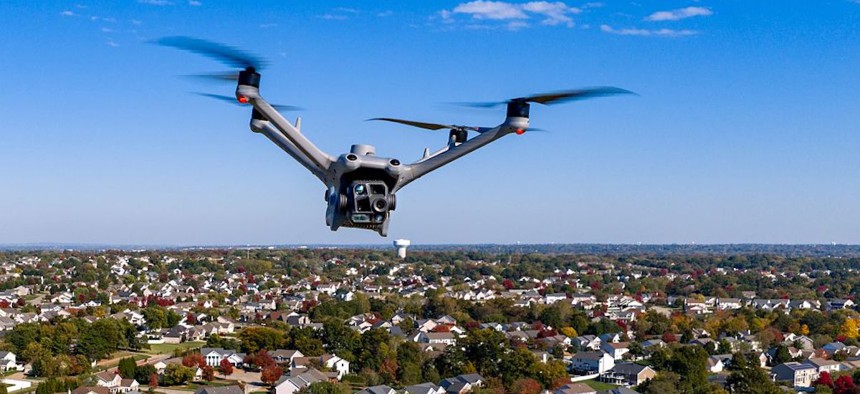
A DJI Matrice 4TD drone used by the O'Fallon Police Department in O'Fallon, Missouri, hovers at 200 feet above the ground during a demonstration flight on Wednesday, Oct. 29, 2026. David Carson/St. Louis Post-Dispatch via Getty Images






From public safety missions to medical equipment delivery, the success of drone programs often boils down to community acceptance, speakers said at a recent event.
As state and local agencies launch drone programs across the U.S., gaining community acceptance and trust in the unmanned aerial systems should remain a top priority, officials said at a recent event.
In Montgomery County, Maryland, about 30 miles northwest of Washington, D.C., its police department quickly discovered how important the role of community acceptance in government’s use of drones can be to getting such programs off the ground.
When the Montgomery County Police Department first enlisted drones in its public safety operations, “we didn’t do things perfectly,” Tony Galladora, director of the Montgomery County Police Department’s Operational Intelligence Division, said during a session at the Drone and AAM Policy Symposium hosted by the Association for Uncrewed Vehicle Systems International this week in Washington, D.C..
The law enforcement agency initially launched a drone as a first responder, or DFR, program in late 2023. The initiative helped officers monitor situations in real time and track individuals as needed, but such use cases were met with public pushback over concerns about civil rights and privacy.
“We just asked for money without [community] engagement initially. We got our hands slapped and got put on a proper path to fix that,” Galladora said.
In an interview with Route Fifty on the sidelines of the event, Galladora said, “we kind of misstepped on the front end and then, after learning that, we’ve tried to be incredibly proactive and do our press conferences and post our … successes.”
MCPD also maintains a public dashboard that logs drone deployments and flight paths.
Prioritizing the public’s feedback also helped “dial in our policy” for drone use, Galladora told Route Fifty. He added that “there were some policy issues that we thought were going to be the smartest way to handle [an emergency], and at the end of those community discussions, we saw people want us to tweak some things.”
During the session, for example, Galladora pointed to the agency’s restriction on “proactive control” use cases for drones, such as monitoring or surveilling communities before an incident occurs.
“That’s a community conversation piece where that [proactive control] is not widely accepted … We’re responding strictly to 911 calls for service,” he said. In coordination with geofences in the county, officers can tune into 911 call audio and access transcriptions to launch and send a drone to a specific location.
Since MCPD’s DFR program first launched, it has expanded to include 12 drones that are launched from six dock sites across the county. They assist with about 750 monthly calls for service, Gallardora said.
Gaining the community’s acceptance and trust to deploy drones is critical as departments grapple with staffing shortages and budget constraints.
“We’re down about 200 police officers. As a result, we’re looking heavily into technology on how to mitigate that impact to public safety,” Gallardora said, adding that “Montgomery County is not unique. I think you see a lot of departments around the country leaning very heavily into technology.”
Indeed, several public safety agencies across the nation have launched DFR programs in the past year alone. The Ventura County Sheriff’s Office in California announced the launch of its DFR program this week. The agency will use drones to respond to incident reports in two local cities, helping responding officers develop public safety responses as they arrive at the scene.
The Boston Police Department launched a DFR pilot program in August, under which officials will evaluate the tech’s ability to provide real-time footage of events to inform agency responses.
And in New York, the Yonkers Police Department launched the city’s permanent DFR program earlier this year. Police officers will leverage two drones that integrate with the city’s crime control center to use 911 calls, radio traffic and video camera footage to inform their public safety responses.
Municipalities are also exploring how drones can help with medical and health needs within communities. The Hillsborough County Fire Rescue department in Florida successfully completed a drone-enabled delivery of blood last month as part of a new initiative aimed at enhancing emergency response. While still in development, public safety officials expect the program to enable the delivery of blood units to patients at an emergency scene, reducing the reliance on transporting them to a hospital first.
The Florida Department of Transportation is implementing a “phased rollout plan” to expand drone usage and broader advanced air mobility, Carina Maloney, AAM principal of air and ground at FDOT, said during a separate session at the AUVSI event.
The state is participating in the federal eVTOL Integration Pilot Program, or EIPP, which aims to pilot innovative uses of certain aircraft, drones and other vehicles, including electric vertical take-off and landing aircraft. Preparation for the program includes having conversations with communities and manufacturers to “make sure the public understands what we’re trying to do,” Maloney said.
The use of drones for public safety, cargo or medical purposes “is not going to be for every community right away. You’re going to have early adopters. You’re going to have late adopters,” Maloney said, adding, “you need to have that constant repetition of what we’re trying to do, making sure that they are aware that safety is very much at the forefront of what we're doing. It's getting them used to these technologies that they haven't seen before.”
In Texas, the North Texas UAS Safety and Integration Task Force has been addressing such challenges since 2018, said Ernest Huffman, senior project manager at the North Central Texas Council of Governments.
Early conversations with community members centered around small drone operations around the Dallas-Fort Worth Metroplex, which helped gain buy-in for more advanced air mobility technologies over the years, he said.
“What we've been able to do really well is establish feedback loops on the local level with all of our local municipalities as well as citizens on the technology because we've been engaging and talking with them about it and putting it in front of them for a long time,” Huffman added.
As an example, he pointed to the value in discussing workforce and job creation opportunities that the drone industry can bring to a community.
“I think that’s the easiest way to bring folks on our side when we want to bring these technologies to their backyards,” Huffman said.