
New York MTA seeks AI subway ‘track intrusion’ tech
aire images via Getty Images




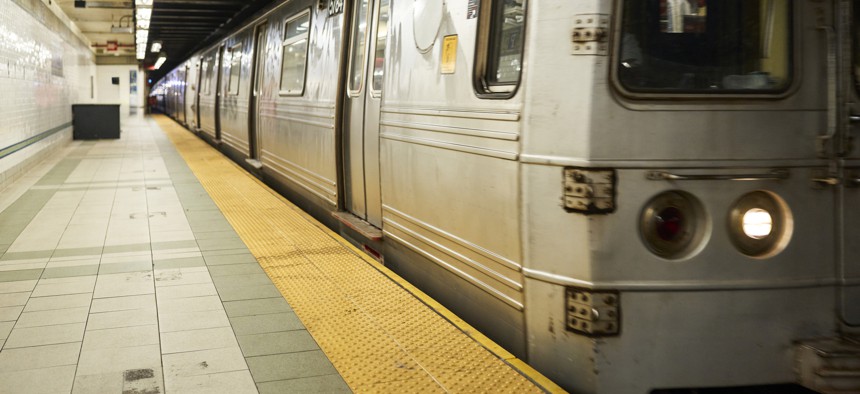
New York’s underground attracts human and animal intruders, alongside debris and trash — resulting in 6% of all subway delays.
This article was originally published by The City Reporter.
The MTA is taking another swipe at tapping into technology that can detect when a person, object or animal is about to end up on the subway tracks.
The transportation authority is seeking a provider to design, build and test an artificial intelligence-supported track intrusion detection system, according to a contract notice it posted in April. The prototype would “evaluate performance under real-world conditions” at an underground station, as well as at one elevated stop. The stations have not yet been determined.
About 6% of all subway delays last year were pinned on the presence of a person or debris on the tracks.
Jamie Torres-Springer, president of MTA Construction & Development, told The City Reporter that the project is akin to other high-tech advances within the subway system, including the rollout of tap-and-go fare payment and the testing of new fare gates.
“One of the big pushes we’re in the middle of in this new capital program is the modernization of the system, acknowledging that we’ve got a 100-year-old system and we’re dutifully trying to tack all these great new technologies onto it to make it work better,” he said. “We’ve got a lot of successes, but it’s very challenging to implement them.”
The latest effort to test track intrusion detection technology comes after there were 1,297 unauthorized entries on the tracks last year — a 22% increase from the 1,062 such incidents in 2019, MTA numbers reveal. An “unauthorized entry” is defined by the MTA as an unauthorized person entering off-limits areas such as tunnels.
That can include people trying to retrieve a dropped item, being pushed down during a fight or assault, ending up on the tracks while under the influence of drugs or alcohol or attempting suicide.
The figures also show there were 491 track intrusions over the first four months of 2026, down slightly from 505 in the same period last year — and from a high of 537 from January through April of 2022.
The six-page solicitation outlines the enduring hope of developing subway-specific detectors that can spot people or objects above a certain size entering the tracks intentionally or accidentally, after several other systems were tested at a pair of Manhattan stations from 2014 to 2019.
It’s a tall order. The MTA wants a system that’s “capable of detecting pre-intrusion behaviors under low and high passenger density on the station platforms.”
In a transit system known for the idiosyncrasies of some passengers, the systems would also be required to flag “erratic movements” and people leaning into the tracks while generating a “timely and appropriate response” through alerts for train operators, station staff and control center personnel.
The solicitation notes that the two-year test at two stations would cost between $10 million and $50 million.
Torres-Springer said the MTA is aiming to award a contract for the project by the end of this year.
MTA officials said that previous tests yielded key takeaways about the strengths and limitations of detection systems, while conceding that rapidly advancing AI capabilities could be a solution in a subway setting.
“We determined that the technology worked to identify a track intrusion, but it didn’t work to do it in a precise-enough way that we could manage how we respond to it,” Torres-Springer said. “And now it is apparent that AI technology has evolved such that we should be able to do much better than that.”
However, nonprofit the Surveillance Technology Oversight Project warned that the expansion of cameras in the city and the use of AI-driven tech may be cause for concern.
“As with any tool that could be used for surveillance and will expand cameras across the city, transparency and reporting is key to accountability,” said William Owen, communications director for the local tech watchdog group. “MTA continues to test unproven AI on New York City Transit instead of real infrastructure and safety improvements to the subway.”
In an effort to discourage people from going onto the tracks, the MTA installed steel platform-edge barriers at more than 100 stations by the end of 2025, and has announced plans to have them in close to 200 of its 472 stations by the end of this year. The agency had previously committed to testing platform doors at three stations after straphanger Michelle Go was pushed to her death in front of an R train in January 2022 at the Times Square-42nd Street station.
The track intrusion test would mark the latest step for the MTA on a winding route to developing systems designed to cut down on safety risks to commuters, transit workers and anyone who ends up in the path of a train.
“We are working on something called the station of the future, which is sort of looking at what a station in the New York City subway system is going to look like and how it’s going to function 20, 30, 40, 50 years from now,” Torres-Springer said. “This is also part of that, it becomes part of the bundle of technologies and systems that we begin to implement in future stations.”ever
“Anything that can help make the system safer for riders and will keep the trains moving while reducing risk to workers is beneficial,” said Lisa Daglian, executive director of the Permanent Citizens Advisory Committee to the MTA. “The increasing emphasis on newer technology is an approach that we’re glad could be tested in two stations with two different environments.”
A 2022 request for information detailed how the previous pilot projects checked out closed circuit television cameras combined with lasers and video analytics; laser scanners with visual and infrared image verification; thermal camera detection technology and microwave scanners that could record entries onto the tracks.
Potential obstacles to deploying track intrusion detection systems include finding ways to ensure that subway on-time performance is not compromised by the volume of intrusion alarms, staffing to maintain the systems — and funding.
Celeste Kirkland, safety director for Transport Workers Union Local 100, said the technology would have to fit with the quirks of a subway system that opened in 1904.
“There are a lot of challenges — we’ve got water intrusions, smoke, poor lighting, curved stations with limited sightlines, crowded platforms,” Kirkland said. “It sounds good, but how are they going to handle the false positives, how are they going to tie it to the existing systems we have?”
The detectors on Vancouver’s automated and driverless SkyTrain are sometimes triggered by the presence of birds or debris, a TransLink spokesperson told The City Reporter in 2022, with workers then having to inspect the area before service can resume safely.
Kirkland said the potential tripping of alarms by birds or other animals would also be a concern.
“We have rats all through the system,” she said. “Would they want a train to stop mistakenly because a rat jumped off a benchwall onto the tracks and is seen by a sensor? So, I think they have a lot to do.”
The detectors are rare in U.S. subway stations, with the Chicago Transit Authority last year announcing plans to test camera-based capabilities at two rail stations. The Los Angeles County Metropolitan Transportation Authority previously tested the technology at a platform at its Civic Center stop.
Daglian, of PCAC, said it is “very encouraging” that the MTA is moving ahead with its plans.
“It’s why you pilot things,” she said. “AI and machine learning are still things we need to learn to trust.”