
Police use of artificial intelligence grows as rules lag behind
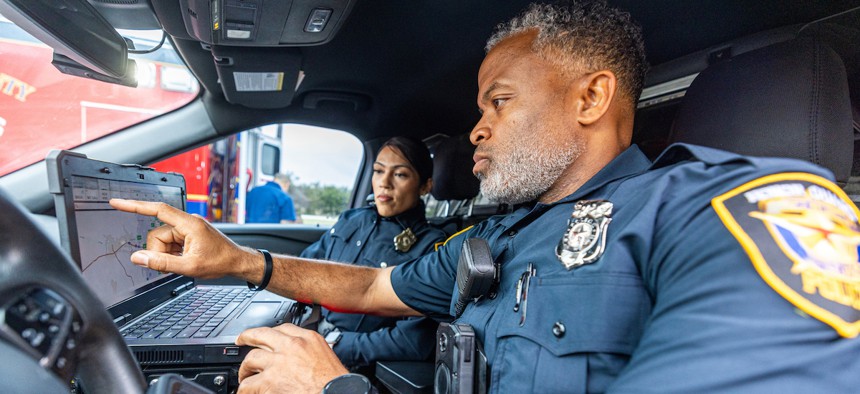
adamkaz via Getty Images





Experts warn that AI-powered policing could expand surveillance and amplify bias.
This story was originally published by Stateline.
Hundreds of people fill a downtown street for a protest, waving signs and chanting as they march past businesses and government buildings. Overhead, a police drone records video of the crowd. Nearby traffic cameras and license plate readers capture faces, vehicles and movements along the route.
With artificial intelligence, experts say, hours of footage can be analyzed in minutes, making it easier for police to track or target a participant long after the demonstration ends.
As law enforcement agencies increasingly embrace AI, some civil liberties advocates, legal scholars and policing experts warn that the technology could amplify surveillance, introduce hidden biases into investigations and make it harder to challenge evidence in court. They also worry about a future in which AI takes on a more active role in policing and criminal investigations.
“It’s especially concerning sort of the ways that these tools could supercharge that kind of surveillance and enforcement,” said Rachel Levinson-Waldman, the director of the liberty and national security program at the Brennan Center for Justice, a nonpartisan law and policy organization at the New York University School of Law. Levinson-Waldman has written extensively about the risks of police surveillance and the unregulated use of AI in policing.
Artificial intelligence in policing is not new. For decades, law enforcement agencies have used data-driven and automated tools, including facial recognition systems, automated license plate readers, predictive policing models and video analytics that can flag objects or activity in recorded footage.
What is changing is the speed, scope and complexity of those tools. As police departments accumulate growing volumes of digital evidence — from body camera footage and surveillance video to jail calls, social media records and case files — AI is increasingly being used to help sort, search and analyze that information.
“AI is going to basically be able to sort through otherwise overwhelming amounts of data in ways that we just haven’t seen yet, and give police and prosecutors and the government a lot more power over us in ways that I think will be deeply uncomfortable for many of us,” said Andrew Guthrie Ferguson, a law professor at George Washington University and the author of “Your Data Will Be Used Against You: Policing in the Age of Self-Surveillance,” a book published this year.
Cris Moore, a computer scientist and professor at the Santa Fe Institute, a research and education center, said the technology is advancing faster than agencies, regulators and courts are able to fully assess its implications, raising questions about transparency, accountability and the role automated systems should play in policing decisions.
“It’s fair to say that the speed at which technologically created evidence has been adopted, and the aggression with which it’s being pushed makes it hard for the legal community to keep up,” Moore said.
State legislatures and police departments are still developing rules to govern how AI can be used in public safety settings. While some agencies have adopted internal policies or vendor-specific guidance, there is no consistent national framework, and state-level approaches remain limited and uneven.
At least two states, California and Utah, have recently enacted laws regulating the use of generative AI in police report writing, requiring disclosure when AI is used and adding safeguards around accuracy and oversight.
More broadly, more than a dozen states have passed laws regulating related technologies such as facial recognition, drone surveillance and automated license plate readers, according to the National Conference of State Legislatures.
Emerging Tech
Some of the major companies offering AI-powered tools for law enforcement include Axon, Motorola Solutions, TRULEO, Flock Safety, Clearview AI and others. Their products can search body-worn camera footage, analyze large datasets, review digital evidence and case files and identify potential suspects through facial recognition.
Some of these systems are built into centralized platforms that are able to pull and search for data from sensitive databases and police records.
There are very real constitutional, statutory and practical risks with this new model of agentic policing.– Andrew Guthrie Ferguson, law professor at George Washington University
Mark43, a cloud-based software company serving more than 300 public safety agencies, offers two AI-powered tools. ReportAI helps officers draft reports using information from dispatch records and body camera footage, while BriefAI summarizes case information for investigators and supervisors.
Police agencies can choose which AI features to enable and who can access them, and the system maintains audit logs of AI-assisted activity. Mark43 told Stateline that dozens of agencies are using, testing out or evaluating the AI features.
“Our core mission is to help responders spend less time on administrative work, so that they can spend more time serving in their communities,” said Wendy Gilbert, Mark43’s senior vice president of product.
Some experts are wary of AI being used for decisions that could affect a person’s rights or freedom, such as identifying suspects, recommending enforcement actions or influencing arrests. Critics warn that AI-generated outputs can make mistakes, reflect biases in underlying data and create a risk that officers or investigators place too much weight on the technology’s recommendations.
They also argue that many AI systems operate in ways that are difficult for the public — and sometimes even officers — to fully understand.
One source of concern is the possible advent of “agentic policing.” Future technologies could integrate body-camera footage, camera networks and other data sources into a single system capable of generating investigative leads, identifying potential suspects or suggesting connections between cases.
Even if humans remain responsible for final decisions, critics say, such systems could shape investigative judgments in ways that make it more difficult to understand how conclusions were reached.
“All that data is going to be dumped into an AI model, and they’re going to query it to say who’s the most likely suspect,” said Ferguson of George Washington University. “The AI is going to be running the agentic analysis of it and come up with the answer, and then police and prosecutors have to kind of work backwards to see if it’s accurate.”
Ferguson warned that this flips the traditional investigative process on its head.
“We’ve never started with an answer and made people work backwards,” he said. “There are very real constitutional, statutory and practical risks with this new model of agentic policing.”
AI companies and some law enforcement agencies argue the technology is designed to assist officers, not replace them. They emphasize that officers are responsible for reviewing, verifying and approving AI-generated information, and that the tools are intended to reduce administrative work and help people navigate large volumes of data more efficiently.
“AI should increase accountability, not reduce it, and so we’re doing everything in our will to provide transparency, governance and human control,” said Zach Barden, the lead product manager for AI at Mark43.
In recent years, a growing number of police officers across the country have been accused of misusing AI-powered tools, including automated license plate reader systems, available through their departments to track people for personal reasons.
In April, a former Costa Mesa, California, police officer pleaded guilty to using law enforcement databases and Flock Safety cameras to monitor his wife, a mistress and several romantic rivals. Similar allegations have surfaced in Florida, Georgia, Idaho, Illinois, Kansas, Pennsylvania, Tennessee and Wisconsin.
Flock Safety, one of the nation’s largest providers of automated license plate readers, uses roadside cameras to capture images and video of passing vehicles, including license plates and basic vehicle details, and store them in searchable law enforcement databases.
Some communities have reconsidered their use of automated license plate reader systems, with at least 30 cities ending or canceling contracts since early 2025 amid growing concerns about surveillance and data sharing, NPR reported in February.
A Flock Safety representative was not available for an interview with Stateline before publication. In a May blog post, the company said misuse of its system is rare and noted that permanent audit logs help identify and investigate improper access.
The company said the camera network has helped agencies recover missing people, connect cases across jurisdictions and identify suspects more quickly.
Reshaping Public Safety Operations
While some law enforcement agencies have moved forward with early deployments, others are taking a more cautious approach as they assess potential benefits and risks.
In Maryland, the Montgomery County Police Department, one of the state’s largest law enforcement agencies, is in the early stages of exploring potential uses of AI, including tools to support non-emergency call handling, translation and transcription services, and report writing to reduce administrative workload and improve efficiency.
“We want to bring technology to policing, but we need to make sure that we do it safe(ly), we do it efficiently, and that when we do do it, we’re setting the community and ourselves up for success,” said Capt. Cody Fields, the director of the police department’s media and public information division.
In Arkansas, officials are developing the Arkansas Criminal Intelligence Network, a centralized cloud platform designed to connect data across police agencies in the state and support the use of advanced AI-powered analytical tools.
In Hawaii, the Maui County Council earlier this month approved a $1.7 million expansion of high-tech policing tools, including cameras and drones supported by AI to assist with real-time monitoring and emergency response. Last year, the Honolulu Police Department announced a pilot program with Axon, which offers a generative AI feature that helps draft police reports using video and audio transcriptions from body-worn cameras.
Legal and Evidentiary Concerns
Police reports often play a critical role in investigations and court proceedings, and some experts warn that errors introduced by AI systems could have significant legal consequences if they go undetected.
Errors introduced by AI systems, including inaccuracies, omissions or misinterpretations of context and language, could influence how evidence is understood by investigators, prosecutors and judges.
Experts and industry leaders generally point to a few safeguards: clear disclosure when AI is used in reports, mandatory human verification of all AI-generated text, regular independent auditing of tools, and training for law enforcement and legal stakeholders on how the systems function and how to trace outputs back to raw audio, video and other source evidence.
Those recommendations align with a framework released earlier this year by the nonpartisan think tank Council on Criminal Justice, which calls for rigorous independent validation of AI systems, enforceable procurement standards, ongoing performance monitoring, and clear human oversight to ensure operators can override AI-generated outputs.
“The pace of change is really pretty dramatic, and there’s a lot of energy and churn and attention to these issues,” said Jesse Rothman, the director of the Council on Criminal Justice’s task force on artificial intelligence. “The opportunities and the risks are really serious.”
Stateline reporter Amanda Watford can be reached at awatford@stateline.org.
Stateline is part of States Newsroom, a nonprofit news network supported by grants and a coalition of donors as a 501c(3) public charity. Stateline maintains editorial independence. Contact Editor Scott S. Greenberger for questions: info@stateline.org.