
How Texas modernized a ‘train wreck’ customer service center
thad via Getty Images




 By
Chris Teale
By
Chris Teale
The licensing division of the state’s Department of Public Safety left people on hold, sometimes for hours, until it modernized its systems and broke down siloes.
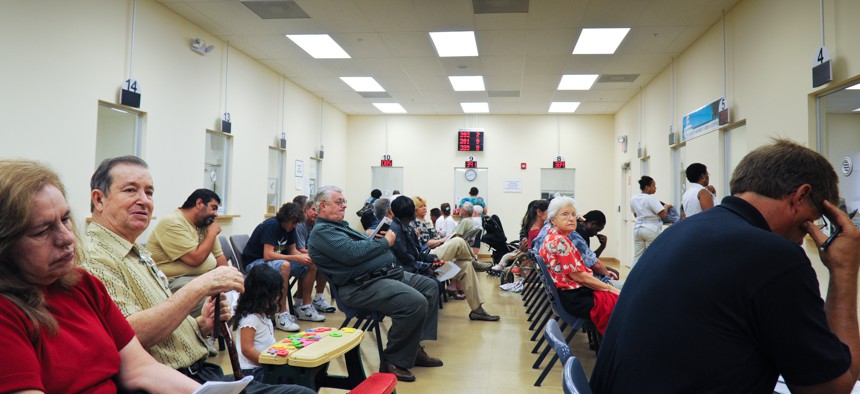
The Texas Department of Public Safety has many areas of responsibility, but one that the majority of residents interact with is its licensing division, which issues driver’s licenses and identification cards.
In the past, the division struggled under the weight of the sheer number of customers it had to help. It only had a couple of hundred phone lines in its customer service center and around 100 people to answer those lines, but it received around 650,000 calls a day.
It meant many people were left on hold, sometimes for hours, or had their calls dropped, all of which made for a “train wreck” of a customer and employee experience, said Jessica Iselt Ballew, the Texas Department of Public Safety’s chief information officer.
“When you compare that with the fact that we have about 30 million citizens, of which about 24 million require driver license or identification services, the math doesn't add up,” Ballew said during a session at the Amazon Web Services Summit in Washington, D.C. last week.
That problem gets even more difficult considering Texas’ projected population growth, with the Lone Star State expected to grow 26% by 2030 to between 37 million to 40 million residents. Typically, government agencies would look to solve a problem like this by spending more money to “throw more people at it,” Ballew said.
But a 2021 assessment by Deloitte forced the agency to think differently, and consider how it could break down technology siloes across its various divisions, which each ran their own IT operations and had little interoperability in their systems and databases. Meanwhile, employees in the licensing division’s customer service center struggled to keep up with the crushing level of calls coming in, and Ballew said supervisors were “blind,” with little insight into productivity or when additional resources were required.
To deal with any surges in calls and to make the service more reliable, DPS moved its contact center to the cloud in 12 weeks with omnichannel engagement, meaning customers could call for help, but they could also text or help themselves through various self-service options. The division started on this new system with its most common calls for service, then expanded from there.
“This lets us start somewhere and get something out there,” Ballew said. Waiting for a system to be perfect and ready for every case would take too long, she said, and would only be perfect for “30 seconds,” so governments must iterate as they go and slowly add more functionality as the system proves itself.
It’s been successful so far. Ballew said the division has been able to handle eight times as many cases and resolve three times as many each week. Almost 70% of cases are now handled by a virtual agent or chatbot, and the system now handles an additional 10,000 cases a week.
Part of that process of improving the system slowly relies on engaging with employees on how they do their jobs, Ballew said, and letting them help shape and reimagine how new technologies are used. It needs a few champions who are willing to be creative and not limit a project’s scope too much, she said, which can be tricky.
“There are so many projects I see where you put these subject matter experts on it and you give them an opportunity to modernize and innovate, and what they do is they design the exact same process, which was probably designed based on the limited ability of the technology that they had,” Ballew said. “But that system was designed 20 years ago, and they try to make the process exactly the same as the new one.”
Those repetitive designs don’t change anything, she added, and they lead state agencies to either shelve modernization projects or scale them back, leaving officials generally disappointed and feeling like they have failed to make things better.
“You're not really getting your money's worth that way, you're not being more efficient, you're not improving quality, you're not improving throughput, you're not improving the ability of your constituents to have self-service or interaction with the system,” Ballew said. “It was really important that we had the right people that wouldn't be self-limiting because they were too married to the way things had always been done.”
Ballew already has big plans for this customer service center model, including rolling it out to other divisions within the Department of Public Safety, which runs the gamut from housing the state police, highway patrol, crime labs and criminal records. Her aim is to eventually have “one way into the agency where I can address whatever it is that I need,” similar to other state agencies that have introduced a unified portal to access services.
“I should be able to interact with this agent if I have a concealed handgun license and a driver’s license, and am in private security,” Ballew said. “Then I should have a common interface.”