
How better forms could help New Jersey improve maternal health care
nattrass via Getty Images





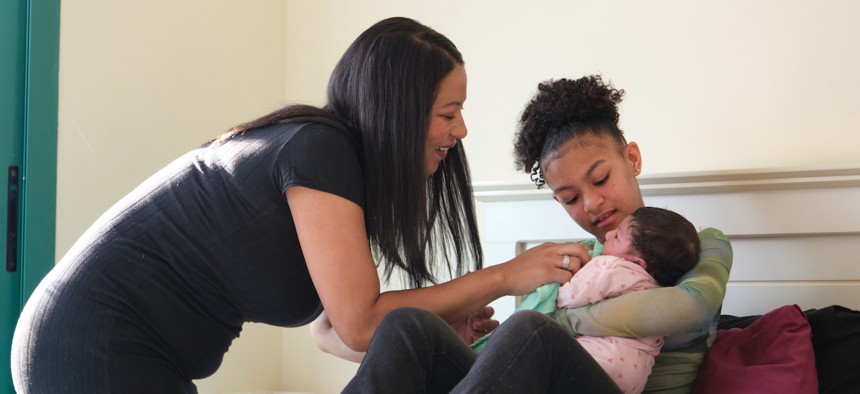
The New Jersey Innovation Authority has prioritized making online registration forms for doula practitioners easier to navigate and ultimately connect with expecting patients.
New Jersey is using the art of digital form design as a lever to attract more doulas to practice in the state and support better maternal health outcomes, officials said during a recent webcast.
In New Jersey, about 30,000 births are annually covered by the state’s Medicaid program, NJ Family Care. That figure “represents thousands of families across the state who could benefit from the assistance of a doula,” Lauren Lalicon, senior program and policy director at the New Jersey Maternal and Infant Health Innovation Authority, said during a breakout session at the virtual FormFest 2026 event hosted by Code for America and Georgetown University’s Beeck Center this week.
“In order to make sure that we're reaching all those families, we need to make sure that we have enough doulas in the state that can provide that care to doulas or to birthing persons,” Lalicon said.
That’s why one of NJIA’s main priorities has been creating and launching its Doula Assistant tool late last year to deliver a more streamlined and user-friendly doula registration process. For doulas, the site has turned an hourslong application into a digital form that can be completed in about 20 minutes, said Jazmyn Latimer, product designer at the New Jersey Innovation Authority.
Doulas are trained professionals who provide a range of supportive services to people before, during or after pregnancy, including physical and emotional assistance, educational support and patient advocacy. Their care has been linked to more satisfying birthing experiences for people and a reduction in risky procedures — such as cesarean sections — and costs associated with giving birth.
At least 26 states and Washington, D.C., offer Medicaid coverage for doula services as of March, according to an April policy brief from the National Association of State Health Policy. Those states, including New Jersey, allow doulas to practice and bill clients independently through Medicaid. New Jersey is also one of 18 states that allow doulas to contract with managed care organizations to receive reimbursement for serving MCO patients.
But such pathways to become a doula and enhance care for pregnant people are often blocked by administrative hurdles. Registering as a Medicaid doula in New Jersey could “be an arduous process, and it includes a 38-page packet of forms that can stand in the way of doulas being able to provide care for families,” Lalicon explained.
“A lot of it has to with the fact that doulas have to navigate six different application forms and processes across different stakeholders in order to get to the very end where they can work with anyone in New Jersey, including folks on Medicaid,” Latimer explained, adding that doulas previously had to parse through more than 100 fields and redundant, sometimes irrelevant questions to their practice.
Clarifying and simplifying the initial registration form for doula practitioners was NJIA’s primary goal when building the doula assistant website, said Andrew Resor, product manager at the New Jersey Innovation Authority.
The assistant site begins by alerting users to have prepared documents ready, including their national provider number, proof of doula insurance and training program information, before they initiate the registration workflow. Throughout the online form, doulas are also prompted with banners and captions that further explain technical terms or direct them to additional resources that could help them complete the registration process.
“We want a doula that's going to use the New Jersey doula assistant to have everything they need in front of them, so that when they embark on filling out this form and going through the workflow, they don't need to pause, they don't need to walk away, they don't need to return later, and hopefully they don't have to call anybody else for help,” Resor said.
NJIA also distilled the number of questions a doula had to field from more than 100 to approximately 40 by eliminating duplicative data requests. The site is able to populate repeated information, such as a doula’s contact information or other personal details, which could otherwise go accidentally overlooked or mistakenly entered the more a person has to manually enter such details, Resor explained.
The agency also established built-in logic capabilities, such as alerting a user if they entered incorrect or incomplete information, to cut out the time it takes for the application to be bounced between the doula and individual reviewing the online form for submission, Latimer said.
Resor also pointed to the site’s built-in screening questions for doulas looking to contract with MCOs, which is often the next step for practitioners after registering for approval to be a fee-for-service doula.
The screening questions determine whether the applicant works as a sole proprietor, which makes them eligible to enter an MCO contract at the start of the form, to prevent people from investing time into completing a form that they later find out isn’t applicable to them, Resor said. For instance, if the tool detects an answer that disqualifies the applicant from being eligible to work with an MCO, it will automatically redirect the doula to another form or service.
The doula assistant tool is still in its beta phase, but early feedback from doula practitioners is helping officials prepare for future developments and expansions, Lalicon said.
“Our takeaway here is for any provider enrollment process that you're working on, try to treat your applicants' lived experiences as your biggest input, not just a validation step along the way,” Resor said.
For instance, staff are exploring ways to enable document uploading, adding other doula business types into the application and integrating MCO applications into the tool. Such efforts are helping New Jersey officials continue to “increase access [to Medicaid] for doulas [and] increase access to doula care by making the process of enrolling in Medicaid a lot easier,” Lalicon said.